
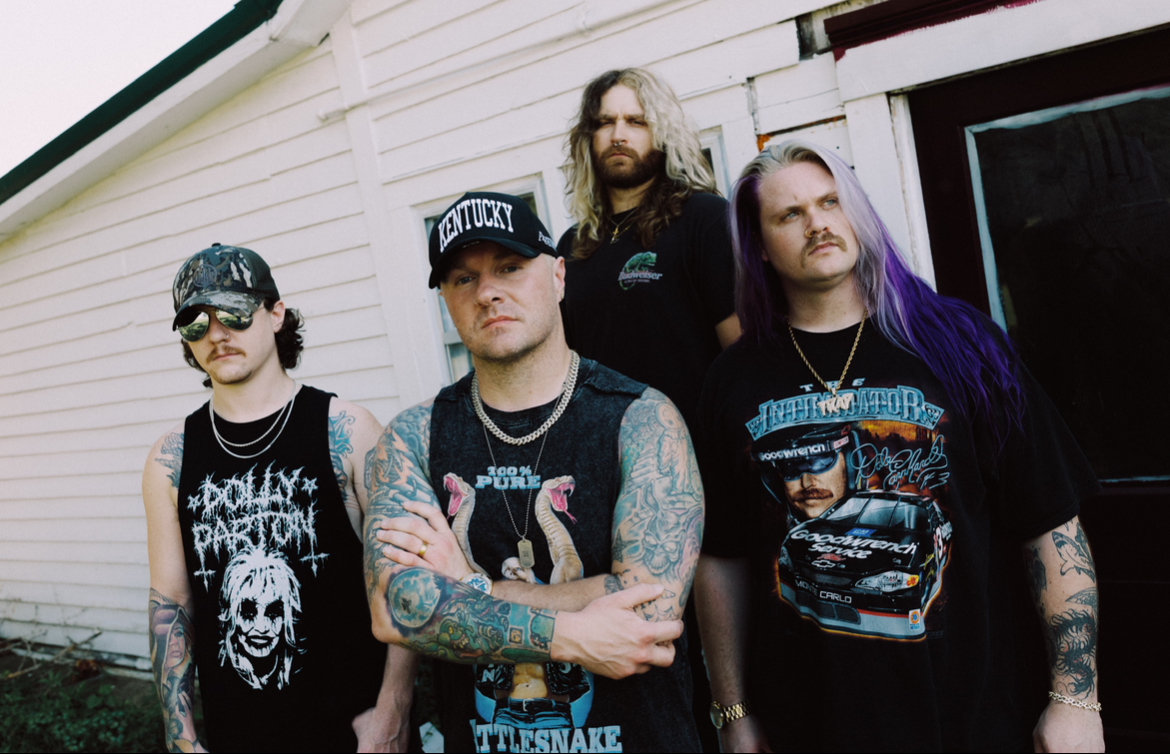
Devil’s Cut is a band from Kentucky that’s been working together for a number of years now, releasing singles, an EP, and touring, but has also just released their debut full-length album, Road Kill, via MNRK Heavy. Made up of Zach McConnell (guitar), Trey Landrum (vocals), Bailey Jones (bass), and Trap (drums), the band has been developing their own style and flavor by combining their love of Hard Rock and heavier music with subtle elements of Country music. That includes the sensibility of Country music songwriting, which goes for the emotional punch via memorable storytelling.
Their manager Cody Ash, drummer for Jelly Roll, originally suggested that they head more in the direction of their Kentucky roots in terms of the substance of their songs, bringing worlds together. Their experimentation with musical traditions and positive reception has led to touring with a wide variety of artists from Country/Metal artist Royale Lynn to Metalcore band Attila, and they’ve made appearances at many large festivals. But for their debut full-length, which was Produced by Evan McKeever (Miranda Lambert, Starset) in Nashville, they really dug through their large reservoir of unrecorded songs, as well as sitting down to some co-writing on new tracks, to offer up their wide range of skills in a high-energy collection. Grittier vocal ranges and subtle elements of mandolin and banjo added to the flavor of Road Kill.
I spoke with vocalist Trey Landrum shortly before Devil’s Cut set out on an extensive touring schedule about co-writing songs, finding possibilities in their sound, taking vocals in different directions, and most importantly, about making sure that songs have real substance to them that an audience can relate to.

Hannah Means-Shannon: I know that you all have released EPs, but it’s great that you’ve decided to release a full album. I’m a big physical media person, and an album always gives me more of an excuse.
Trey Landrum: It seems to be growing. There’s always a place for vinyl. That doesn’t seem to be going anywhere. But you see people doing tape presses, old school tapes, and CDs now. I grew up with CDs, but I don’t even own a CD player. But people are asking us for CDs!
HMS: There’s so much choice, just like there is when it comes to the path to making an album. There’s not just one way to do it. Like your choice to go to Nashville and do some writing ahead of this album. That’s a very specific choice. What nudged you in that direction?
Trey: To backtrack, we’ve had a lot of songs accumulate through the years that we just never cut. In our demo box, we had 20 to 25 songs that we did not cut, but we always want more. Even our manager said, “We’ve got great songs, but let’s keep writing!” So when we went down there, it was to actually do the album, but to write as well. We knew that if we didn’t come up with anything else, we still had great songs in our demo box. Nashville’s two-and-a-half hours away, it’s a good place to just get out of your element. Our element is rural Kentucky. We went into the music mecca. There are so many good songwriters down there. Out Producer was down there, too, so it just made sense.
We went down there for about a month, and we accomplished a lot. We sat in a small room until midnight every day, and I’m proud of what we accomplished.
HMS: A lot of people have told me that, being in a room with other writers working on a song, you learn to put your ego to one side for the sake of the song.
Trey: Oh yeah! Our first session that we ever did was with Cody Quistad of Wage War. Up until then, I’d never done a co-write. I’d had never really wanted to, because my mentality was like “I know how to write a fuckin’ song!” But when I dropped my guard, I had admit, “I don’t know everything.” I gave it a shot, and went, and it was fucking awesome! You just ping.
It’s like “What do you want to write about?” You spit ideas back and forth, and it’s like a little thinktank for the song. Everyone does it differently, too. Quistad is a genius when it comes to writing, but there are others who are geniuses in different ways. Some want to break out notepads and write down choice words. It’s almost like therapy! Everyone’s thought process is so different, but it still gets the same outcome of formulating a song. It’s really cool.
HMS: I’m sure it can be really revealing to speak about yourself in front of strangers, but if you’re focused on the same goal, that makes it easier.
Trey: It does. The only difficultly I’ve ever had is in stepping inside someone else’s head to grasp what they are trying to say. Sometimes you have to keep asking questions. It’s an experience, but I really love it, and I choose to do it that way now. I’ve made some great friends, and it’s a lot of fun. Songwriting is work, at the end of the day, but it’s still fun. Everyone celebrates a great line.
HMS: In the end, was it hard to choose between your songs for the album, since you did have so many?
Trey: We had a lot of songs, some that we didn’t cut, that I really, really liked. But we ended up writing better songs, there, in the studio. “Roadkill” was the last song that we wrote for that, and we were supposed to cut another song, one that we had in the demo box that I loved. But then our guitarist started fucking around with a riff and it sounded really cool. They said, “Let’s just write a new song from scratch!” And I’m happy that we did. It was a last minute decision that we went with.
Evan said, “Let’s do it like a Dad Rock song!” I love Nickelback and all that stuff. He said, “No one new is doing Dad Rock.” I said, “Fuck it, let’s try it!” The only suggestion that really threw me off at first was for that “F U Anyway” song. He said, “I have this idea of mixing Country Trap with Deathcore breakdowns, with a dab of EDM.” I was like, “Come again? How the hell do we do that?” But he mapped out the song idea, with the chorus that’s literally an EDM build-up and bass-drop. I said, “This is insane! Let’s do it!” That one really took me outside my element.
HMS: That’s like one of those recipes that sounds like it’s going to be terrible, but then you taste it.
Trey: It really brough us out of our comfort zone!
HMS: I was wondering if you’d done anything new that you hadn’t done before on your experience of this record, because I do see so many little sonic directions and ideas on the album. It’s very wide-ranging. You’ve got choral vocals, even.
Trey: Yes, vocally, there are so many different directions. A lot more grit. When we first started out, I was going for a more polished Pop sound, vocally. We did a song where I started adding some grit, and they said, “You sound like Chester Bennington [of Linkin Park]. Keep doing that!” I kept trying to add in hints of grit throughout the songs. But there are also some that are more like my softer Pop approach, or a hybrid. We were trying to find sounds that would suit each song the best. We tried things different ways, too. The album is one gigantic puzzle.
HMS: That’s the great and scary thing about blending traditions the way that you are with Devil’s Cut. You end up with a much bigger playing field to choose elements from. I think your style tends to fit in with the subject matter, and each song’s main emotions.
Trey: Yes. We tried different things, too. The demo for one of my favorite songs, “If I Leave”, is just so fucking bad. It was made with a shitty Casio loop for the entire song. It was just a starting point, and not meant to be released, but to go from that to what it became is just awesome. The initial inception was very, very rough. To see what it became was like adding water to a flower, though, and I’m proud of it.
HMS: I think something that all these songs have in common is that they all have a lot of energy. To me, that shows that you’re thinking about the live show and how this will be interactive for audiences.
Trey: Right, we want to keep your attention. Through my younger years, and in doing this, it seemed like anytime there would be a ballad at a show, it would be the “pee break” song. If you slowed it down, people would go get a popcorn or beer.
It’s funny that you say that because we’re rehearsing our set right now for tour, and the songs are so high-octane, that even those slower ones, are energy. It’s never full-blown slow. It’s still energetic. We did that “unintentionally-intentionally.” It’s just how we are. Looking at the album, it is pretty energetic.
HMS: That’s the challenge with heavier music and a live set, how to carry out that pace.
Trey: Yeah, it’s not easy! Especially when you’re up there riffing it. Sometimes the slower songs are breathing breaks. If you don’t do that, it’ll catch up with you, straight up.
We’re hitting everywhere from Texas to New York, to Florida, to Michigan, and it’s going to be a busy year. We have stuff in the Fall and onwards that’s in the works. I’m up for it, let’s do it!
HMS: Does it take some thought to figure out who you all should play alongside on tours, given how you’re blending traditions?
Trey: Yes and no. People here like the word “Country”, so we’re “Country Metal.” But a lot of people get immediately turned off by the word “Country.” It’s a preconceived notion and won’t even give it a chance. Our avenue, and the way that we talk about it, is that we are really a Hard Rock band that has subtleties of Country. Whereas there are bands who are doing the opposite route, where they are Country, but they are doing hints of Hard Rock and Metal, like Hardy, Treaty Oak Revival, and so on. There are different avenues of it, we’re just more on this side of the fence.
So when we’re booking tours, or even just doing PR for the album, people hear “Country Metal” and they don’t where to put it. Sometimes you just have to stop saying the word “Country.” We’re a Hard Rock band with subtle elements of Country that people can pick up on. We can do shows with Three Days Grace, or whoever. The best example was when we went out with Atilla and it was so heavy. We’re heavy, but we’re not that heavy! [Laughs] We crushed, actually, and the crowd loved it! Maybe I was over-thinking it.
HMS: I’m from North Carolina, and I felt like, listening to this album, this music would fit pretty well with most of the heavier tours that I go to. But I guessed that you might not fit as well with the full-makeup guys. To me, it just felt like regional heavy music, that speaks from a certain place.
Trey: Right, we’re from Kentucky, and we’re repping our state hard. We’re just proud to be from Kentucky. It is regional, to a degree, but it’s also a mindset, because our music is a lot about storytelling. Country music, I think, has the best storytelling. The storytelling, the substance to what is being said, and being able to relate to it, is strong. Whereas with a lot of the substance in Rock music, Metal music, Hip-Hop, and across the board, somewhere that substance got skewed.
I remember when everyone could relate to songs in those genres, but it’s just not quite there now. The writing in Country music is so stellar, and you thinking, “Damn, that was deep!” It gets you thinking about life, you’re contemplating your decisions in life. When you break it down like that, you break down that barrier of even being regional. Everyone has had feelings like “If I Leave…”, or “Bottles Run Dry”, or “hUNGOVER yOU”, which is where your ex leaves you, and you go out into town, drinking to get over them. I hope there is some kind of reach to that.
HMS: Absolutely. You do have a sense of story to each of these songs. There’s no song here where it’s all about the sound. I think that may what you’re hinting at when you say about some of the music that’s around, it’s just about the sound, not about the substance.
Trey: Right, or where there are throwaway lyrics, saying a word just to say it. I feel like a lot of music is headed in that direction. We need to start getting back to substance, to people relating to songs, and feeling something.
