
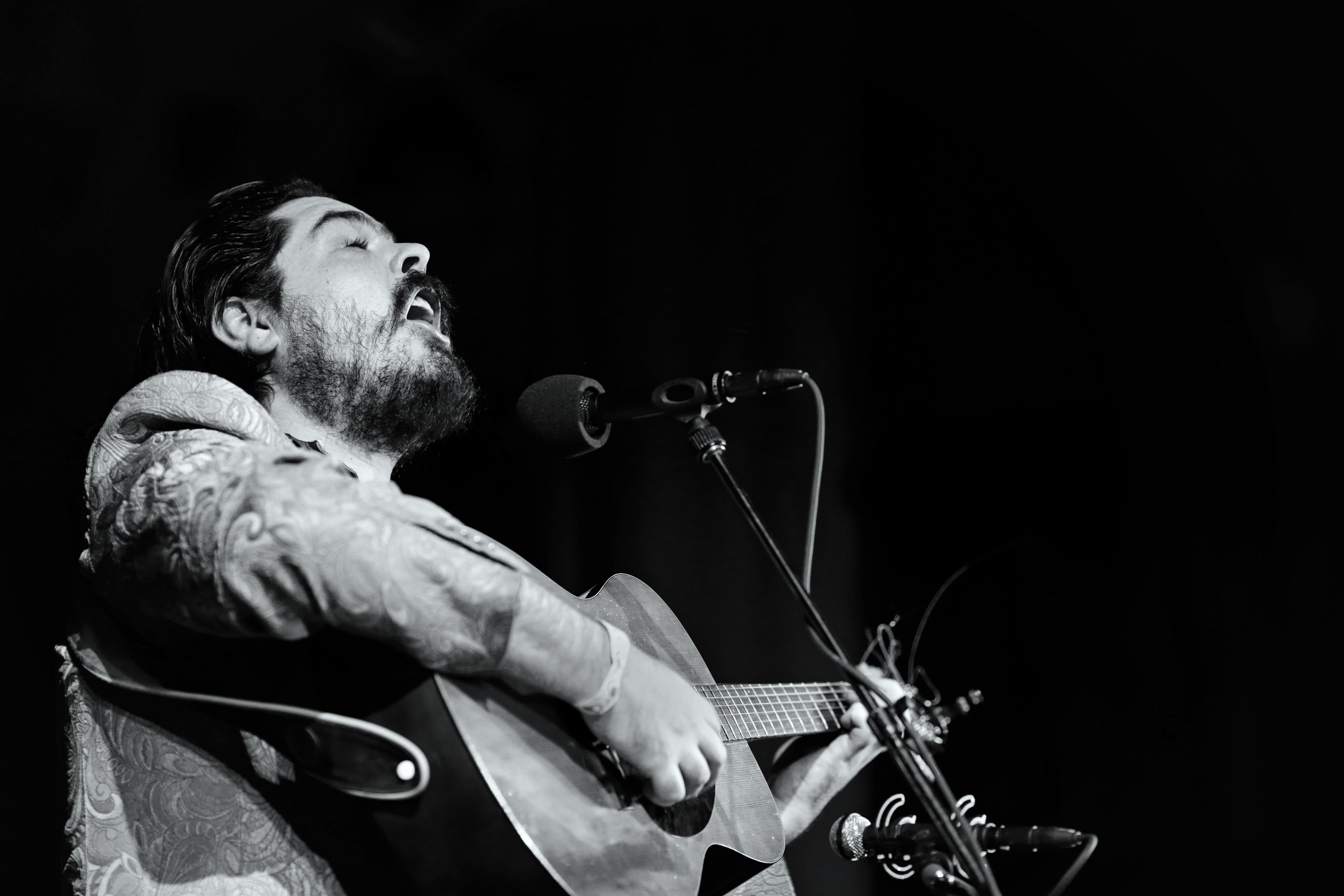
[Cover photo credit to Brian Geltner]
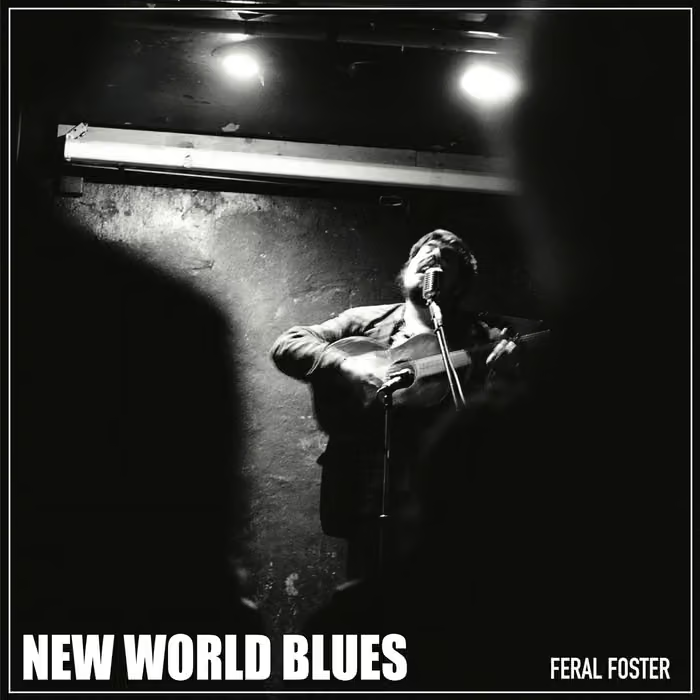
This Friday, October 23, 2026, New York-based Folk and Blues musician Feral Foster will release his new album, New World Blues, via Jalopy Records. It marks his first release in about 12 years, but for those active in the live music community, he’s been a constant fixture during this time, as well taking part in the Brooklyn Folk Festival, where he’ll also be performing coming up. His new album draws on original songs with a long history, and two favorite covers, and was recorded on multiple dates of performances at the Brooklyn Folk Festival as well as another show at The Brooklyn Rod & Gun Club.
The songs on the album show a wide range of Foster’s interests in sounds and traditions, but draw in observations from life lived in the 21st century that have a lot in common with the past, including natural disasters, struggle, and uncertainty. Foster himself has been heavily influenced by his experiences as a self-taught musician busking in New York, then working for over 21 years hosting live event gatherings with multiple performers, including the ongoing “Roots ‘n Ruckus.” The love for live performance, its spontaneity, and emotion, is clear on these newly-released tracks, where Foster connects with audiences in the moment.
I spoke with Feral Foster this autumn in the midst of our several damaging Nor’ Easter storms, and in the lead up to his album release, about his live events work, the watery themes in some of his songs, and how he got drawn into Folk and Blues music as a fan and as a practitioner.
Hannah Means-Shannon: I saw that you’ve got some live shows coming up that will celebrate the new album.
Feral Foster: I’m definitely doing a live show at Gottscheer Hall, in Queens, which has been the setting of the wildly successful, “Honky Tonking in Queens” series, which has had Charlie Crockett, and the Deslondes, who have played at my shows over the years, and gone on to do bigger things. I’ve lived in Ridgewood, Queens, for about 16 years.
HMS: From what I can tell, a whole portion of your brain for many years has been dedicated to facilitating live musical events as an organizer. You seem to really know what you’re doing.
FF: Oh, I don’t think anyone ever really knows. The formula for the perfect show and event is always just beyond reach. The whole career is trying to figure out your aim.
HMS: Is your commitment to events part of why it’s been a while since you’ve done an album release?
FF: It’s fair to say that. I’ve been booking shows and putting on shows since I was 18. I run a weekly series called “Roots n’ Ruckus” which has had the best and the brightest. A lot of the big stars of Americana, Folk, and adjacent scenes, since Fall of 2005, have come through. It was weekly until January 2023, and it’s been monthly since. It’s been about 21 years, since I was 19 when I started that show. That was just one series that was my weekly gig, but I have a cooperative post at Jalopy Theater that also makes it easy to throw shows together that are “pass the hat.”
If you play Jazz, work on Broadway, or are in Classical scenes, or if you’re a busker, it is extremely difficult for people to live off gigging alone, especially if you’re a touring musician. But I was a busker for many years, and I had experience as a touring musician, and I got to the point where I learned a lot about booking, curating, and seeing how a venue worked. With me wanting to pay rent and bills, I was lucky to fall into an adjacent career in the curation and booking side of music.
HMS: It seems to me that it’s amazing for musicians to have someone who’s looking out for them in that way, because they need opportunities to play, and we’ve been through better times and leaner times in terms of venues, and what’s available for musicians to play. But with someone like you in their corner, trying to create something for them as much as for the audiences, I’m sure that’s created a lot of good will.
FF: Thank you for the kind words. It’s not just the affordability crisis in a lot of artistic enclaves around the country. It’s the commodification of venues, with Live Nation and such, which is why we’ve worked with NEVA (National Independent Venue Alliance) where a lot of independent venues have come together to work and fight for themselves and for the artists who they like to host and work with. The people at Jalopy definitely had that in mind, and it’s been an essential part of my philosophy.
I haven’t been on a proper tour since 2018, and the pandemic came along not long after that. That really changed things. I’d been on a bunch of little tours across the country before that, and there were routes that people knew, and a lot of little databases. There were spreadsheets that people shared with each other, and the pandemic kind of blew that all up.
HMS: Afterwards, a lot of those places weren’t there, or were under new management. And a few new small places popped up, but things were often off the grid.
FF: Yes, and it changed everyone’s routine, too. Everything was upended and got more confusing. Other than the short tour that I did with Sam Shackleton [aka Sorley the Bard] I did in the Spring, aside from one-off dates in Boston, Philly, and Upstate, I haven’t done much. But it was great to see someone like Sam who managed to get such enthusiasm and big crowds, for someone who hasn’t been in the states but once or twice. It made me think, “Maybe there still is magic in the air with certain people, in certain places, and certain times.” I was very appreciative to have been included in that little stint.
HMS: I’m talking to you after some big, big storms in the Northeast this autumn that you’ve been dealing with as well as me, and I notice that your album does talk about things like this. It seemed good timing to bring climate issues up, like in “New World Blues.”
FF: The last time the water levels rose so high here was like Superstorm Sandy. There’s been incredible subway flooding, that never used to happen when I was a kid, and that’s related. We do know about rising water levels, and on top of that we’re having weather pattern changes. I’ve written a lot of music that talks about water, I’ve noticed. There’s something about the unconscious metaphor, for me, of water rising and swallowing all of us. I’ve noticed it comes out in the language of my music, in my lyrics a lot.
It’s funny, because it’s also something that you hear consistently in a lot in the music that really influenced me early on, like Country Blues music, like Charlie Patton, who always sang about catastrophic flooding, and water rising all the time. It gets into your subconscious, and you see it playing out in your life. It helps make the music coming out of you, in a way.
HMS: It’s so true! I hadn’t thought about that. There’s Blues music associated with New Orleans, and Blues music associated with the Mississippi River, and even the Blues music associated with the Piedmont area, are all going to address water levels and survival. Various types of Blues have water imagery because it’s part of the rhythm of life and catastrophe in those regions.
FF: That’s right. And a lot of the people in the Mississippi Delta were living where it was not necessarily the most suitable place to live, but it’s the most suitable place to have agriculture. So it’s not always a coincidence that these things happen. I’m not comparing beach front property to that. But there’s no coincidence that people who suffer most from climate change and natural disaster will be the people who are in the most vulnerable position for a reason.
HMS: Tell me a little bit about the ways in which this album is drawn from live performance. Was it a single event?
FF: It’s several performances, mostly at the Brooklyn Folk Festival. There’s one track from the now defunct Brooklyn Rod & Gun Club. The rest are from the Brooklyn Folk Fest between the years of 2014 and 2017.
HMS: That’s interesting, so it goes back in time a little bit.
FF: Oh yeah. I’ve been trying to figure out getting an album together with Eli Smith, who is the founder of Brooklyn Folk Festival, but also runs Jalopy Records. I was actually working on a brand new record a few years ago, but my engineer had a baby, and we lost track of time. So there are a few tracks together for a new record. But the whole time, Eli was saying, “You know, I have a bunch of live recordings that are really killer, and I think it would make a great album!” I, being the constant skeptic, kind of brushed it off. But then he played them back for me, and I said, “Some of these are a lot better than the takes on my original studio album.” It has people who I had played with for a few years at that point. Then I got excited about it.
HMS: It makes sense to me, because you’re someone so connected to live music, to do a live album. Whatever we love about live events, you’ve captured that here, too. It’s part of it. You were spontaneous in your performances here. Did you even know that you were being recorded?
FF: [Laughs] You know, I did sign paperwork saying that I was, but I did not really think about it. I figure nowaways that everything is being recorded. But what I didn’t realize is there was actually live footage for several of these, too, or from similar arrangements in previous years.
HMS: Given that this was recorded live, did you still have to pick the songs out of a larger body of possibilities? Was there a reasoning behind the ones that you chose?
FF: Because we do have some tracks for a studio record, and thoughts about what we might do for a record after this, we chose different tracks. We said, “Why put a version of this song out now when we have a studio version almost done?” We did stuff like that. We also had some back and forth about tracks we preferred. I think we had about five or six more songs to choose from, and cut a few out. I think we’re all very happy with the place we landed and what we chose.
HMS: I think it’s pretty wide-ranging, like a good live set, in terms of sound, and you’ve got a couple of covers, alongside originals. It’s a differentiated listening experience, if someone hears it all at the same time.
FF: I think I should listen to it again! Ben Brown has really helped me get a lot of stuff together for this record, and I’ve never felt supported like that. For the vast majority of the times that I’ve played music, about 99% of the time, I’ve played solo. But also, I used to busk. I hadn’t really dealt with my music outside of myself. But it’s been great to have the support that I’ve had making this record and making it possible.
HMS: You mentioned starting shows when you were only 18 and 19 years old, so did you get into this music just from listening to albums, or did you have other friends or older people to learn from?
FF: My parents never listened to this kind of stuff. I got into some stuff like Classic Rock, Bob Dylan, Jimi Hendrix, and then I tried to figure out who their influences were, going backward. I was kind of nerding out about it. Also, I was of the time, and place, and age, where the internet became a very easy resource to access. Unless you were really hitting the books, or visiting record shops to do research, previously this stuff was not accessible.
I would research who influenced what, and say, “Charlie Patton, who’s that?” Or, “The Carter Family, who are they?” Then you’d find some of the music online. That just opened up a whole world. I kind of did get into it on my own, though I tried to get some of my friends into it, and I successfully did get some of my friends into it.

HMS: Good for you!
FF: Some of them have gone on to have great music careers. My friend Jonah got into it, and realized his dad had some CDs, so we’d hang out, and drink beers, and listen to them. I got a little bit of an interest, and dove in. I tend to get into something really intensely, and go all-out for a while.
HMS: Did you grow up in Queens? It seems like New York live music might have had an impact on you.
FF: I grew up in Alphabet City in the East Village area, and I went to high school in Brooklyn. I took a couple of lessons at the YMCA, but after that, I taught myself, from looking at chord charts, and lyrics, and playing around with it. After that, there’s no better hazing and training school than busking in New York City! But playing the same five to ten songs over and over again, for four to five hours, you never want to hear them again.
I played a couple of open mic events around age 16. When I was starting to busk on the street a bit, sometimes I’d try to befriend them, or find out what they were doing. After I’d had a crappy summer bar job at the age of 18, I met a busker, Zack, who told me about traveling all around, and hitch-hiking to different cities. He actually convinced me to go, and we did it! We got across the country. At 18 years old, I saw him being so out there, and saying “This is how you do it!” I was somewhat neurotic at that time, but traveling around the country, and seeing other people doing this kind of stuff just gave me the confidence in the moment, and we’d just find a bar to let us play.
Upcoming Dates:
November 6 – Brooklyn, NY – Brooklyn Folk Fest (with Lonnie Holley, Mama’s Broke, The Deslondes, Guachinangos)
