
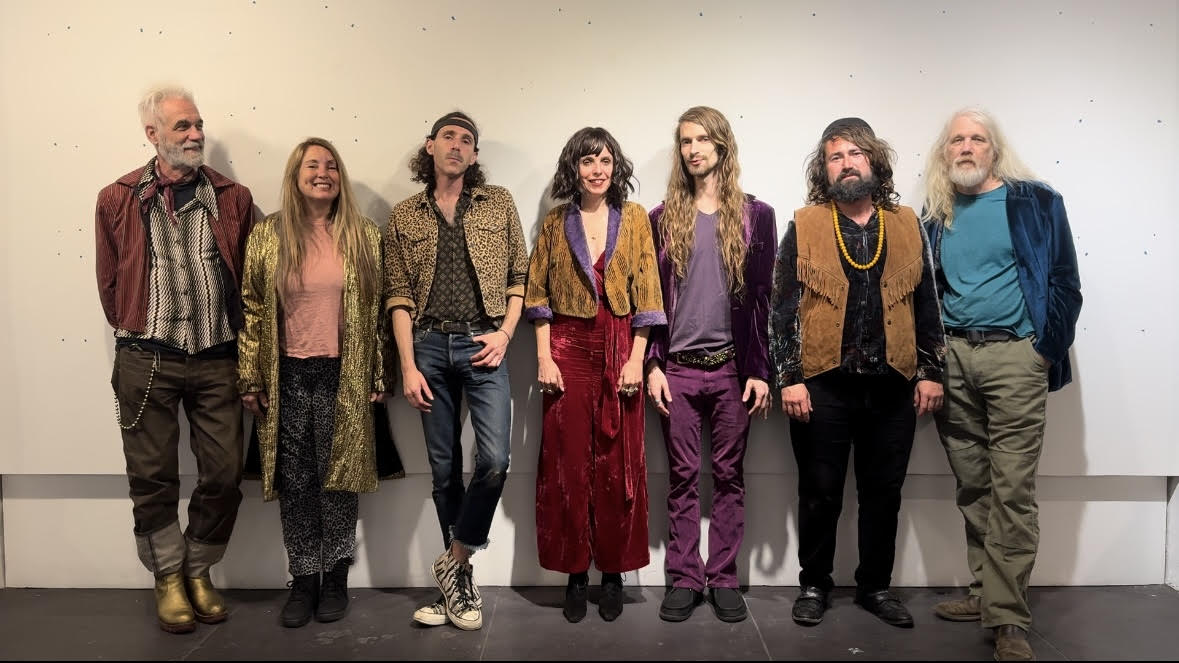
Elf Freedom are a large improvisational band who hail from Los Angeles and bring Psych Rock elements to experimental tracks that draw on many musical influences, from Folk to Classical. The band name speaks to a certain meditative state of mind that connects with the natural world and one that they pursue when making and performing music, which over time, has become almost the same thing for them. They recently released their latest album, Solstice, which derives from a single long improvisational session which was recorded on the summer solstice in June of 2023, then shaped and enhanced with added instrumental and overdub elements to create a full sense of story and movement.
Key members who worked on shaping Solstice were front person and lead singer Nora Keyes, multi-instrumentalist Bee Appleseed, and guitarist and synth-player Rocco Mirage, who also handled a lot of Production for the album. They are currently a band of nine members, however, and their collaborators include Mirage, Noel Rhodes of Unusual Tuesdays, ZZ Ryder, Paul Kaufman, and Tonya Lee Jaynes. I spoke with Nora Keyes, Bee Appleseed, and Rocco Mirage about their outlook, their approach to making and recording music, and how they feel the audience participates in their sonic experiment.

Hannah Means-Shannon: I know that you’ve done a lot of songwriting, Bee, and work on your own, but this is a large group of musicians that you work with on this project. Is that big group setting something that adds to your life?
Bee Appleseed: Yes, in my solo music, I’ll play alone. With a band, I get a lot out of playing with other people. In terms of sound, it’s far more beyond what I contribute to it. I had never really done the jam thing before.
HMS: Is that something that you have in your background, Nora, to do improv work?
Nora Keyes: Yes, in my previous groups, I’ve done a lot of improvisation, and with this group, I wanted it to be mostly improvisation, and it’s become pretty much 100 percent improvisation. I had been in a lot of bands and written a lot of songs, too, and at some point, I felt like you can improvise a song. At a certain point in my songwriting, I realized it was just verse, chorus, bridge. Once you understand that, you can pretend to make a song every time that you improvise and the pretending becomes a song. That flipped my way of songwriting on its head, that it can happen in real-time.
We’ve been together for a number of years now. Rocco joined us about two years ago now. We’ve been jamming with him every Wednesday, and right now we have a group of about nine players. It’s grown. We practice being very confident in feeling each other’s expressions so that we can improvise in a very relaxed way.
HMS: So you have sessions together where you improvise, without an audience, and that’s preparation for the improvised public performances?
Bee: Oh yes, way more than the public ones. We have hundreds of hours of recording.
Nora: We play together and record it on 16-track.
HMS: That’s amazing. I guess you can decide out of that what you’d like to release. This album, Solstice, derives from just one show, one event, that you performed, right?
Bee: Solstice comes from one week, and then we just took a session from June 21, 2023. Then we filled that out, and added some overdubs.
Nora: Me and Bee, and Rocco, went back and forth and spent a lot of time on that album.
HMS: So there were two phases, the time during which you wrote and played that music, improvising, and there was the time that you spent deciding how to shape it towards a release?
Bee: Yes. I think that session in its entirety was about two and a half hours, then we cut it down to 40 minutes or so, so a lot of that session wasn’t even used. Then we had to structure the thing, so there was bass, drums, and two guitars. Then we added a bunch of vocals, synthesizers, and various instruments and percussion.

HMS: How did you develop your production skills to be able to make these recordings and then shape them for release? Did you learn from other people, or by doing, for instance?
Rocco: I started recording using one microphone, recording bands, and one day discovered that we needed a fade-out, so I just instructed everyone to keep playing after the song was over. During that time, I found that the stuff that was supposed to be “nothing” and a fade-out, allowed everyone to open up a little more, and be a little more loose. That became the groundwork of everything I think about now in terms of how I Produce performances, at least.
HMS: A lot of people struggle with how to record or stream things live. It was a big challenge for people to try to learn during the pandemic period.
Rocco: With a lot of volume in the room, too, it’s a big struggle. With drums, all you can really record in a loud room is the transient quality, and not really the sound of it. You kind of do the best you can with what you’ve got.
Bee: I’ve been home recording for 20 years now. I started out doing this in Oregon, growing up. I’ve made a ton of home recordings over the years. Coming into this project, I have a 16-channel digital interface that I use to multi-track for this band. We were in a superbowl commercial a few years ago that allowed us to upgrade our tech. But with live recording, I have to get there an hour before everyone else does, when we have practices. Usually, it’s a couple of hours ahead when we have shows, because it’s the plugging the sound into the house system, which is a bigger process.
I have an insane amount of gear that I take with me everywhere. That’s what I did with this album, I plugged it all into the room. Then Rocco and Nora added overdubs, and we had another overdub session that was all of us. We had the original recording, and then I had us set up where we had people playing in different rooms and zones. I had some weird instruments I use, too, for various sounds.
HMS: This stuff is hard enough to do on your own, but when you have that many people, it must add complexity to the situation.
Nora: Sometimes when you have that many people, it does make it more complex. We’re running into some things like that, too. The landscape of that comes into play.
HMS: It makes for a very full sound on this album, though. It’s almost like having a small orchestra.
Bee: The more people you’ve got in the boat, the harder it is to steer the ship. [Laughs] One thing I play is a weird little instrument with five nobs. You hear this a lot in the opening track and in transitional pieces. It’s a weird synth sound that we use quite a bit. There’s another one that I use where only about 700 to 800 of them exist, a midi harmonica. It’s called a DM 48. When we have strings, and sometimes flutes going on, it adds a kind of space cello sound.
We have 16 channels, and for perspective, The Beatles were using a four-track! Towards the end, they had an eight-track recorder. In the Get Back documentary, they are asking how they are going to get an eight-track recorder, and they want to borrow one from George, but they need to move it from his house. We get to use this technology every week! We’re grateful and lucky to have these innovations. I take the 16-track everywhere, to all the shows and we can record them.
Rocco: You don’t take it in the shower, though, do you?
Bee: [Laughs] Not in the shower, no. There’s nothing to record in there.
HMS: Was there a reason why you chose these sessions for an album? Is there something that stood out to you?
Nora: Bee really liked how this one jam turned out on Solstice, so he spent a lot of time mixing it. That was something that we needed to get done, since we’d put a lot of energy into mixing it. I added overdub vocals to some pieces and then I sent them to Rocco. Then Rocco went and remixed some stuff, added some overdubs, and mastered it.
Rocco: At first, I didn’t like it, then I really liked it after working on it for a while. Then I could see it.
HMS: Just as an audience member listening to the tracks, I felt it was a really interesting mixture of different sonic pieces. Because even though it’s the same group of people, there’s a lot of variety between the pieces. For me, that makes it feel more like a narrative or story as it moves between these positions. Then, the last bit, the “Solstice” short piece at the end, feels like a closing, thematic element. It brings it together. Were you thinking that way about it?
Rocco: That “Solstice” piece was a random synth arpeggiation thing that I was doing. Then, I thought it was a cool little element to throw on at the end. I think it came from the overdub session.
Bee: That makes it cohesive, for sure.
Rocco: I did a lot of doctoring to it to make it louder. There were a lot of random bits from the midi harmonica in a different track that I then flew into that at the end. It kind of worked. I was doing a lot of that kind of stuff.
Nora: When I’m working on these, I like to feel like, even though it’s a ten minute piece, it can keep the attention the whole time. Even when it moves, it has a story, and these different energies within each piece. When I listen to this album now, because I’ve had enough space from it, I feel like it has an interesting effect, like a waking dream. I don’t know if you felt like this when you were listening to it, but I feel like, at certain points, it pushes me into other states of consciousness. Then I’ll have a feeling that I’ve woken up, and the song will still be playing.
Rocco: [Funny voice] “When will this ever end??”
Nora: [Laughs] It’s not that…It’s more like…
Bee: It’s like you lose your sense of time.
Nora: Yes, it’s more like when you wake up in a dream. I think it’s because these pieces are made from the place of improvisation, and there’s a very fine line between channeling and improvisation, you’re actively being creative. That’s firing off a part of your brain that’s different from when you’re doing memorized things. There’s a whole study that was done on this. When you’re making music like this, you’re also firing off the listener’s brain in the same way. I think when I’m having that effect, a waking dream feeling, and a peace, it’s because the music is coming from this active place. You’re experiencing us being creative in the moment, not taking something that we made in a creative moment and presenting it to you.
HMS: Something that’s improvised also ends up being more detailed, too, I think, because there’s not a prescribed route. I think that keeps the listener paying more attention, almost in a participation sense and a concentration sense. Maybe it brings them in, closer, to that original experience. There’s also the idea of “active imagination” from Carl Jung, where you can imagine dreams forward to see what would have happened next, and maybe reach greater resolution.
Rocco: I think active resolution, though, can be a thing that spoils it, too, since there’s not the power of the improv. Because it lacks resolution, it becomes this thing that we don’t expect, and seems a little more out of this world.
HMS: It definitely allows the audience to participate, though, which might allow them to enter the same state and imaginative process.
Rocco: Totally.
Nora: A lot of our audience members will tell me that they felt inspired, afterwards, or that they got ideas while we were playing. This is a really important thing for me to hear. I think that’s what it is. By witnessing the act of creativity in the moment…
Bee: It’s contagious.
Nora: Exactly, it’s contagious. It makes people want to go off into their own imaginative state, or it sets them off into it. Because the more we’re in that state, where we have to listen really carefully, and be in the present moment, the more possibilities we find within it.

