
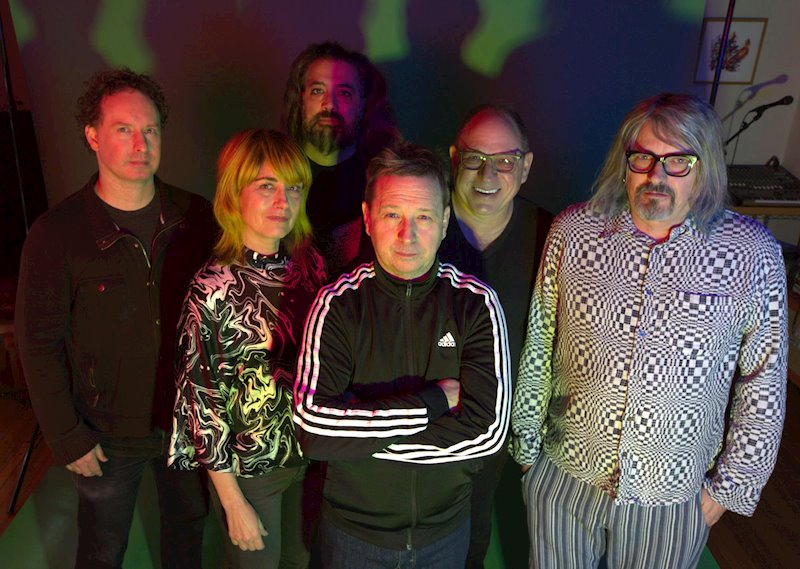
Today, LA-based Psych Rock band Tombstones In Their Eyes (TITE) are releasing their new album, Asylum Harbour, via Kitten Robot Records. It builds on their 2023 release, Sea of Sorrow, but also represents substantial developments, particularly in the use of vocal harmonies as a central element of the sound. The contrasts that the songs builds between powerful harmonies and heavier sonic elements creates a uniquely visionary and cathartic feeling for the record.
Tombstones In Their Eyes is made up of John Treanor (vocals & guitar), Stephen Striegel (drums), Courtney Davies (vocals) , Phil Cobb (guitar) and Paul Boutin (guitar), along with new band members Joel Wasko (bass) and Clea Cullen (vocals). Using that large band feeling to maximum effect, TITE was able to work with Producer Paul Roessler to create an imposing blend of vocal and instrumental layers. While songwriter John Treanor drew on difficult experiences to create the songs, he also harnessed a feeling of transcendence that the music created in order for him to build the tracks.
I spoke with John Treanor about the ways in which Asylum Harbour, which was a title chosen for its sense of reaching a sheltering shore, is a step forward into a sound that has been brewing for some time.

Hannah Means-Shannon: I don’t want to overstate this, but I feel like this album is a big development. It’s a significant difference, but I don’t mean to imply that Sea of Sorrow was not also a very interesting record. The tone, feeling, and some of the sound aspects are quite different.
John Treanor: It’s like an evolution. The other one was written from a completely different place, mentally. All of those songs were written in the year leading up to it, and for this one, eight of the ten songs were written last year. Two of them were from a few years back. “Sweet as Pie” is a little older. That’s around when Courtney joined the band, and features her vocals a lot. Then “By Your Side” was written eight to ten years ago. I don’t know why it never got into an album.
HMS: That’s interesting to me because it suggests that the changes I’m seeing on this album were underway and bubbling under the surface earlier than I suspected. It’s just about which songs you were choosing to release.
JT: Are those some of the songs you were thinking of in terms of evolution?
HMS: Partly, but mainly it’s that the sound of the album is pretty cohesive, so these songs all really fit together as a development. It wasn’t a sudden shift. These were organic things starting to happen, they just weren’t as visible to the outside world.
JT: I think you’re right. Those two just happened to fit in with the newer songs. There is a big difference, I think, between the last album and this one. This one sounds more cohesive, to me. I think the last album has maybe four or five songs that were the best songs that I’ve ever written, but there are a bunch that I can’t listen to anymore.
HMS: I feel like you could almost have this album on repeat and it feels like one body of work. One observation is that the vocals are really central and part of the cohesion of each song. Everything can be structured around that. It’s architectural, almost. The songs feel very precise in that way and they have that in common.
JT: I get that. Last year was a very difficult year for me, maybe the most difficult year that I can remember in the last 30 years. The year before that was difficult in another way, with a lot of chaos. Last year was coming out of that, and having some damage in my life that was very painful. The funny thing is that these songs aren’t wallowing in that.
HMS: There’s a really interesting balance between some heavier ideas a very different space that the music creates. You’ve always done that, but I think these songs have a fine balance between the two.
JT: To go back to the vocals being more up front, I think that’s just a natural progression from the last album. Part of that was that I was getting into harmonies, and I would do some with Paul, our Producer. He would drop stuff in. Then Courtney came in and that was another step to adding more harmony. Then this album was kind of all about harmony. I think about that every song now. It naturally pushes the vocals forward, because you want to hear that. It’s also not as heavier as the other records, and is a little quieter in places. I noticed that because when we were practicing one day, I noticed that I didn’t use the fuzz pedal for eight of ten songs. That was like, “Wow!” That’s a difference and things are changing.
HMS: I thought it was cool that you still have some heavier sounding elements here, too. But that becomes an interesting contrast and tool on the album. “I Like To Feel Good” is the slowest song, but in some ways…
JT: That’s also the heaviest to me.
HMS: I was thinking that. It also has those vocals we were talking about.

JT: Right now, that’s my favorite song on the record. It’s just got a nasty kind of riff to it. It’s kind of a riff song, and I love it. I wrote all the vocals in one take, I think, stream of consciousness. That’s usually how I approach writing vocals, not thinking about it, and just playing the song back, and singing. I think a lot of times I’ll leave it as-is. Other times I’ll tweak it a little. It’s all coming from the subconscious. That song talks about a “hole in my heart” repeatedly in the second verse. At the end it says, “The hole in my heart is really a gift.” That’s kind of true. I compare it to sensitivity and over-empathizing where it can be painful. But at the same time, it makes you understand people more, or maybe kinder. What I’m saying is that it’s a gift, not a bad thing.
HMS: I was thinking of that when I was listening to the song because being “over sensitive” is often a criticism towards children, young people, and even adults. It’s seen as a cut-down. And I’ve seen that in my own family. It can make people assume that it’s a bad quality and can lead to low self-esteem.
JT: Exactly. In the last year, I’ve been doing a lot of searching, with therapy and stuff like that, and I discovered there’s a thing called HSP, or “highly sensitive people”. It’s a character trait, not a diagnosis, and people should look it up. It really made me feel “seen” and there are a lot of people who have this. That made me realize, “Hey, I can use this! I don’t have to feel burdened by it.”
HMS: It seems like it could help someone meet people where they are at, at their level. Are there other positive aspects that you’ve come across?
JT: Oh, yeah, like being able to read a room. If you look at an HSP questionnaire, that’s one of them, where you feel the vibe, so it helps you to go with the flow. Maybe it helps you determine what’s going on beneath the surface. I can tell within a couple seconds whether I like someone or don’t like them, and it’s based on that. I don’t want to deal with superficial shit that much, and not honesty.
HMS: It’s harder and harder these days to avoid! But not impossible.
JT: It is. I don’t create drama. I can let things go. Some people just can’t.

HMS: We should also mention the video for “I Like To Feel Good” which is really cool. What was it like making that video?
JT: That’s the second real video that we’ve made. The first one was “Quarantine Blues” on the record before last. I learned some stuff from that one, which happened during Covid. We spent a day making it this time, and we made it fun. I had a friend come in and do hair and makeup. We had a guy do PA stuff. The weird thing is that the guy whose studio we rented to make it in recognized me when I got there. I didn’t know, and he recognized me first, but he used to be my drummer around 2000. It was insane! It was a fun day. I like the video and I’m proud of it. The ones for the last record were mostly done by me on my computer.
HMS: I like it when videos have some live play so that people can feel like they know who you are. Also, it suggests what your live shows are like. I’m glad you did it.
JT: I like it from that standpoint, too, since none of the other videos have had the full band.
HMS: Did you choose that song to use for the video because you like it so much?
JT: Probably. I think so. It was also going to be the next single, but it totally worked.
HMS: I do notice that the sequencing on the record has some of the lighter feeling songs towards the front or middle, and gets a little more questioning as it goes. Did you have thoughts about the sequencing?
JT: Not in that way. I just try to do it in a way that feels like they flow, and not by lyrical content.
HMS: How about “I’m Not Like That”? That song reminds me of music traditions where there’s an imagined conversation between one person and another. In the 1950s and 1960s, we get a lot of love songs like this. It’s also mysterious, since it seems to contradict itself. But it suggests there’s more to the story.
JT: [Laughs] I know. That’s what happens when you write the way that I do. Sometimes the verses are nowhere near the choruses. The verses are just what came out. The chorus is just what came out. My subconscious was not aligning those properly. A lot of the time, I just keep that the way that it is, but I like how you interpreted it. Because the lyrics are about a partnership and the chorus is different. Obviously, something happened to the partnership.
HMS: Anything that raises questions in a song is probably good. I was thinking about how hard it is to convey our real, inner selves to people, so that divide in communication felt relatable.
JT: It asks, “What happened?” Which is cool.

HMS: It’s very dreamy, with lots of bending notes.
JT: I had a guy do pedal steel on it, but that wasn’t quite working totally, so we had our guitarist, Phil, do slide guitar, so it’s a mix of those things. I love pedal steel. Most of the reason I love it so much is because of Jason Molina and Magnolia Electric Company. The song “Farewell Transmission” is one to listen to.
HMS: You mentioned that “Sweet as Pie” is older, which surprised me because it has a similar visionary feeling to some of these other songs. It’s like a feeling of transcendence or imagery that relates to that.
JT: It wasn’t that long ago, just a little before the other ones. I get that. There’s really no verse/chorus pattern in that one, but one is about climbing a mountain top. That’s another one of those songs where there’s a disconnect between lyrics.
HMS: I really like the phrase “You’re sweet as pie when you get your way.”
JT: I like that. The rest of the song’s pretty positive, but that throws a little hook in there.
HMS: The song “In Your Eyes” also has a similar feeling of looking at relationships, showing that a relationship can be a transformative experience. Sometimes that feels a little dangerous, even, because total devotion to someone else can go too far. You end up lacking self-preservation.
JT: That’s another stream-of-consciousness song, though I think I did tweak a couple lines in that. I think you got it. It’s about someone being totally into someone, but you get the chorus about the mirror in the gloom.
HMS: The guitar in that one is really cool, too. It’s quite a hypnotic track, but importantly, it’s your opening track.
JT: Yeah! I don’t know how that came to be, I just decided that would be a great way to open it. It’s a beautiful song, I think. One of the reasons I like it so much is because of the harmonies. When Paul and I soloed the harmonies that I originally brought in off the demos, it was seven layers, and it sounded like The Beach Boys. You can’t hear all that now because of the music going on, but it’s really thick with vocal tracks, and I love that.
HMS: Do you all try to do all these harmonies live?
JT: That’s why we now have two harmony and back-up singers, so we can get closer to that.

