
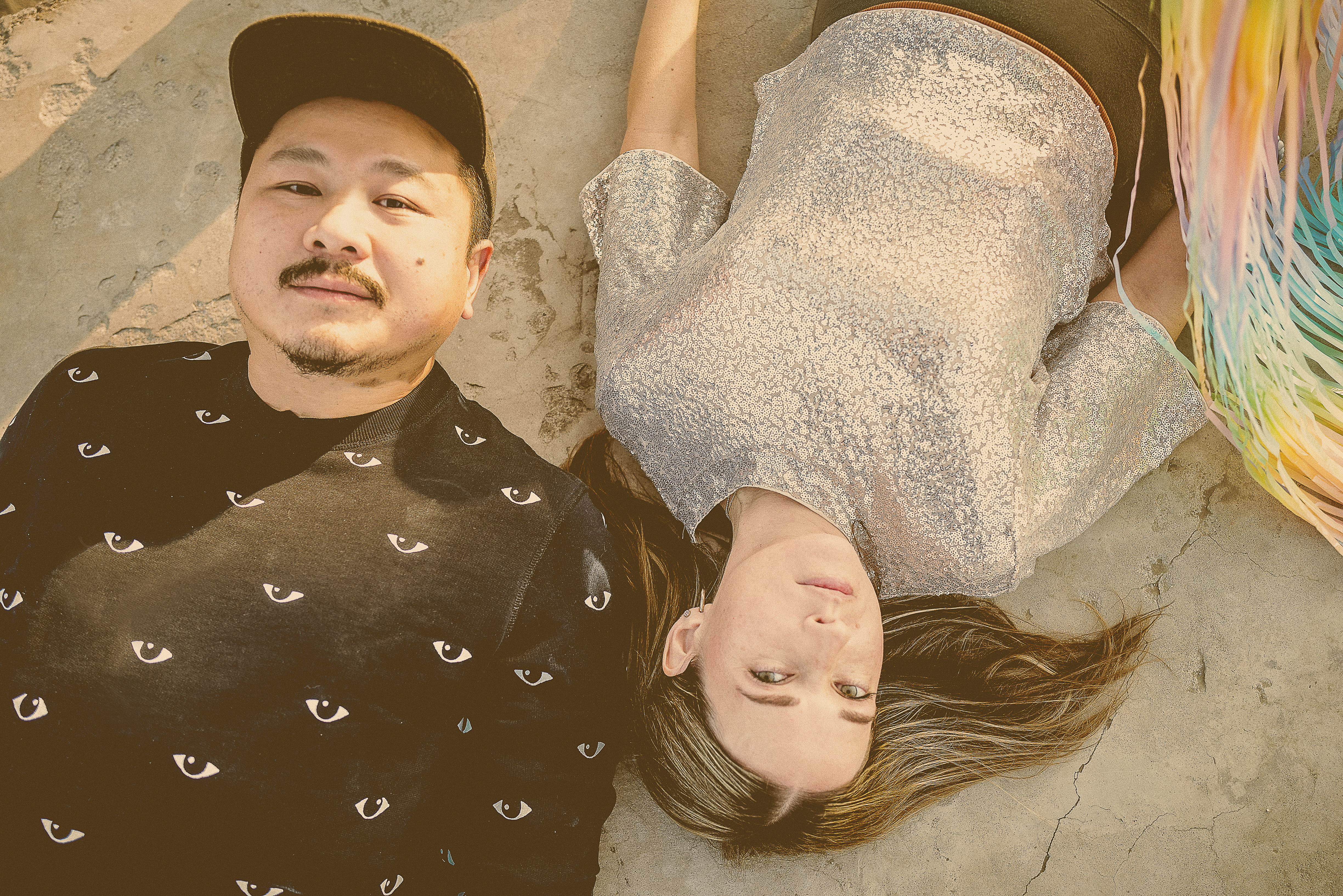
[Cover photo credit to Kelly Segre]
Singer/songwriter and teacher Jen Wood and electronic musician Ted Chen had known each other for many years in the Seattle music scene, but teaming up on a new project, GEMZ, took them down a brand-new road creatively and personally. They now credit their collaboration, and creating their debut EP, See The Future, with having a significant emotional impact on their lives as it enabled them to process past trauma and create something that could be a source of hope for other people, too.
Wood and Chen describe the five songs on the EP as “statements of empowerment, all of which tackle the human experience of learning, growing and healing from various life difficulties and past traumas.” Reading that list, most people will recognize something that resonates with their life of the past few years, whether it’s recovering from global upheaval or losses and life-changes much closer to home. It’s particularly interesting that they have managed to combine subject matter which speaks to overcoming personal struggles and sounds that might just get you dancing in a meaningful and uplifting way. I spoke with Jen Wood and Ted Chen about some of the ways in which making this music has touched their lives and what they hope it conveys to others.

Hannah Means-Shannon: I feel like the distraction level in the world is at an all-time high. It’s something that got extreme during the pandemic, but has never really gone down again, producing a lot of anxiety and stress. I feel like it’s really impressive that you two have managed to focus on your project and get this EP ready during this time. Did you have a certain schedule or were you fairly open about it?
Ted Chen: I think it was organic. In fact, it was by design that we gave ourselves the space to not try to structure the songs with a specific theme, or genre, or vibe. We gave ourselves the space to say, “Let’s explore what the music wants to tell us.” But I think there was a thematic connection because these songs, in many ways, are about finding ourselves through the chaos of the time. That includes all the external factors, all the stuff that was going on in the world, and that includes all the internal factors, all the stuff that was going on within ourselves. We were having to reorient ourselves to this ever-changing world. That was a connective thread.
Jen Wood: It has been no small undertaking. It has been such a long journey, honestly, to get here to this point, right now. I really appreciate you acknowledging that. It hasn’t been easy for any of us. Things have taken longer. I think, originally, we were hoping to release the EP in February, but we’ve had so many life interruptions, just like the whole world has. We’ve been very forgiving with each other, giving each other time and space, because we’ve both been on our own journeys, going through healing, personal growth, spiritual growth, and making huge life changes. I feel like that’s the theme. The pandemic was such a huge pivot point, people started making bold life changes. Some of them for the better. We should celebrate that. We were really realizing our mortality in the way that maybe many of us hadn’t.
Ted: Realizing your mortality helps to reframe what the hell is really important in our life. If we’d had this interview three years ago, it would have been in my studio, in my townhouse, in Seattle. But now we’re in a tiny town, Sebastopol, in Sonoma, but that was by intention and design. My wife and I found ourselves needing space, needing somewhere to breathe, needing to be able to put our feet on the grass. We needed to be able to see the stars at night. Those were reorienting my own priorities, and I feel like that’s reflected in the music as well.
HMS: I feel like people reassessing mortality had so many knock-on effects, reassessing jobs, geography, relationships, having kids. So much happened during that period. From a therapeutic point of view, I think people are still working through this stuff. But that has also made for some amazing projects that people have created, and are still creating out of this. It’s like when there’s a terrible forest fire, but then the ecosystem starts to come back.
Jen: That’s something beautiful that I resonate with, the death and rebirth. We have a million tiny deaths within this one life, or like the Phoenix rising from the ashes, there has to be a death for there to be a birth. We are often in survival mode and we will continue to be. But I just remind myself that we are stronger together.
Ted: Things are going to get wild. With the pandemic and all the successive rollercoaster that unfolded, it did give people an opportunity to pause and reflect, in a way. But then the machine just turned back on again, and a lot of people didn’t really have time to process and heal. But that also opened up opportunities for change. People realized that they weren’t ready to jump back on that train, so they realized they could stay where they were and reassess.
For me, I left a job two months ago that I was in for 14 years, because I wasn’t ready to get back on that train. I said to myself, “No, I don’t want to get back on that hamster wheel. I want to know what else I can explore when I’m not constantly chasing after something.” A lot of the music that we wrote was really a declaration of that, and giving myself the space that I needed to be able to sit with the music. It was a very deliberate act.
HMS: Something that’s inspiring, also, is that this is a collaboration between the two of you that’s new, but it came out of a period of isolation. It’s cool that two creative people found new ways to work together.
Jen: Yes, as Ted has said before, it’s been a “beacon of light.” Gemz has been a North Star, a lifeline, something to help us.
Ted: It definitely provided that balance. Making the decision to leave my job wasn’t easy. To be able to have this outlet, or even the steadiness, to help orient me, was amazing. I was really fortunate to be able to work with Jen through this time.
Jen: Also, I’ve been through big life changes and challenges. We’ve known each other for 20 years, and have a long history back in the Seattle music scene, but it wasn’t until we started working in music that our friendship started to build. Our collaborative working relationship is really unique, I think. We’ve been having conversations and supporting one another, through the context of the song’s I’ve been writing. Ted will hold space for me to get through what I need to get through. I think there are a lot of music projects that are happening like this, because that’s the state of the world. We need connection, and we need to support one another more loudly.
Ted: Most of the time in collaboration sessions, we’re not even talking about music! We’re supporting each other through the shit that’s going on our lives. We’re saying, “I don’t feel synced up creatively. I don’t feel powerful. I feel like I need to get over this hump.” Then we help each other reframe that. Then, somehow, the music comes out of that.
HMS: I’ve noticed that the music enters very emotional territory, though it’s broad enough that I think people can find their own connections. That’s pretty brave of you, as artists, and takes some doing.
Ted: It’s pretty vulnerable shit. We give each other enough space to communicate the emotion, and we respect the content of the music in order to take it where it needs to go. Sitting there, listening to it, figuring things out. For me, as a Producer, what resonates is not so much the mood, but the potential for hope. I listen for hope, actually, in this. [Laughs] Obviously the music touches upon darker themes, and at times more melancholic, darker themes, but when I’m listening to it, I’m always in that act of transmuting things. How do we celebrate the light in the darkness?
Jen: It’s a healing experience working with Ted. When Ted was speaking, I was thinking about the song “Karma”, and all the songs that I’ve written. For years, I’ve written very personal songs, but I’ve also just hinted at a lot of things. I’ve subtly hinted things, and wasn’t really feeling ready at times to speak more freely. But that’s okay. We don’t necessarily have to reveal every detail. For some reason with “Karma” and the song “The Cycle Stops”, I feel like, in a way, they could be anthems for survivors. “Karma” could be an anthem for survivors, using it as a broad term. At the end of “Karma”, it’s such a victorious message, that I’m better than I’ve ever been before, I’m dancing in the light, and nobody’s going to stop me. I am now stronger, and I’m going to shine. I’m not going to give my power away.
HMS: It’s a decision as well as a statement.
Jen: Yes, and it’s a huge decision. It celebrates those of us who have been in those crisis moments of having to make that decision. We really need to love one another and celebrate one another so fiercely.
HMS: I appreciated the fact that with “The Cycle Stops With Me”, I was thinking about all the types of relationships that are affected by these issues. I’ve seen a lot of families go through stuff like this, with intergenerational struggle. It’s things that get us stuck, basically, and I think people can connect with that. Things that get us stuck could be cultural assumptions, misunderstandings. Those are the things that hold us back. “The Cycle Stops with Me” is a decision, to confront and remove those obstacles.
Jen: I hope so. I want the listeners to interpret it in their own way in whatever resonates with them. Talking about confrontation, and being deliberate about breaking patterns, it’s actually inevitable. We all get to places in life where we are actually forced to change, even those of us who don’t like confrontation, like me. I actually don’t like confrontation. I also hope that people can just dance along.
It doesn’t have to be all doom and gloom! The music, the beats, all that Ted has added, is intentionally keeping this energy of joyfulness, of lightness. Yes, things get heavy, but you can literally just enjoy the music, and let that carry you through. You don’t have to just take the music in an intense way, and that’s important to me! I want people to “choose your own adventure” with the songs.
HMS: I think this is music that could be part of peoples’ lives in different ways. It can be on in the background, easing people through their day.
Jen: I listen to music almost constantly throughout the day. It’s the soundtrack of life. That music in the background is subconsciously going to be shifting your mindset, your vibe.
HMS: I think it’s true that music makes a contribution to peoples’ lives in that. I don’t think that all music has to be happy, but I think we do look for sources of positivity and need them.
Ted: It’s a compelling when you can communicate that breadth of emotion in a song. As a Producer and a songwriter, I’m always looking for that contrast, the happy and the sad, and celebrating that. That also speaks to the power of Pop. That is why Pop is so powerful. Yes, the origin might come from specificity, but universality is what it appeals to. Anyone can put it on in the background and jam to it, or sit and listen to it, and cry to it. It has that range to it. Not just our music, but Pop in general.
HMS: I’ve often heard people say that when they are going through hard times, there is only certain music they can listen to, whether it’s instrumental music, or Folk music. I think Pop can also work that way because it’s approachable.
Jen: That’s really important to me for my music, even lyrically. There are some aspects of me being very intentional about how I write my lyrics, because I’ve always wanted my message to be universally accessible. I want someone in another country to be able to understand it. That’s always been in the back of my mind. Sometimes I worry that my lyrics aren’t interesting enough, and critique myself, but I keep returning, naturally, to a simplicity in my language on purpose. As Ted has said, music is universal. I don’t know how we could get through life without music, honestly, and with what is going on in our world, music is going to be one of the very few things that can’t be taken away from us. People always find a way to listen to a song.

