
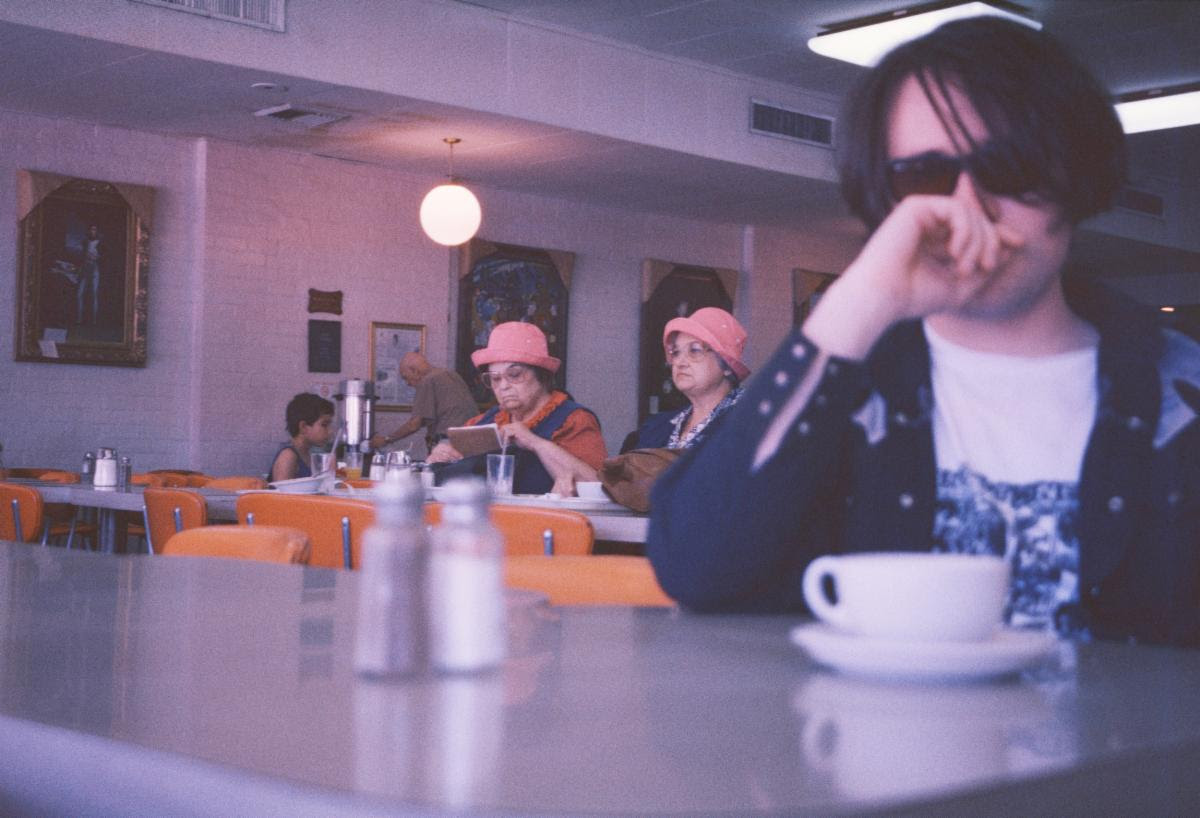
[Cover photo credit to Karl Rumpf]
This Friday, on October 9th, 2026, Bar/None Records will reissue the 1996 album Reseda Spleen, created by L.A. project Ventilator, spear-headed by Matt Devine. It’s a 40th anniversary year for Bar/None Records and the label’s founder and former head Glenn Morrow has a special relationship with the release, since he heard Ventilator perform in New York and was struck by the music in the 90s. Ever since then, he’s hoped the album would get a wider release than its initial reach.
The album has a special history of its own because it was mainly recorded at home on Matt Devine’s used Tascam 388 tape recorder. Devine, who had previously been in the studio as part of the trio Permanent Green Light, decided to Produced Reseda Spleen himself, with mixing chores handled by the great Earle Mankey (Sparks, Mumps, Runaways, Beach Boys, etc.) The album features bandmates Byron Reynolds (Possum Dixon), Jeff Caruana, and special guest Brad Laner (Medicine).
Arriving in its new iteration on 12” LP vinyl, digital download and streaming services, Reseda Spleen represents a wealth of musical knowledge and sound explorations set in motion by Devine, with each song carrying its own mood and inspiration, making for a rich listening experience. I spoke with Matt Devine about his musical milieu in the 1990s, the jump to self-recording and Producing, and how that feeds into Devine’s continued interest in modern recording methods.

Hannah Means-Shannon: It’s wonderful that Glen Morrow could hear so much in your music when he caught your concert back in the day. He’s someone who’s really enthralled by music traditions, particularly Rock ‘n Roll traditions, and I feel like I can hear that on Reseda Spleen. Whether that’s intentional on your part, I don’t know.
Matt Devine: Well, thank you. Maybe what you’re speaking to is really a reflection of my record collection. I’ve always been a guy who bought records, went to record stores, bought more used records than new records. I had an older sister and brother, and they had records on the shelves. My sister was especially cool because she was going to see all these Punk Rock bands in 1979, 1980 onwards. I was listening to her records and discovering all this left-of-center music that you didn’t hear on the radio, so it seemed like these magical discoveries. It’s like most of us, that our records are probably informed by our record collections.
HMS: That’s true, and thank goodness for older siblings who like music. I don’t know where I’d be without that, myself.
MD: Yeah, totally! It’s like Almost Famous, where she says, “There’s something under my bed that you should check out.” And she leaves him behind with the records. It’s this amazing moment where he’s listening to Tommy, by The Who. In my case, it was, “Don’t listen to my records!” My sister would leave, and then I’d sneak listens to it. I listened to Los Angeles by X, and it just terrified me. I thought, “Maybe I shouldn’t listen to this!” I discovered The New York Dolls, and Cramps records that I hadn’t heard yet.
HMS: I know you got into playing in bands quite young, also. Did you find that your friends as a young person were as broad in their musical knowledge as you? Did you have similar tastes?
MD: It was that era of making mixtapes for your friends. You’d talk about something, and say, “Oh, you haven’t heard of Big Star? Let me make you a tape.” So I’d put # 1 Record on the first side, Radio City on the second, and I’d put some live tracks from a live bootleg I had at the end of each side. So, I turned on Jeff [Caruana] to Big Star, but then he turned me onto The Byrds. I knew The Byrds from listening to AM Radio, but he was listening to the Clarence White records.
It was a time pre-internet where you would discover records in the record store that you didn’t know existed. It was like we kept discovering these Byrds records that we didn’t know existed. And Rob [Zabrecky of Possum Dixon], too, we would talk about bands, and he’d say, “You like The Stooges? I love this Iggy Pop record.” So it became that reciprocal turning each other onto music.
HMS: That open atmosphere strikes me as being a little foreign for a while in music, where people would get stuck in certain genres, though I think it’s coming back, thankfully. That’s an open atmosphere of curiosity that you’re describing.
MD: I think that speaks to the time, where you’d ask questions, and get to know people through music, bringing us all together. That still happens, but just in other ways. But yes, it was music, music, music!
HMS: That sounds like the mindset necessary to create this album, immersion, seriousness, and sticking with something difficult. I’m referring partly to the Production of this album, which is a whole other area of discussion. You really had a mountain to climb. You bought this expensive machine, and then you had to learn how to use it. That sounds daunting, but admirable.
MD: I used to record on a cassette 4-Track and take that seriously. I wouldn’t just record a song to get a point across, but I’d add overdubs, reverb, and echo. I was familiar with the 8-Track because my first band, Lazytown, had recorded on that machine. I knew Jack Waterson, a guy who had always worked at vintage stores, and he was talking about a “388”, and asked, “Have you heard of those?” And I had, and I reached out to the guy who still owned the machine and asked if he still had it. I said, “I’ll buy that from you.”
For me, it was part of that whole journey of taking it to the next step, that I could record, and this would be something that was better quality. It would have 8 tracks, and be quarter-inch, and have level-fidelity. Also, more than that, I said, “I can work at my own pace, and do what I want to do. If I want to spend time tracking this guitar part, and take an hour, I can do that. No one will be asking me, ‘Why are you doing that?’” Or, conversely, if something was dashed-off that I thought was cool, I could keep that. It was also in an environment that I had created, and I needed to do that. I needed to kind of step away from nightclubs and “the scene.” I needed to hang out by myself, doing my thing.
HMS: There’s always the issue of self-Producing that finding stopping-places, and deciding when things are done can be tricky. Some people are looking for an outside perspective of some kind. Was Earle Mankey one of those people? I know that he helped you in figuring out how to use this machine, initially.
MD: Earle became a friend when he Produced the Permanent Green Light record, Against Nature. I would ask him questions, and talk about Production, and he was great. We would talk about recording, records we like, and the vibe of a recording, as well as some technical stuff.
But you’re absolutely right about when you work on your own, and there’s no accountability for hitting a deadline. As far as my situation, it wasn’t, “We need to get this in the stores…We need to make sure…” There was none of that. I took my sweet time, doing my thing. For me, in this space, creatively, it was great. I enjoyed it, and I look back on that time fondly.

HMS: The appeal of that is very apparent for people recording right now. A lot of people are creating their record first, maybe via crowdfunding, then shopping it around these days. They don’t want that outside influence on the material, initially.
MD: Yes, and recording on the computer means that you need less real estate. You don’t have to ask, “Where am I going to mic this amp?” Now, you can just use digital amps and digital plug-ins. It’s just a different place to be. Now, there’s Bandcamp, and using Instagram to spread the word. I was just in my second bedroom in my apartment, doing my thing. I wasn’t worried, “Who’s going to hear this? When is this coming out?” I think I benefitted from that, creatively.
HMS: I was wondering about this, since the 388 was kind of “cutting edge” at the time: Are you still interested in Production, and modern Production methods? Do you use digital now, having worked so analog in the past?
MD: Yes, I am. When the 388 died, in 1998-1999, that was when it was easier to get set up on a Mac, and use Logic, and I was able to record that way. Again, I was doing it on my own time. I was gainfully employed, and I started a family, and I would be able to make music in my spare time. I could do whatever I wanted, which is how I preferred it. I would play in bands with friends, but for my own music, I’ve always worked at my own pace.
I definitely thought the 388 was cool, back in the day, but there was a certain amount of “Why are you doing this?” from people, and “Shouldn’t you be in a real studio?”, or “When are you playing live?” But with Reseda Spleen, there was none of that, and then when a few people in LA heard Reseda Spleen, and a couple labels were interested, they were saying that, “When are you hitting the clubs?” That’s a different dynamic. That’s not what made Reseda Spleen, Reseda Spleen. That was a bit of a rub.
HMS: It sounds like the current way of marketing music at that time was very live-based, so they couldn’t really comprehend a release created with some other goal.
MD: Yeah, and we did play live. We did it, and it was fun. I can do that stuff. That’s being professional. It’s doing a demo, getting it to tape, marketing and all that stuff. Reseda Spleen had been the opposite of that, but then it became that at some point. We had to have photos, and album artwork. I wanted the album to be heard, for sure, but as far the creation-process, it was definitely at my own pace.

HMS: At what stage in the development of the songs did other people hear them, like your friends, who helped out with parts? Had you laid things down really tightly for them, or was there a looseness to it?
MD: I did do more Ventilator recordings in the year or two afterwards, but as for the Reseda Spleen stuff, it was pretty mapped-out. I had done a demo on my 4-Track, and then said, “Okay, I’m going to go and record this.” I had ideas for arrangements. Of course, when you get someone like Byron Reynolds [of Possum Dixon], who’s such a great drummer, he’s going to bring his own swing to it, but he served the song with what he was playing. It wasn’t improvised.
For a couple of the tracks, I had recorded acoustics first, then Byron overdubbed drums onto them. Byron could do that, because he was good. He could listen to a loose acoustic, and play along. The songs “Landsdowne” and “Lint Duet” were him overdubbing, so those have a little bit of a different vibe. But arrangements were usually part of the approach.
HMS: That makes sense to me because everything on this album seems so intentional, and the interrelationship of parts within songs sounds so intentional. At what point did you know for sure that it would be an album? Is it more freeing to just work on separate pieces of music and exploring sound, rather than having to think of how they fit together?
MD: I did feel like, once I got the first few songs happening with Byron, that it was the start of a record. I did believe that. I didn’t know what the sequence would be, or who would release it. Until Mark Linn [of Delmore Recordings, Chicago] came along, and ended up being supportive, giving me feedback, and listening. He ended up releasing it back then. With the second batch of songs, which ended up being released later on Rock Folk Suicide, that was definitely something where I felt like I was recording songs for a record, but it didn’t manifest itself into “a record.” Years later, I cherry-picked the best recordings, and this guy in Austin wanted to release them, and I let him. But with Reseda Spleen, it was definitely, “This is going to be a record.”
If you’re asking about the sound of it, I didn’t worry about every song having to sound the same. Whatever the song called for, arrangement-wise, was kind of what it became. Going back to your previous question, I wouldn’t say that what got recorded was “pre-ordained”, though. That’s what’s fun about recording, you have these musical moments, where you’re tracking, and you realize, “Whoah, that sounded really cool.” Then, maybe you harmonize it, or you double it, or you do something special that leads you to something musically different, that you didn’t anticipate. The overall approach is there, but then all those discoveries happen through it. But I knew it was going to be a record, which was why I got the 388 and thought, “I can do this on my own.”

