
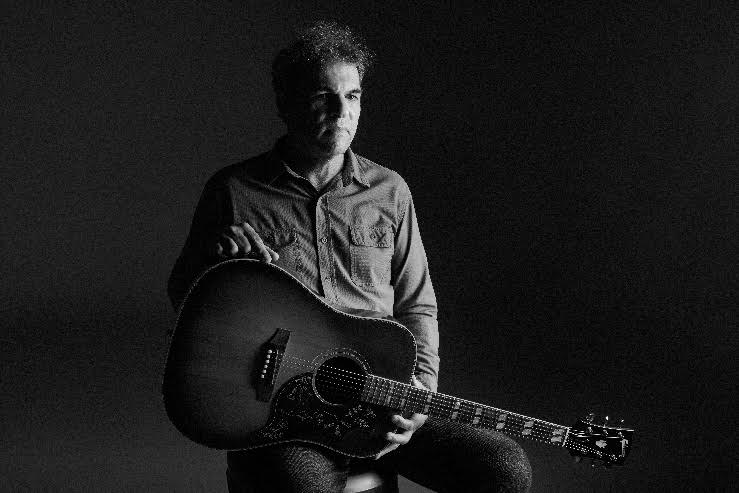
[Cover photo credit to Patrick Fore]
Here at Wildfire Music + News, we’ve previously interviewed singer/songwriter, archivist and Producer Jeff Larson, particularly about his previous solo album, Adobe Home. Audiences paying attention to Larson’s solo albums and to Gerry Beckley’s solo albums will have noticed that these two have an ongoing songwriting collaboration that often results in guest appearances on each others albums. But in this decades-spanning creative friendship, Larson and Beckley hadn’t yet put out a shared album, fully illustrating the ways in which they write and develop songs together, until now.
The album Jeff Larson with Gerry Beckley arrived in late October from Melody Place, and showcases a riotous blend of genre elements that the two songwriters extract from their wide-ranging musical experiences. For Beckley, having co-founded the band America with Dewey Bunnell, and toured extensively for 53 years, writing and recording tracks at his own pace and with his creativity off the leash is a very rewarding thing. It’s even a daily practice. Jeff Larson, having worked on collaborative projects in the past with Beckley, Bunnell, and others, later became immersed in the art of Production, and through that found a renewed passion for songwriting that makes him just as committed to keeping the creative output flowing, day by day.
I spoke with Jeff Larson about the ways in which he and Gerry Beckley collaborate and the wide-ranging musical territory they cover for this fascinating collection that documents their creative lives.

Hannah Means-Shannon: We had previously spoken about your solo album, Adobe Home, but it makes a lot of sense to build on that conversation, because there’s a lot of continuity in your collaborations. I think you’d even mentioned that you might be doing more with Gerry.
Jeff Larson: That’s true! Yes, that’s pretty much a continuation of things. It’s really the same story, because normally, in day-to-day life, we collaborate every day. As Gerry says often, “We don’t have an off-switch.” What we do is not necessarily done with the idea of some future album. It’s more that we have a song, and we’re craftsmen working at the tune, and things accumulate over time. That’s really the story of this album.
During Adobe Home, which was last year, and into this year, there were a whole handful of songs where he would send an idea for a song, like a hook, and I would take it on and fill in some of the melody and lyric. When we’d finished a song, it would be on to the next on. It became eight or nine songs, and Gerry said, “That’s an album, really.” Then we needed one more, really, and Gerry had a really great hook in a song called “C’Mon Home.” And that’s the one that we used as the first single for the album.
That song was one that we went back and forth on, but really knocked it out in a couple of days. But there’s no hard-line stop. We keep doing the same thing. If we find that our songs are stepping on each other too much in terms of subject-matter, then we throw in a cover working together. Recently, we did, “Norwegian Wood” from The Beatles, and “Ain’t No Sunshine”, the old Bill Withers tune. Those may add up to a future covers project, but it’s really just so much material develops, and some become my solo albums, and some of them become his, but these songs, particularly, seemed like “true collaborations”, so we decided to put them out as Jeff Larson with Gerry Beckley.
HMS: It’s not unheard of, but it’s pretty unusual how you two take this measured pace in terms of songwriting and recording, and don’t force a predetermined outcome at an early stage.
JL: A lot of this is benefitting from another area, as well, which is that Gerry has been on the road with the band America, spending 53 years tour, and I always worked with Gerry and Dewey, on little projects I’d do over the years. But, at some point, I burned out, about a decade ago. Then Gerry got me into audio production, and that led me into being America’s archiver and Producer on some things. I still do that.
When I got into Gerry’s material, as an archiver, there were a whole lot of unfinished songs. And a lot of them ended up being on Gerry Beckley solo albums. That’s still the case. A lot times, he’ll start something, and have half a song finished, and then it just gets abandoned. Working on those helped me cut my teeth on the Production side. On the songwriter side, I had my own projects, and he and Dewey would guest on mine. There was a level of trust that built up.
Then around 2008, Gerry asked if I would like to do an album covering his songs. That record was one of the best things that we did. That relates to this album, since it’s not just Jeff singing Gerry songs, but now it’s more of a collaborative effort. So you’ve got both personalities in there singing, and in the mood of the record.
HMS: It has a wide range in terms of representing both of your personalities in terms of your songwriting and your sounds.
JL: The record goes all over the place. It has the usual ballads, it has the mid-tempo stuff. There’s even some things that are a little like America. Then, there’s one cover, of “Let’s Live For Today”, which is an old Grass Roots song, though Gerry completely flipped it. He brought in a modern Production edge. That one’s a lot of fun! Then there’s “Oh Wow” which is kind of a Power Pop song. I wrote that song to talk about different experiences, not just those of a creaky old guy, so that one’s kind of a children’s Pop song. That’s why I used a toy piano towards the end. It’s saying, “I’m looking at things fresh and new, where everything is bright and wow.” It’s just as simple as that.

HMS: All of the songs that you’ve mentioned are ones that really caught my attention. But given that you have this collaborative relationship between you and Gerry, is it satisfying to now see an album that tells the story of your relationship more fully? This is a picture of your day-to-day life in a direct way.
JL: It is, exactly. We’re both proud of it, and it’s self-titled. But due to the consistency of the work-effort, we hope that there’s more to come under this heading. It’s a separate base that we can go to, and there are songs that might fit a follow-up. But either way, we’re happy to put this out, because we think this is a pretty solid statement of where we’re at.
HMS: One other thing I wanted to clarify: It sounds like as you’re writing, you’re also recording. So, were these songs each recorded separately at their own pace, at their own time?
JL: Yes! That’s right. When it’s all figured out, we go back and tweak, things, though, of course. And we get guests on there. For the song “Amnesia”, I have a friend in Nashville who plays cello, and so we got a cello on that, then we thought it warranted a whole string quartet, so we did that. That’s kind of how these things build up. But Gerry is so quick, and so keen on a lot of Production stuff, that I defer to him on a lot of it.
The song “Let’s Live For Today” is probably the oldest song on the record, that goes back three or four years. We didn’t know where it would fit. That song was really strange and different. I sang it in full voice originally, then he said, “Can you sing it in your whispered tone?” And I did, and that was a blast. His piano was a felt piano, where the keys were soft.
HMS: That outcome, on that song, is just crazy. I’ve never really heard anything like it. It’s really neat, how it has elements from different eras of music. It almost felt like a New Wave song at times, with a synthy feeling, but the voices are so idiosyncratic. I also love how the song keeps going and you add so much to it.
JL: We did! It really took on a life of its own. We both have a lot of musical interests, from Grateful Dead to Dojo Cat. So it’s pretty diverse. It’s just the craft of songwriting that has developed for us. We don’t think that being diverse is particularly appreciated these days, and that can be depressing.
HMS: It’s a hard time to be in music. Within that landscape, that’s pretty bleak, the bright spots are human ingenuity. There’s a lot of great songwriting out there to discover.
JL: That’s all you can hope for, any time you do a project like this, is that you’re putting up a flag and hoping that somebody sees it. I listen to the whole thread of songwriters through the decades, and I gravitate towards that, because I know that they are in it for the right reasons.
HMS: Are there any songs on this album, particularly, that you feel have been affected by the events of the past few years?
JL: I’d say that one has, “Looking at the Rain.”
HMS: I really like that one a lot.
JL: It speaks about “trouble in the east, trouble in the west.” All the verses are alarming, but don’t get too specific, but the chorus turns much more positive. The end of that chorus is about love. Musically, to me, that song is closer to an America sounding track, but lyrically, I could see someone singing that in different ways. The world’s got problems, and always has problems, but it’s calling all that out, and trying to resolve it in the chorus.
HMS: It’s got a very urgent beat and tone.
JL: It does. Gerry did a great job on that.
HMS: It really gets your pulse going. Are those horns on there?
JL: Yes! The arrangement is great. I think on these kinds of projects, Gerry really gets to show that off. I’d say he’s only gotten better. He was away from a home studio for several years, but he was one of the guys way back, like in 1972 or 1973, who had the home set-up. He was way ahead of the game in that area, though it’s now a common. This is really two home studios coming together to create a piece of work.
HMS: One of the songs that you mentioned earlier was “C’Mon Home” and I think it’s so funny that it was the last song that you wrote for the album. I think it’s such a neat expression of the two of you working together. It sounds like exactly what I wanted to hear from this album, really!
JL: That’s good to hear. That was such a nice cherry on top. Gerry had sent me a track that he started, but I was busy on other things. Then he said, “I really think that you should listen to that song, ‘Fly Away.’” That was the initial working title. He let me have it, and he had the first version, and it was just so easy to do. Every once in a while, a song comes along that you don’t really have to wrestle with. That song was so easy to sing, and adlib. It just came together the way that you hope a song will.
HMS: It has a feeling of archetypal things. It covers a lot of American history and culture.
JL: And it’s positive.
HMS: It’s positive. It has this strong imagery. It makes me think of the American West and it has an open feeling to it. It captures a kind of American spirit.
JL: I think that slide guitar is actually the same slide guitar used on “Sister Golden Hair.” Gerry has always kept that instrument around! [Laughs]
HMS: No! I love that sound.
JL: Gerry and I are both fairly melancholy songwriters, but sometimes you have to step away from yourself a bit. We didn’t look at our shoelaces, and went different ways with it, emotionally, and musically.
