
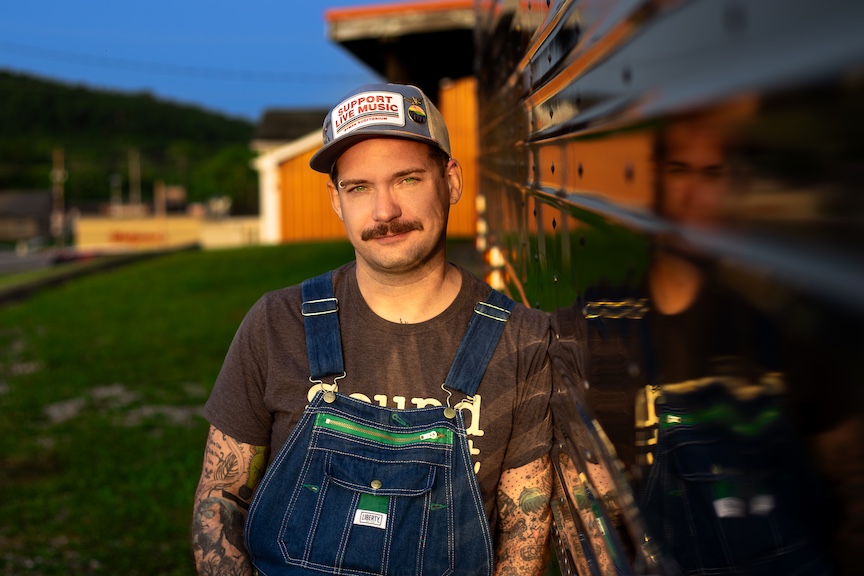
[Cover photo credit to Laci Mack of Hopeless Holler Photography]
Mandolinist C.J. Lewandowski is known for his work with Bluegrass group The Po’ Ramblin’ Boys, and for his relationship with mentor Bobby Osborne of The Osborne Brothers. Bluegrass legend Bobby Osborne championed the genre in wider music culture and brought new approaches as well as an expansive personality to the music community. When Bobby Osborne passed away at the age of 91, C.J. Lewandowski not only had to process the loss of a key figure in his life, but was also left with a partially completed album that he and Osborne had been working on.
Significantly, Osborne had brought tremendous energy to these final recordings, making them a stirring testament to his Bluegrass contribution and love for music. While the album had already been planned as a collaborative one, it took some time for Lewandowski to understand the way forward was through bringing in even more of the music community to carry out Osborne’s wishes on remaining tracks. Once the word was out, supportive musicians delivered their contributions with gusto, including Del & Ronnie McCoury, Billy Strings, Molly Tuttle, Sam Bush, Wyat Ellis, and many more. Their willingness to take part was built not just on Bobby Osborne’s music, but on his warm and supportive persona. What emerged, the album Keep On Keepin’ On, is as energetic as a packed stage performance, and is far from a project tying up loose ends.
C.J. Lewandowski’s role in spearheading and guiding the album, from start to finish, is a testament to his own musicianship, vision, and respect for Bobby Osborne. His performances on these tracks are also a highlight of his career so far. I spoke with C.J. about his experience of friendship and working alongside Bobby, finding a way to complete the album, and where Bobby Osborne’s own example leads us when it comes to the future of Bluegrass.

Hannah Means-Shannon: I know a little bit of the background leading up to when you were first working with Bobby on these songs. I know what a cool and important thing it was for you to get to the point of actually recording together, since he was your hero, but I also understand that because of his age, you had to be pretty flexible about things. How you think the songs that you worked on with him got picked?
CJ Lewandowski: Everything that included Bobby, including vocals and a lot of stuff, were his idea. Even with “Rosie Bokay”, that was his idea, but we didn’t get to do it with him in the studio. We cut the instrumentation, but we never got to track his lead. He had wanted to come in and redo it, and unfortunately, we didn’t. Fortunately, later, we got Paul Brewster to do it, which was amazing. Everything that has Bobby’s vocal on it was picked by Bobby. He wanted to do those songs. And I wanted him to feel him to feel that this was his project, even though it was labelled as Bobby and CJ.
This was giving him something to do. He was still playing shows. He was still operating. But there was a point where Bobby got a little depressed because he felt that no one wanted to see him anymore, and nobody cared. It mainly was after Covid, and he was just sitting at the house a lot. The main point of me and him recording together was to get him creative again, and make him feel like he was somebody, because he totally was! It hit me hard that somebody of that calibre, who has done that amount of stuff in his lifetime, felt that way. Most people can’t even do that in one lifetime, and he did. So I talked with his son, Bobby Jr., and I talked with the label. One day I was chatting with the label, and they said, “If Bobby says ‘Yes’ to recording, we’ll cover the bill. Just do it between you two guys. Showcase your friendship.”
HMS: Wow, that’s so great to hear.
CJL: So, in short, everything was Bobby’s idea up until his passing, then I shelved it for a while. I didn’t want to hear it. I didn’t want to touch it. I guess that was part of my grieving process. Eventually, it came back around, with a little help from him. He has this spirit. A spirit that strong on earth, I feel like doesn’t go away. He’s still around. He still shows up whenever I need him to. And I don’t even know when I need him to!

HMS: I’m so glad that you still have that presence in your life. I’ve interviewed a few Blues artists in the past couple of years who are of an older generation, and they have told me, they are bored! They don’t want to retire, they want to collaborate, which is similar to Bobby. I think people leave them alone out of respect, saying, “Let them retire, now. They deserve it.” But they don’t want to! It’s a misconception.
CJL: Ever since I was a kid, I’ve always had people who were 50 years older than me as my closest friends. They believed in me, and they invested in me. I think it’s only proper, and it’s only natural that you give that back, when they need it. You owe them something. They aren’t sitting there saying, “You owe me this.” No! When it comes to a certain point in time, you do it. And I’m doing that with a guy I grew up with right now, who will be 90 in a couple weeks. He came down to Tennessee and we cut 14 songs together. We’re saying, “You guys invested so much in us, well, we still believe in you!” It’s a feather in your cap at the end of the day.
HMS: This also speaks to the fact that it’s one community.
CJL: It sure is.
HMS: It’s not always physical or geographical, but it’s the spirit of things, like you were talking about. That’s one community. In a lot of different art fields, the older people are heroes, and we ought to hear about how they are feeling right now, not just how they felt 50 years ago.
CJL: Exactly, yes. There’s more to life than what they did. They are still doing.
HMS: The other thing is I know of many people who have worked with older mentors, and then lost them. They, too, had a profound emotional reaction, and couldn’t finish those albums for a while. It’s like losing a parent. It’s a big process.
CJL: Yes, that’s kind of where I was. We all knew this day was going to happen, so we all coped with it, but it still hits you hard. I would consider the loss of Bobby like losing a very close family member, a parent or a grandparent. I literally talk to him every day, whether texting, facetime, or at his house. We’d work on cars together and talk about anything he wanted to talk about. It wasn’t all music, all the time.
But that’s the kind of stuff I miss with Bobby, just hanging out. We had so much in common. He didn’t have to be “Bobby the mandolin player,” or “Bobby the Grand Ole Opry Star”, he was pretty much just Bobby, and he could be that guy all the time. He was meant to be somewhat of a star, and he had this charisma.
HMS: When there are people who are so themselves, it’s their presence that has an impact. To get to be around them probably helps others figure out how to be themselves.
CJL: He had that going on. And for sure, he encouraged me. I remember him talking to me, and I asked him about how I played a certain thing. He said, “What’s it matter what I think? Do you like it?” I said, “Yeah, I like it.” He said, “You gotta be yourself. I figured that out a long time ago. Back in the ‘50s, everyone wanted to play like Bill Monroe, since that was the only style to play on the mandolin.” He said, “I found out real quick that you can’t beat a man at his own game, so I made up my own game.” That’s what he did! And you couldn’t beat him at his game, either. He told me many times, “Play what you feel, and it’ll all work.” He was always pushing people to be unique and creative.
The main thing with Bobby was that I was burned out, playing. I wasn’t happy with how things were going musically, and personally. I was just going to drop everything. If the Po’ Ramblin’ Boys wanted to go on without me, they could. But seeing Bobby after 70 years still excited, and still happy, and still playing music, that encouraged me to “keep on keepin’ on.”
HMS: That really speaks to a lot of creative people right now. It’s so easy to become burned out. You can have love and commitment for your art, and the whole world encourages overwork right now. There’s a lot that the artist is carrying right now in terms of recording, promoting, and playing live. There are human limitations.
CJL: Oh, yeah, it’s tough. Just what you just said about self-promotion is part of it. You try to be present on social media as much as possible, but that can steal away some creativity time. Then you get a phone call from a promoter saying, “You’re not pushing enough on social media.” There are more and more expectations for the artist than just creating music and being on stage. There’s so much more than just stepping up and playing. In order to do your best job, you’re always working, and sometimes you’re not even getting paid.
HMS: There are a lot of people who are very, very good at what they do as musicians, as artists, and it’s pretty shocking that people want to complain that they aren’t good at everything, full-stop. That they aren’t social media wizards, that they aren’t tech savvy, and things like that. You can’t be a wizard at everything.
CJL: You can’t do everything. You have to find a good team, and you have to find people that have the same mind-set as you, and the same humor as you, which comes into play a lot. It can be very overwhelming, really.
HMS: It doesn’t seem like it’s going to get better, so it’s about strategies for survival. One strategy is somehow cut through it all and just make music. Listening to this album, the energy, and the fact that everyone brought their A-game, is really obvious. It’s powerful. It’s not an afterthought, this album.
CJL: No, it’s not. Anytime I put together an album, whether it’s for the Po’ Ramblin’ Boys or not, there’s no filler material. Every song should be able to stand alone as a single, if you want it to. But the people who are on it, that also helps! (Laughs)
HMS: There are a lot of amazing guests on this album.
CJL: Oh, yeah!
HMS: That’s also a great strategy, because it brings this energy, like a whole group of people, carrying it to the finish line, and also celebrating Bobby’s work and legacy. It’s like you’re getting to see a packed stage when you listen to the album.
CJL: Yeah. And I think rotating different people in and out, and sprinkling different voices in between the tracks that Bobby is on, helps. Bobby is only on 8 of the songs.
HMS: That’s actually a lot more than I expected under the circumstances.
CJL: Well, me and Bobby actually had two albums planned. He was ready to start the second one when we got done with the first one.
HMS: I think it’s interesting that Bobby was clearly not such a traditionalist that he didn’t want to work with younger artists doing new things. What did he think of innovation?
CJL: Well, that’s what made the Osborne Brothers the Osborne Brothers. They weren’t afraid! They were progressive at that moment, but now the Osborne Brothers are considered one of the premier traditional Bluegrass acts of the genre! Even though there were drums, electric bass, and other instruments that were electrified.
HMS: That’s so true. Perspective is such an issue here.
CJL: I’ve had arguments about how Bill Monroe was the pillar of tradition. I’ve said, “You don’t think that, when Bill Monroe hit the stage of the Opry with Earl Scruggs, and Buster Flatt, and all of them back in the day, that wasn’t progressive? People were jumping out of their seats. They were going crazy because they’d never heard banjo like that before. They’d never heard keys so high. They’d never heard trios singing.” That was progressive for 1946 and 1947. It was. If the path is comfortable, you’re not going the right path. There’s got to be some briars that you’ve got to cut through, or else you’re not doing what you’re supposed to be doing. You’ve got to stir up a little dust!

HMS: You’re reminding me that a few years ago, the Bluegrass museum did a Jerry Garcia exhibit because he played Bluegrass so much in his younger days, and traditionalists were up in arms. What were they angry about? Jerry Garcia went and studied with real Bluegrass legends, he was devoted, and served the older generation. Did he play it wrong? Come on.
CJL: Yes, he was. What I’ve been hearing lately is that so many people found Bluegrass through The Grateful Dead and Jerry Garcia’s connection to it. You can put it in a box all you want to, but you have to poke holes in the shoebox so that something can live. And you need to let things into the box and out of the box.
For Billy Strings to say, “I would love to record with you and Bobby on the project.”, was a huge deal. Then there are all the people saying, “Billy is doing all these wrong things for Bluegrass music.” No, he’s exposing people to it who have never even heard it before, so this is huge. A rising tide raises all ships! They need to get on the boat and shut up. (Laughs) It’s good for everybody.
He thinks outside the box, just like the Osborne Brothers did back in the late 60s and early 70s, opening up for Merle Haggard. They were singing their version of harmony, and people ate it up! They were one of the top Bluegrass acts, but they were also one of the top Country acts. They were on package tours with Loretta Lynn and Conway Twitty. They weren’t afraid to say, “We play Bluegrass instruments.” But they also took it where it normally didn’t go.
A lot of people are saying these days, “We have to change our material to get a younger crowd into the festivals.” Instead, it should be, “No, you have to take what you do, and you have to take it outside of the Bluegrass norm.” Go to the places that normally wouldn’t have Bluegrass music, and play it. If you’re authentic, they are going to like it.
