
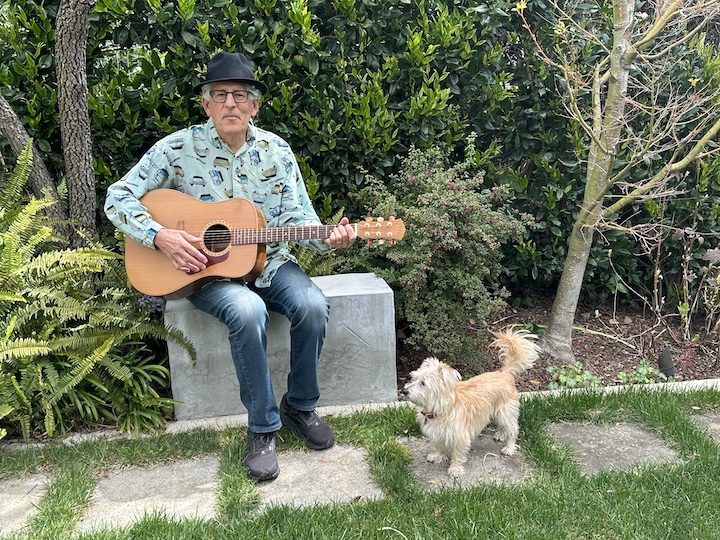
Robert Stoner is an American born Singer/Songwriter from Berkeley, California. Building on a youth playing classical piano, he grew into playing the guitar and songwriting before long and continues to work with the piano and guitar.
In recent years, he has been recording many of these songs, aided by Producer Ben Bernstein in Oakland, California, who has also brought his instrumentation to bear. He has announced his second, upcoming album American Dream. His 2021 debut album was titled Year of Pain.
We’re very pleased to premier Robert Stoner’s new song, “The Lady Spoke”, from his upcoming album, American Dream, here on Wildfire Music + News. It arrives this Friday, June 6th, 2025.
The song is ambitious in a positive way, taking on a massive subject–that of the immigrant experience of people coming to the shores of America seeking a better life. Stoner takes the size and scope of the topic into account by delivering an unhurried, reflective, and substantial track that moves through many possible iterations of this very human story with visual and emotional detail. The big, epic sweeps of the song concern, firstly, the idea of journeying over a deep and frightening ocean, a physical thing, but a good metaphor, too, for the psychological and identity change that immigrants face on new soil. Then, there’s also the idea of the hot sun and of manual, physical hardship that drives people to immigrate, and the often equally hard labor they take up in a new country just to survive, whether it’s minumum wage jobs or working as migrant workers. Finally, Stoner packs a big emotional punch by focusing on young people, and even young children, and the uncertainties they face when they look up, with hope, for shelter, and may or may not find it.
Much of the track turns on the idea of hope, and this is what the “lady spoke”, the lady that is America, and of course, the Statue of Liberty who has so long represented her. Little touches of instrumentation and the foundational vocal elements of the song suggest Folk music, the various nations that immigrants come from, and the beloved cultural memories they carry with them to new lands. When you contrast all of this song with the experience of America at this exact time, it’s a sobering if not shocking view, which is no doubt why Stoner felt it was the right time to release this song and to work on an album called American Dream.
The treatment of new immigrants right now in America, and even of those who have become citizens, is so shameful and horrifying that it seems like any American should be both ashamed and fearful for their own safety in the face of such unjust treatment. Aside from arrests and deportations, we have citizens spreading hate and taking violent action against others for their differences in a country that has always been built on differences. Something that’s particularly effective about Stoner’s song is that it strips all of this away, and goes back to the beginning. From this bedrock of essential human experience, of risking everything, having nothing, and needing shelter in a new place, Stoner paints a picture of the empathy and acceptance that we need to extend. We need to do this in memory of our own ancestors and in honor of human dignity. The song closes out with the air of a hummed lullaby, and this is possibly the hopeful, consoling feeling that Americans can experience again when we reclaim the spirit of The Lady.
Robert Stoner shares about the new song:
The Lady Spoke is an ode to immigrants, whether our grandparents that came to this country looking for a better life or today’s immigrant escaping hardship in the country of their birth. It is also a tribute to the enduring power of the symbol of the Statue of Liberty, the lady who speaks so eloquently to what America represents.

American Dream was Produced, mixed and mastered by Ben Bernstein in Oakland, and piano on “The Lady Spoke” was provided by Kirby Hammel.
Robert Stoner also works as a practicing professional Ph.D economist. His songs are often a “commentary on modern American life, politics, and relationships.”
