
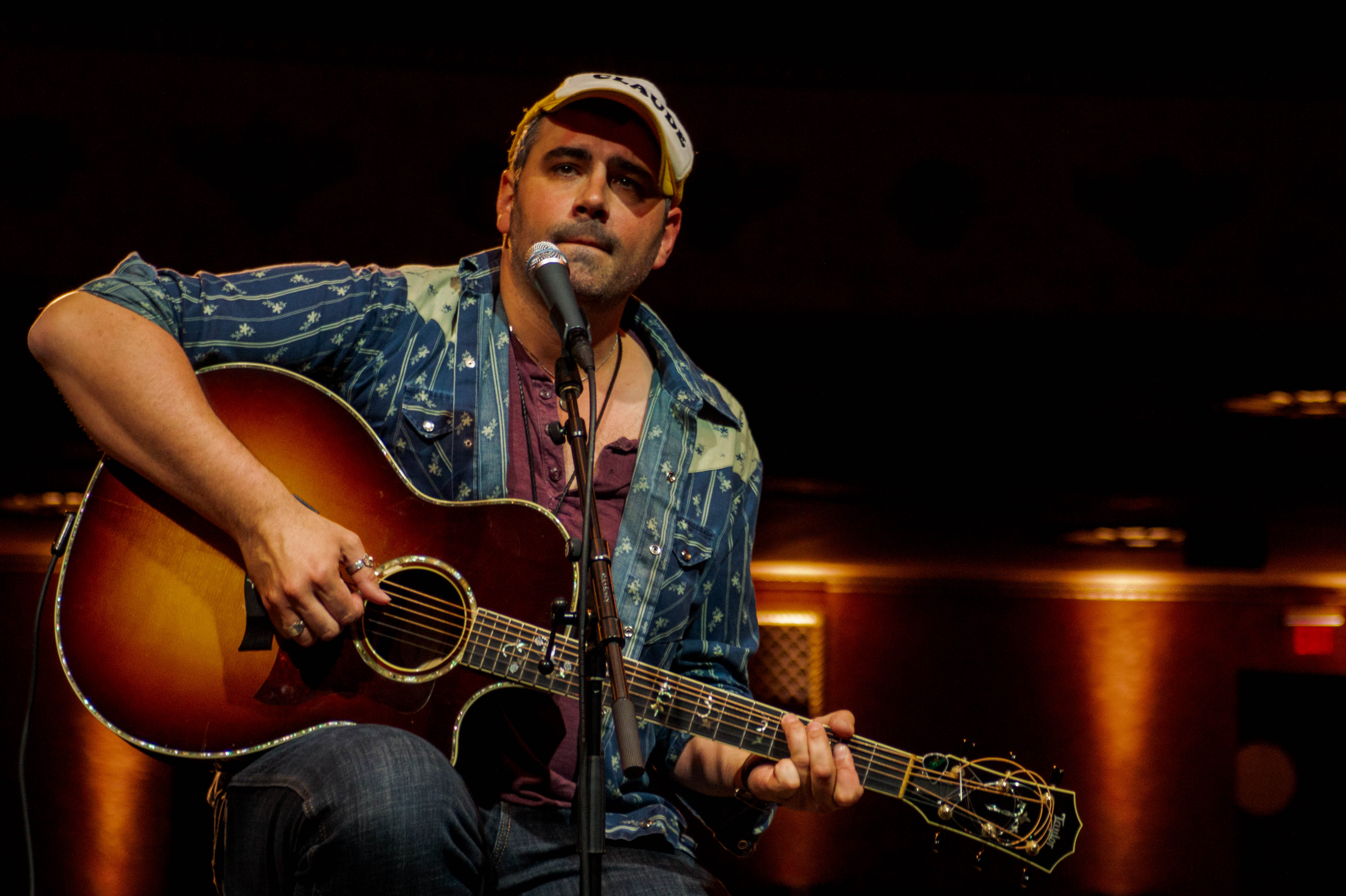
Singer/songwriter Lyal Strickland will be releasing his new live EP, Ghost Light at the Gillioz, on July 18th, 2025. The six-song EP marks “both a homecoming and a rebirth” for him. The live recording was made at the historic Gillioz Theatre in Springfield, Missouri where Strickland has performed through various stages of the theatre’s renovation, from bare floors to opening for headlining artists.
Strickland has previously released albums including Preservation and Balanced on Barbed Wire. For the live performances, fan favorites like “The Hotel Maid” and “O Arkansas” are reimagined in the historic space accompanied by a small intimate audience along with new songs.
Today, we’re very pleased to premier Strickland’s new live track “The Hotel Maid”, taken from Ghost Light at the Gillioz, which arrives this Friday, June 6th, 2025.
It’s easy to see from this song and this particular recording that Strickland is an artist who works via storytelling and a highly personal vocal delivery to paint a picture of life experiences which quickly draw the audience into an emotional connection. The song itself gives little prelude to the story Strickland’s conveying this time around, the situation of a family farm in foreclosure due to unpaid taxes. He makes brief, quick sketches of different scenarios and emotions, using visual details that will stick and a central idea that’s also visual–of digging oneself down into a very deep hole–to grab the attention. Something that’s also key is the idea of family and responsibility, something everyone can relate to, to illustrate the weight of the situation and the vulnerability of the narrator.
There’s a subtle sense that the narrator is the focal point of the trouble, since he says he’s the one who hasn’t paid the taxes, and his partner is working a manual labor job, therefore, because of him. It’s a web of interconnectedness that’s certainly emotionally true in the song whatever the legal details. He also reflects on the unpleasant self-knowledge, this “rock-bottom” state has brought to him when he starts a bar fight and sees himself as an aggressor. The bigger context is also part of this song, that of generational property, agricultural life, the idea of deciding whether to leave traditions behind or to uphold them. The narrator has a higher education he feels he doesn’t use, and still toys with the idea of leaving in order to be “free”, but there’s a ghostly suggestion of the “cost” that might entail. What would that be? Mainly loss of identity, loss of legacy, and of carrying a sense of failure forward in life, I’m guessing.
The song is very vocally driven, giving every pause and drawn-out syllable a special reflective and emotional quality geared toward the story Strickland’s telling. The instrumentation is minimal but poignant, coming in like extra voices, adding a little force or extra emotion here and there. The slow pace suggests how “stuck” the narrator is, between a hole they can’t climb out of and the bedrock under their feet. It’s a place of perspective, but also a place of desperation, of lowness that many of us fear, and some of us have faced in very direct terms. Strickland suggests through the song itself that there’s some importance in holding onto this story, though, in painting this picture of familiar anguish and contradiction. He wants resolution for himself, his partner, and his family property, but that seems impossible. He wants freedom, but that seems impossible too. What he gets instead is a kind of stripped-down knowledge of his own self and what remains during times of bleakness.
Strickland doesn’t resolve this story for the audience. He keeps them with the narrator in his conundrum, suggesting that this is a kind of enduring state happening to others in very similar, or even in different ways, all the time. The only appropriate response to this song is empathy, and maybe a sense of relief if you have been there yourself, and thankfully are not currently there.
Lyal Strickland says about the song:
I legitimately didn’t pay my taxes for a few years, and they will try to sell your farm on the courthouse steps. Times get hard and you’ve got to find the bottom to know what you’re actually made of.

On “Hotel Maid”, Lyal Strickland plays acoustic guitar and performs vocals, Thaddaeus Morton plays electric guitar, Headline Productions handled recording and engineering, and Jeff Smith at Studio 2100 handled mixing and mastering.
Ghost Light at the Gillioz is an album that shows Strickland’s own journey going through hard times and reclaiming a sense of personal truth. Songs from previous albums like “Misery and Mischief Prone” take on new meaning while new songs like “Gatherin’ Dust” speak to “the feeling of spinning your wheels in tumultuous times.”
