
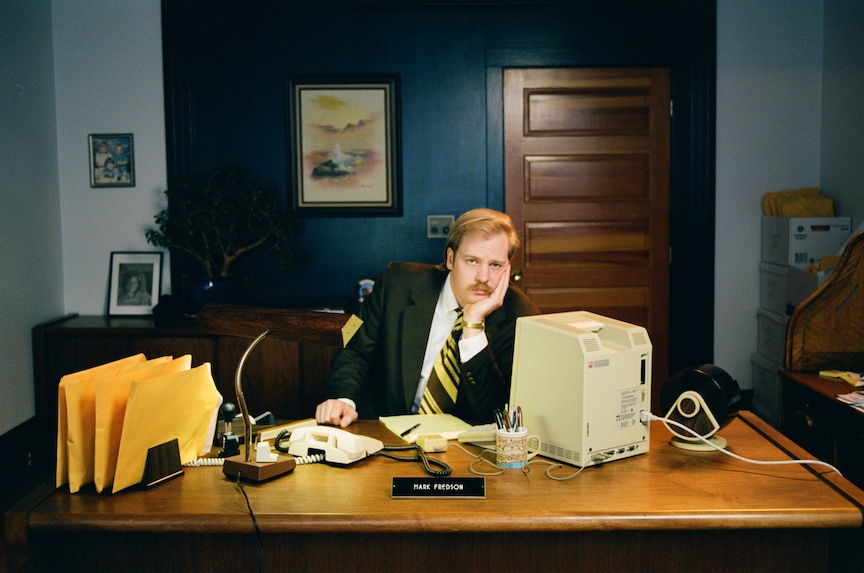
Originally from Washington state, Mark Fredson signed his first record deal in high school, and spent many years as a songwriter and performer in Nashville, along with beginning to release his own solo albums in 2020. Last year, he made the difficult decision to uproot his life and move home to Washington as the most pragmatic way to assess his creative life. Out of that upheaval came his newly released album, Company Man, which addresses getting older, looking at the “music industry” itself, and the struggle to survive in modern society.
Following solo albums Going to the Movies (2020), Nothing But Night (2021) and 2023’s Outskirts, Company Man builds on an even more Pop and synth-driven sound, often delivering airy layers of reflective instrumentation that couch the more somber lyrics of the album in deceptively sweet tones. Out of that gentle reflective space, however, Fredson has crafted some catharsis for big life changes, and for an over-the-shoulder look at his youthful days that stand in stark contrast to adjusted expectations.
I spoke with Mark Fredson about his move from Nashville, the widespread challenges that creative people face in order to work and share their work these days, and about the interesting contrasts which he builds into the songs on Company Man.

Hannah Means-Shannon: I know of quite a few musicians who have spent a lot of time in Nashville but have decided to now live elsewhere, as you have now. A lot of people who have a lot of professional credentials are having to be more independent now and sometimes that means choosing to live somewhere else that works for them.
Mark Fredson: Absolutely. A friend of mine, years ago, right as I was starting to release music under my own name, said, “You know, man, no one is ever going to care about your thing as much as you do.” It’s one of the truest things I’ve ever heard in my life, and it hit home so hard, it’s become like a mantra. I said, “You’re right.” If you want to express the sound that you hear in your head, and, for instance, making recorded music, you have to set those wheels in motion.
It’s not going to sound the way that you want it to sound unless you have your fingerprints all over it. You can kick it upstairs to musicians who understand the project, but you’re the director, you’re the engineer, you have to be the face, you have to be the promoter. For this album, I’ve even been spending a lot of time on the design element. I’ve even taught myself how to do photoshop, doing photos and videos. I’ve been learning how to make things look more vintage, giving things a little more of an 80s’ vibe. No one was going to do that stuff for me, and you have to be a jack of all trades. It’s been a lot of work!
HMS: It’s a huge amount of work. The album artwork is a very big statement. And making your own album can be a huge financial burden, too, and many artists resort to crowdfunding, and you can only trim things down by doing so much yourself. It’s kind of crazy what people have to go through now if they have a vision for something.
MF: The cost is high, in many ways. If I hadn’t done all this, maybe I’d have a home, but instead I wanted a discography! You have to kind of weigh it. At this point in my life, I kind of want both. I think I’m going to look back on my life and see that a really great representation of me and my life are these albums. I can look back and say “I did that. I feel like I was doing it for the right reasons, and these are pretty good!” That’s kind of what motivates me.
HMS: So much hard work comes from you on the creative side that it makes sense to dignify it all with making it the best it can be with all the other details. I understand doubling down.
MF: “Dignify it” is a good phrase. Sometimes it’s okay to go further.
HMS: I’ve seen a lot of memes and quotes lately from creative friends online saying that life is just not worth living unless there’s a create aspect. Sometimes I feel like you have to put that on the line, in a place of value. But maybe people are sharing memes like that because it’s so hard, right now, to hold onto creative endeavors due to financial and social pressures.
MF: It is. My girlfriend even said, “Making art these days is almost its own act of rebellion. They don’t want you to do it.”
HMS: From a purely machine-like and financially-driven model, creative work is seen as a waste of time.
MF: That sort of message is burrowed into my mind, too, especially when it comes to the music business where you’re seen as having a certain time-line in which you’re relevant. And as you get older, as more seasoned, and have more things to talk about, that’s when you’re time’s up. That’s been subtly, and even in a very forward way, crammed into our brains while consuming culture, especially American culture. You have to do mental gymnastics to justify creative work because of our conditioning. But I try to think in large terms, and a larger timeline.
HMS: Some types of music seem to value life experience and perspective more, side-stepping some, but not all, of that agism, like Americana music, for instance. Some Alt-Country and Bluegrass wants perspective on the stories that you’re telling.
MF: Yes. Jason Isbell’s basically aging like fine wine. In terms of mainstream genres, Country music has always allowed longer careers with chart-topping hits. The perspective changes, but it’s still valued. You don’t see that in Pop music. I don’t make Pop music, but I think in terms of that, because it’s a big umbrella.
HMS: The overlap between solo artists making their own music, and Pop, is very interesting because there are artists out there making music that is so idiosyncratic. It’s almost like singer/songwriter tradition, but the musical world is Pop.
MF: There’s a duality there, and it’s hard to frame when people ask me what my music is. I don’t have a team of songwriters making songs with me. It is me from front to back, but I am framing it, sonically, by laboring over Production. It does have a lot in common with Americana, and I have a lot of connection with Americana, since it’s kind of a catch-all for outcasts. [Laughs]
HMS: It is! In the early days of Punk, that’s what it was, too. These are umbrellas under which people can shelter.
MF: Everyone needs shelter.
HMS: I know some of these themes were on your mind while writing the songs on the album, and I feel like you made a choice to present the music in a fairly welcoming, warm way, because it can carry reflective, heavier themes.
MF: I think that’s one of my favorite things about juxtapositions in a song, where you have a light, airy, happy-sounding tune in a major key, like on the third song, “Expectations”, but where there’s literally a line that says, “You’re never going to be an astronaut.” It’s about hard conversations with yourself as you get older, and I remember thinking, “Should I throw in a little tinge of positivity at the end?” So I changed the end a little, but the rest of the song is about readjusting your expectations. It’s like “Dancing in the Dark” and a lot of my favorite Pop music, where you have dark lyrical elements with an approachable, Pop sound. I love it. I think that stuff’s delicious!
HMS: The biggest example of this, I think, on the album is “That’s That”, which has the buoyant music, but is about aspects of life that you’re rolling up. I think it’s relatable because everyone, at some point, seems to reach a point where a more youthful group of friends grow up enough that they have to start parting ways. Life just changes on you. And they stop hanging out together on the weekends.
MF: Maybe they stop drinking, and therefore their whole social life completely shifts because they don’t go out to bars anymore? That’s a big shift, too.
HMS: Sometimes people stop going to live music, too, which is a shame.
MF: We all put ourselves in more adult boxes at some point, and we start putting away things that brought us so much joy when we were younger. We feel like they are not for us, anymore. I do it, too, and it makes me sad. But I also realize that I do it, so I try to counteract it, too. But that song, specially, is about as autobiographical as the album gets. I think it was therapy for me. I needed to write that one.
There’s the line, “Pack it up and leave Tennessee”, and I wondered if I should get so specific. But it rhymed, and I decided to leave it in. I thought, “Let’s close this album out with a full bow-taking, and get out of town.” Because leaving a city that’s enmeshed in your identity is hard. It was such a big part of my life being there, and it was my whole world. I kind of wrote a whole album about it, but I also needed a specific song that spoke to my departure. That song still kind of hurts, listening to it, but in a good way. I’m very proud of it, but it’s definitely one of the most emotional tunes I’ve ever written.

HMS: I think that moving on from a place is sometimes necessary, creatively, even if a place has been formative. Sometimes that’s part of a new era of creativity. Some of these songs remind me of the idea that if you over-stay at the party, it doesn’t wind up being fun anymore, anyway. You’re giving away all your energy, but you’re not getting anything out of it.
MF: You’re absolutely right. It starts to feel a little silly. It’s not as cute as it was when you were in your twenties. Once it’s out of your system, you can take a look around from a fresh perspective.
HMS: Moving back to Washington State must have been a big shift. Does that have connections to music for you, or do you have to build new roads for yourself?
MF: I think about it all the time, but I haven’t really dipped my toe into local waters yet, to put myself out there to play. But I really do want to. It’s my favorite thing to do, to obsess over making albums, but there’s a flipside that’s about performing, where I get to be in the moment. I really, really love singing. I like to mess with the deliveries and melodies. I really do love performing, and I have a friend in Seattle who is part of a collective of a band called Country Lips and has been part of a bunch of Production companies. He’s been quite the proponent of easing me back into a creative path up here in the Pacific Northwest. We made a video for the title track. We’re playing a show in May in Seattle where I’m the opening set for their band. I think once I’m back on stage, I’ll get the itch again. It’s all about seasons for me, and it’s a lot easier when you’ve got new material.
I also have the seed of an album about my hometown, which is right on the edge of the world. It’s right on the tip of the Northern part of the Olympic peninsula, looking out at Canada. The Olympia mountains are right behind us. It’s just this strange little place that’s completely rich with all these crazy, kooky characters. There are also all these childhood stories that I can draw on, as well as the stories of friends and their parents. The history of the place is there, too. It’s an ambitious idea, but I’ve had it in my mind for a while, now, to make an album spotlighting the different personalities and communities, as well as the overall grit of this town. I really do think that it’s just brimming with a rich narrative landscape. I’ve got some things written already in my head. The sound might be driving, Rock-forward, but with a lot of synth elements.
