
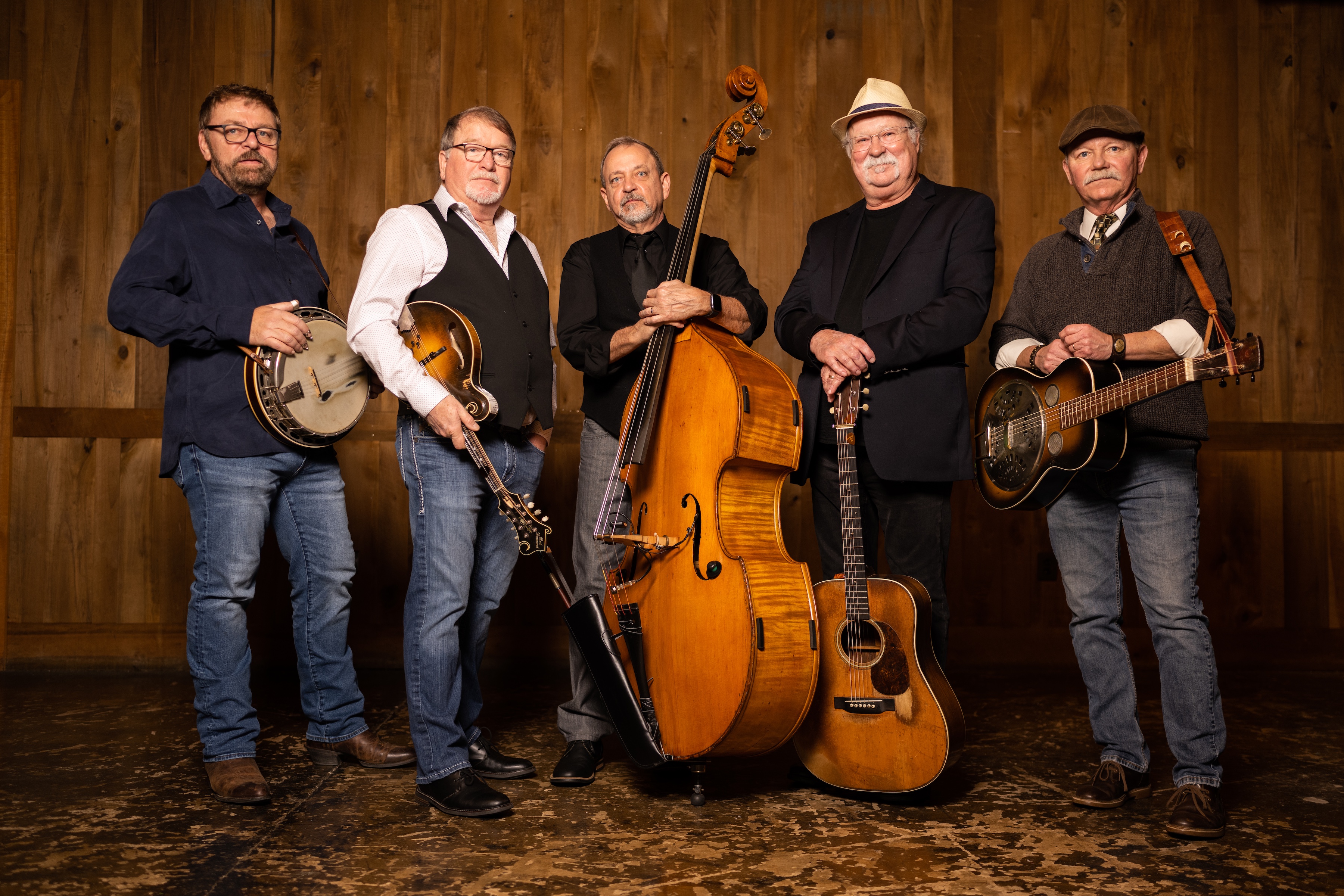
Northern Virginia-based experimental Bluegrass band The Seldom Scene has been going for 53 years and recently released their new album, Remains To Be Scene, via Smithsonian Folkways. It arrived in multiple formats, including on vinyl for the first time in many years. Always genre-pushing, The Seldom Scene have chosen several Classic Rock and seminal singer/songwriter tracks upon which to work their Bluegrass magic for their new album, including songs by The Kinks, Jim Croce, and Bob Dylan, as well as Flatt & Scruggs.
This marks the first album since founding member Ben Eldridge’s passing and will be their last with Dudley Connell on guitar, however Eldridge was able to review and provide feedback on the album’s progress, and even contributed liner notes to this collection of songs. The current lineup, who played a release show at The Birchmere and will continue to make live appearances this festival season, is comprised of mandolin player Lou Reid, bassist Ronnie Simpkins, banjoist and fiddler Ron Stewart, dobro player Fred Travers, and guitarist Dudley Connell, who was recently succeeded by Grammy award-winner Clay Hess.
Bassist Ronnie Simpkins, who has been with the band for nearly 30 years, took the time to talk with me about his time with The Seldom Scene, his recent retirement from working for Smithsonian Folkways, and putting together this energetic new album.

Hannah Means-Shannon: I’m a big fan of Bluegrass as well as of Classic Rock and singer/songwriter music, so I was really intrigued to see the songs that you all picked for this album, Remains To Be Scene. How did you choose the songs for this collection?
Ronnie Simpkins: It’s funny that you say that, because everDuff since the band was formed, back in 1971, that’s been true. Of course, I’m not an original member, but this New Year’s Eve, that will mark my 30th year. Me and the dobro player, Fred, and also the guy that just retired, Dudley, joined the band at the same time, on New Years’ eve 1995. Our first show was at the Birchmere!
But getting back to what you said about Rock music, the band has always thought outside of the box when picking material, and this last album, as you mentioned, does have some outside of the box songs that a normal Bluegrass band would probably not perform, much less record. The opening track is a song by The Kinks that they wrote and recorded back in the 1960s, “The Last of the Steam Powered Trains.” The Scene has always been known for their train songs, and this is a train song.
There are also two Bob Dylan tunes on this recording. One is “Walkin’ Down The Line.” There’s also “Farewell Angelina.” I think a few people have recorded those songs before. Our album was released on the Smithsonian Folkways label, and I’m proud to say that in addition to CD and digital download, you can order this album on vinyl. That’s kind of neat for us.
HMS: Is that the first time in recent days that you’ve released on vinyl?
Ronnie: Going back to the early days of the band, they had quite a few on vinyl. When I joined in 1995, we had a recording that came out, with original members John Duffey and Ben Eldridge, was only available on CD, Dream Scene. Since then, we’ve done four or five recordings that I’ve been a part of, and this will be the first one that’s available on vinyl since I’ve been in the band. Kind of funny how things go full circle!
HMS: It seems like this album would be particularly good to listen to on vinyl. Was that vinyl format something that affected how the music was recorded or mastered?
Ronnie: If we were smart, we may have thought about that, but not really. That’s something else that I should mention, that I’ve just retired from my day job, and my day job was with Smithsonian Folkways Recordings. It’s kind of bittersweet. I miss it!
HMS: Congratulations on that! But I understand how it might be hard to leave. I love Smithsonian Folkways and think the releases are so interesting and well presented.
Ronnie: Thank you. It actually ties into the band, too, because my first year of working at Folkways was actually almost the same time as my first year with the band, which was 1996. Now I have more time to put into the music part of my life.
HMS: What led up to you joining the band back then? Were you in a previous band before that?
Ronnie: I was fortunate enough that the area that I grew up in, Southwest Virginia, had a lot of Bluegrass and old timey music. My family played, and one thing led to another. I had just gotten off the road with Tony Rice. I had worked with him for almost ten years. I was living in Northern Virginia, where The Seldom Scene are based out of, and they were looking for a bass player, guitar player, and dobro player. I happened to get a phone call from John Duffey. That would have been the early part of ’95.
We just got together at his house, and it was like a weekly card game! [Laughs] Instead of cards, we played music. We just rehearsed and by New Years’ Eve, we were the last band to go on at The Birchmere. It was a night I won’t forget, that’s for sure! Because the original guys were there, and the current Seldom Scene, and us. The “up and coming” went on last. In short, that’s how it came about.
HMS: That little circumstances has affected your life so much, shaping your life for 30 years. What if you hadn’t gotten that call? It’s amazing.
Ronnie: It’s hard to believe. It’s been a lot longer than the original band ever imagined. Members have occasionally left, and, unfortunately, some have passed away. I had one year with John Duffey once I entered the band, and I wouldn’t trade anything for that. He passed. Lou Reid came back into the band as mandolin player, and he’s been with the group ever since. There’s been very little changeover in the band since I’ve been in the group. Since I’ve been in, Ben Eldridge retired about ten years ago. Unfortunately, he passed away about a year ago. Now, unfortunately, there’s only one original band member left, that’s Tom Gray. He’s in his early 80s, but the good news is that he will be joining us for an album release party coming up at the Birchmere!

HMS: I’m so glad. That’s such a great venue.
Ronnie: That’s been kind of a home-base for the band over the years, and the owner, who has now passed away, acknowledged that the band kind of built the Birchmere because that was kind of like their home for years. We still play there maybe four or five times a year. We feel real blessed to be able to showcase the album there.
HMS: Do you have other live performance plans?
Ronnie: We will be playing some Bluegrass festivals. It’s kind of part-time for the band. We’re not full-time road warriors! But that’s how the band got started, they all had professions, and they just played music on the side. That’s how they got their name, “Seldom Scene.”
HMS: I think the current music climate is even more that way. It’s very hard to have a career in music these days because there’s not much money to be made in selling music. A lot of people are part-time now. But there’s still amazing music being made and performed.
Ronnie: You’re so right, Hannah. There are only a few, select individuals who can make a full-time living, especially in this genre of music, Bluegrass. There are only so many Alison Krausses and Billy Strings. The original guys had day jobs that they did, and I’m so thankful that 30 years ago, I went that route, too. So I could have retirement, and insurance, and that kind of thing. The arts are really hard.
HMS: I’ve spoken to some of the experimental Bluegrass bands who are out there, and for a couple of them, they’ve managed to make a living, but only by constant, fairly extreme touring. Some of them are starting to have families and question that schedule, too, wondering if they can keep doing that.
Ronnie: That’s a big thing. I went through that. I have two grown daughters, and three grandkids now, and it was tough because I’d be on the road on the weekends working with the Tony Rice Unit, and I missed out on a lot of stuff with my daughters growing up, sporting events and birthday parties. That’s a good thing, getting some of that back, since I spend so much time with my grandkids now.
HMS: If you don’t mind me asking, what was your work at Smithsonian Folkways?
Ronnie: I worked with audio, so it was a great job. I worked with outside Producers, and engineers, on projects that they had. I pretty much managed the audio assets that would come in. There would be WAV files, high res, and I would manage and upload them to different services for marketing and Production in-house, and then send them off to different manufacturers for CD replication. Some projects, we have on vinyl, and that’s quite a few now.
In addition to that, I would do transfers from quarter-inch tape. During Covid, I was allowed to bring home equipment, so for the last five years, I’ve been working out of my basement. It’s been great, whereas before I would commute into the DC about an hour each way. Working with analog tape was a fantastic job. I’d play music on the weekends and work with audio during the week, so it was pretty much music non-stop.
HMS: I hear that Ben Eldridge was able to hear this particular collection before he passed away. Did he have any particular thoughts about it? I think he wrote the liner notes.
Ronnie: Yes, he did! We were able to, early on, take him roughs. I made him a CD for him to listen to, do he could critique it, and come up with thoughts, and he did! He liked it. He liked the whole selection. He felt that we were carrying on the tradition, and that meant a lot. He was very generous with his comments, and it meant a lot for all of us in the band. It’s something we’ll ever have.
HMS: How did you go about recording these songs? Do you think things fairly simple?
Ronnie: Whenever we go into the studio and record, they are brand-new songs that we haven’t really played. Maybe we’ve gotten together first for a rough arrangement, and sometimes not even that, and you just go in with a lyric sheet and notation with chord changes. For me, I just try to be as basic as I can, and stay out of everyone’s way. Usually, it’s later on that you get familiar with the songs and go back and say, “Oh, I wish I’d played this!” I think that’s true for any musician, and usually after you’ve played it live.
HMS: It sounds like that’s your foundation, really, for anything you might want to do live at a later time.
Ronnie: Right. In the studio, you’re just trying to play it correctly and in time.
HMS: None of these songs feel “by the book”. There’s a lot of energy to the songs and the performance. It doesn’t come off as being overly careful, for instance.
Ronnie: That’s good to hear! That’s a feeling that you’d normally have on stage, but you’re not as conscious of it in the studio because you’ve got headphones on, or you’re reading a lyric sheet.
HMS: It feels like you all really like these songs and really relate to them. That energy comes through. Maybe playing together, live, helps with that.
Ronnie: I think that you’re probably right. The five of us, plus our new guitarist, do have that feel. You can kind of read what’s in somebody’s thoughts, musically, like what they are going to do, or how they are going to attack a solo. Maybe that carries over with some of the new stuff, too.
