
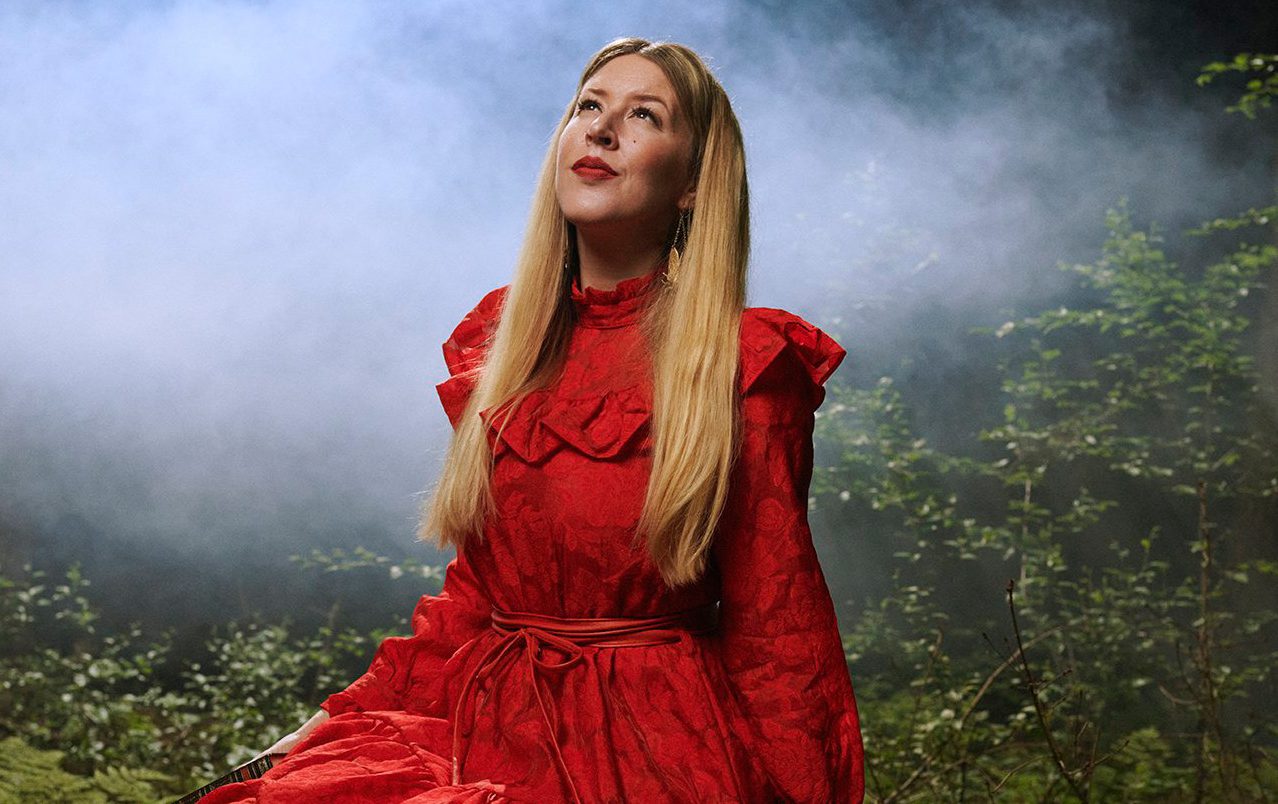
Gayle Skidmore is an artist best known for her songwriting and piano compositions, as well as for her live performance. Originally San Diego-based, she spent a period of time in The Netherlands before more recently returning to Southern California. Coinciding with some of those life-changes, and partly prompted by explorations during the quieter time of the pandemic, Skidmore found herself drawn to new revelations in her family history that linked her to a large-scale national tragedy that happened in 1876 known as “The Ashtabula River Railroad Disaster.” At the time of the disaster, the collapse of a railroad bridge during a terrible blizzard plunged 11 train cars into a ravine, killing most passengers, including Gayle Skidmore’s relative, the well-known hymn writer, Philip P. Bliss.
Researching this subject matter, and building upon her background as a classical pianist, Skidmore found herself writing a different kind of music, music that was both instrumental and classically-influenced, but also cinematic. Sharing her early compositions with a close community on Patreon actually encouraged Skidmore to follow her inspiration beyond a couple of songs, and into creating an entire album with a narrative aspect. Each dramatic track takes a different chapter of the wide-ranging story into account, a story that encompassed the passengers, but also the nearby town, and the people who were part of the tragedy as a hindrance or a help. Skidmore was drawn to the implicit beauty of some of the elements of the story, like the enchanting qualities of a winter snowstorm, and the heroic qualities of the townspeople, to allow her to address the poignancy of human loss of life and a nation’s reaction to a preventable tragedy. Her album, The Ashtabula River Railroad Disaster, arrived on April 4th, 2025.
I spoke with Gayle Skidmore about her journey into creating this album, The Ashtabula River Railroad Disaster, and the compelling story that inspired her to bring it to life through her music.

Hannah Means-Shannon: This album is quite a departure for you, I think, because it’s not only an album with a focused concept, but it’s entirely instrumental. It’s very brave. What made you ready to take these steps?
Gayle Skidmore: I’ve been doing commercial music for a number of years, working with my friend Brandon O’Connell. He and I also worked on a project for music licensing together, and I was A&R director for a few years. So I’ve done classically-influenced stuff for commercial work. I discovered, by doing that, how much I enjoyed that. Then I began to think about how much I might enjoy doing a whole album that way. Through Patreon, I became a lot more comfortable recording myself. I thought, “I could just do this!” After I’d put songs up on my Patreon, I began to think about them a little more and I was really able to digest them.
I got really into ancestry, as my Covid hobby. I got really into the story, and there was a lot to find, since there have been several books written about the event. Bliss is our family name, and it’s my dad’s middle name, and grandmother’s maiden name. Our family history goes way back. My grandmother was really interested in that, and I thought it was really strange that I’d never heard about this crazy story, since I’d heard about Phillip Bliss my whole life.

HMS: Wow, so you’d heard about him as an ancestor of yours, but you didn’t know about how he passed away in this disaster? That’s intense, but sad.
GS: Right. I was really shocked to find this story and all the crazy elements behind it, like the fire chief being an alcoholic, and just giving up, saying, “What’s the point of fighting the fire?” There were so many tragic elements. I was kind of in a dark place with it for a little bit. All of the contemporaneous writings at the time, from the newspaper articles, were very dramatic and full of emotion. I included some of that in the little book, with sheet music, and the story, that’s going to come out with the album.
HMS: That’s wonderful. Of course audiences need that, which will help them enter into the story more.
GS: I included little blurbs for each song, and also my own story, including why this was important to me.
HMS: I can understand the fascination with history. For me, the human element is very much the thing. And there’s so much here to work with. It is dark, but it’s not that the album sounds dark. Rather, you really had to allow yourself to feel all these things to come up with all these different musical vignettes.
GS: I’ve been through a lot of tragedy in my own life, so I guess reading about this one made sense to me. I’ve always felt connected to Phillip Bliss, because he was a songwriter, and I’m a songwriter. I had always felt like it was cool that I was related to a famous hymnwriter, and his hymns mean a lot to me, but like me, he also wrote music. He was special to me, but to find out about this tragedy made me feel even more connected to him, because I have also had a lot of loss in my own life. Going into the tragedy was heavy, but it felt familiar.
HMS: That reminds me of the idea behind catharsis, that you can follow the trail of a relatable experience, and maybe come out feeling a little different.
GS: Yes, definitely.
HMS: When I hear about your commercial work, it reminds me of how cinematic this music could potentially be. Were you thinking visually when you were telling these stories through music?
GS: Absolutely. There are definitely strong images that come to mine. There was a fire that broke out among the wooden train cars, where they had kerosene stoves and oil lanterns. There were gale force winds at the same time, so it was a raging fire. That’s very strong visual imagery. When writing the songs, I definitely imagined what had happened. There’s a movie in my head of how it looked. I saw a few of the sketches from the time, but the descriptions are very vivid. I actually found that there was a documentary about the railroad disaster that came out a few years ago, but I had just missed it!
HMS: Did getting so deeply into these different passengers’ lives make you wonder about the circumstances that affect our lives, wondering why each person happened to be there at that time?
GS: I always wonder about why things happen. I come from a certain viewpoint on that since I went to seminary, so I have a specific worldview, but I also, like everybody, question why this tragedy happened. But I try to look at it as, “What good came out of this?” A lot of good came out of it, because they had to look at how they were designing these bridges, and all of these different elements had to be addressed. There was a lot of heroism and beauty that came out of it, because the townspeople ended up fighting the fire. Then they also took people into their homes. It does make you think about human nature, though, since there was actually a lot of thievery that went on, and people were robbing victims! There were several accounts of looting! I think we always see that kind of thing.
HMS: Were there very many survivors?
GS: No, the majority of people perished. Because the numbers are so uncertain, it’s tough to say exactly.
HMS: For a song like “Among The Wreckage,” it made me wonder if there were people going through the wreckage, looking for survivors, and trying to help them.
GS: Yes, there were. People from the town came down, and since it’s in a steep ravine, they slid down the incline, instead of taking the steps. Some people brought axes to help break people out. It’s a grisly story. The death toll is only estimated because of how many bodies were severely charred.
HMS: Since you’re known for your singer/songwriter releases, did you think audiences would be surprised by this album being pretty different?
GS: In the end, you have to make decisions based on whether you’re doing things as an artist, or because you’re trying to make a living. It’s always going to be a little bit of both, because you’re putting them out there. I could sit in my living room playing these songs, and I’d be happy, but I decided to put them out there. I think I made a decision, as an artist, to do what I want. I’m independent for a reason. I want to put out music that I like, that I’m proud of, and that will survive me.
HMS: It’s great that you were able to make that work for you, to find the time and ability to write and record the music.
GS: I feel really grateful for the time and ability to do that. It was really a great challenge for me, too, to learn how to do some engineering on my own.
HMS: How did you think of the structure of the different songs, and the way in which that would tell the story. Did you let yourself write just based on inspiration, or was there a more methodical approach?
GS: I had to think about telling a story with this album, so it was definitely different than just writing about my life, and then putting the songs in order according to what made sense for the themes. This time, I had to think about the stories that I was trying to tell. Even with the songs that I wrote first, and had in mind, I had to think about, “How do these fit in, and what stories are they telling?” That was made clearer by writing my little stories about each song, so I could make them make sense to me, and flow as an album. I did do 11 songs, which is one for each of the 11 cars that fell into the ravine, so that’s why I picked 11.
HMS: What is liberating to work without lyrics this time? Maybe writing the little book is where the writing aspect was directed.
GS: I hadn’t thought about it like that, but maybe you’re right! I write so much that I don’t feel like I took a break. I continued to write other songs with lyrics in between this. It wasn’t like I went off by myself, and wrote an album. I did these songs between my regular writing.
HMS: Is performing these pieces live something that you’d like to do?
GS: I would love to do that, but as far as setting up an album release, I have a two-year-old right now! As far as doing a performance, I was a classical piano performance major in college for a year, then I switched. Back then, I was practicing eight to ten hours a day, and if I had a performance of this, that’s what I’d want to be doing. 11 songs is quite long for a performance. When I was performing these for the record, I would learn just one song, and then I would move on. Then I’d do the next one. It would take a while, though I’d like to do it.
You can also still check out our premier of Gayle Skidmore’s track, “The First Flakes of Snow” here on Wildfire Music + News!
