
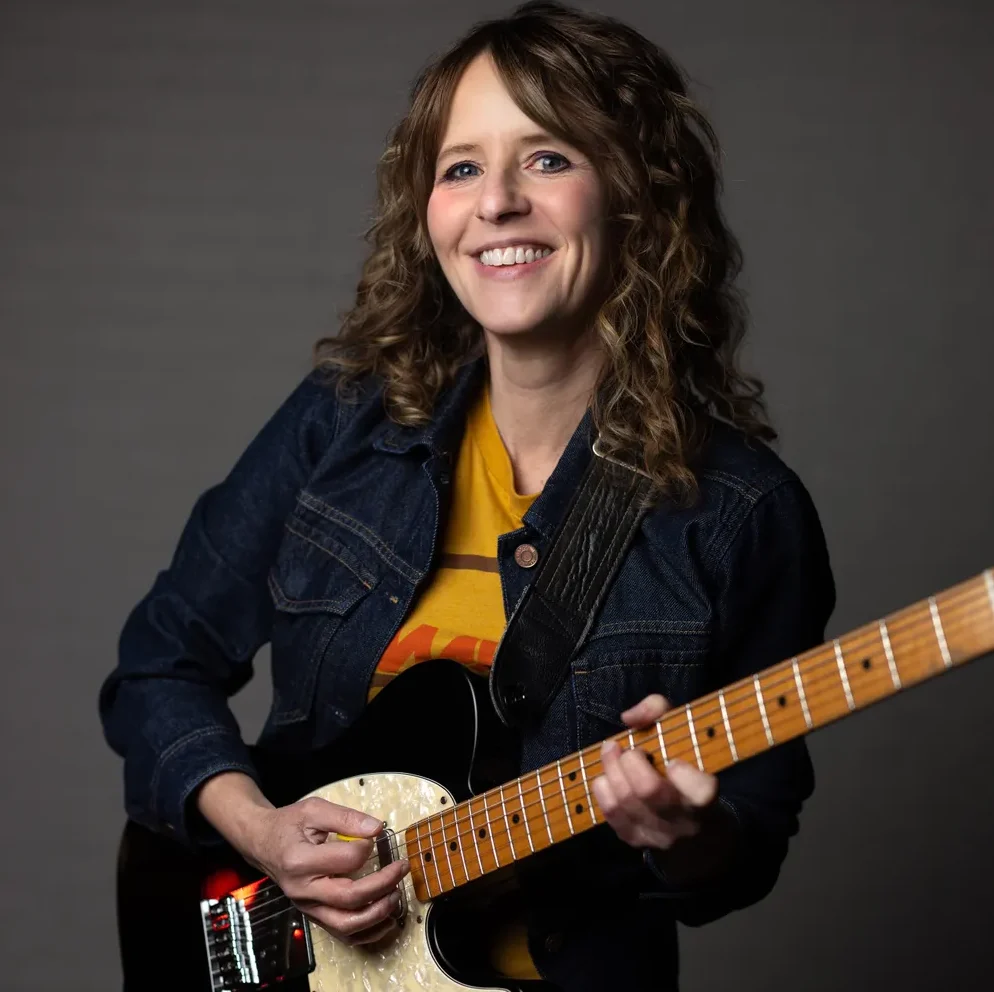
[Cover photo credit to Justina Lee Photography]
Singer/songwriter Nikki O’Neill offers a major development in her songwriting and sonic palette with new album, Stories I Only Tell My Friends, arriving today, on March 14th, 2024. Having made a big move from L.A. to Chicago during the period just before writing and recording this album, O’Neill had to put down new roots in the music community, both as a music teacher and as a perpetual student of her art. Chicago offered both for her, and this also coincided with a look back at the lessons she now gleans from the truths of her childhood and youth. Some of those ideas you’ll find reflected in the songs on the new album, and as the title suggests, there’s a confidential personal element to letting audiences in on her observations.
Nikki O’Neill is having a listening party for the album tonight in Chicago at Val’s halla Records and will play a record release show on April 1st, 2025 with her band at Colvin House in Chicago. I spoke with her about the move to Chicago, teaching in an exciting environment, learning from great songwriters, and deciding to look at the ups and downs of her international life as an opportunity for growth in order to counter a lot of the brokenness that we see in the world around us.

Hannah Means-Shannon: I understand that this album reflects much more your current life in Chicago, whereas you previously lived and worked in LA. Did that take some settling in after your move?
Nikki O’Neill: When it came to making an album, it was all new people, and that can be a little nerve-wracking. I think a lot of artists create a comfort zone with musicians who you’re used to playing with, Producers who you’re used to working with, and things like that. When it’s completely new, yes, it can be a bit scary. But I think it turned out way beyond my expectations, and was quite exciting.
There’s also the way that the songs were informed by this. They were informed both my music and things that I dove into when I first came to Chicago, and other elements. During lockdown, when there were no gigs, we all had different projects. One of the things that I did was dive into Sister Rosetta Tharpe. I looked into one of her solos and realized, “Wow! She’s got amazing Jazz chops.” Then, I started teaching a little bit at the Old Town School of Folk Music.
That’s an institution in Chicago where John Prine and people like that started out learning guitar. Then, it became a legendary institution for communal learning of music with workshops, classes, and a beautiful concert hall. That exposed me to a lot of Roots music. Of course, I also have my childhood memories of old Rock and Soul heroes who I’ve always been inspired by. All of that kind of trickled down into the album, and I allowed that to happen.
HMS: Did you feel like you were being more open to multiple genres than before because of all this?
NN: I knew that this sounded pretty eclectic. But with some of the albums I love, that’s true, like even with a Led Zeppelin album, which can contain Rock, Folk, and Arabic musical influences, but it still sounds like Led Zeppelin. It’s true to those musicians, that combination of people, so I allowed that to happen. It’s also a natural part of what I do. I’ve always blended Rock, Soul, Blues, and a little bit of Americana twang.
HMS: What sort of ages of students were you teaching at the Old Town School? Can you tell us more about that experience?
NN: It’s the biggest community art school in America. I think there’s about 300 to 500 classes going on every week! There’s a huge outreach program to veterans, and underserved communities. It has kids programs. It’s music and dance. I teach there one night a week in group classes for adults. Instead of music theory, when the school started in 1957, they’d bring over Blues masters. There’d be a hundred people sitting in a room and they wanted to learn to play this stuff. The musicians sitting in the center of the room are not necessarily instructors. They are often self-taught. How do you teach them how to play? They had their own way of teaching orally, in a community way, instead of using sheet music.
That tradition developed into something where after the classes, every day of the week, there’s something called “second half.” That’s basically that after you’ve taken your class, you have the option of going to a big strum and sing along. People from all levels gather in one room, and us teachers kind of lead. The school has its own songbook with classic songs, and all sorts of cool stuff, and we strum and sing. That happens every day of the week, and is free and open to the public. It’s a unique thing! I’ve taught in New York, in L.A., and Sweden, and I’ve never come across anything like that.
HMS: I noticed that some of the songs on the album reflect on stories from your life, and a lot of people over the past few years have been taking stock of their lives.
NN: I had people asking me if I was going to write songs about what was going on during the pandemic, and I just couldn’t do that. I felt like I couldn’t write about what was going on at the time, and needed time to step back. But now that you mention looking back at the past, when I moved to Chicago, it coincided with a period where I was doing some research on my dad’s side of the family. Two second cousins came out of the woodwork and told me some things about my dad and his side of the family that I had no clue about it. Maybe that played in. So much of that was brought to the front with a song like “Newcomer Blues” when I was writing it.
HMS: That song is really impressive. I’ve never heard anything like it. I was wondering why I was reacting to it so much, and I think part of it is that some people are more comfortable talking about their international roots than others. I’ve lived in several countries myself, so I found the perspective really relatable.
NN: I think constantly feeling like you’re caught between different scenes or cliques has been a theme in my life. I’ve kind of learned to embrace it. When I lived at home as a kid, I grew up in a trilingual household. I lived with my mom and my grandmother. My grandmother never really learned to speak the language in the USA. Then my mom met a new husband, and he was Swedish, and we moved there. All three of us were speaking Swedish, and English, and Polish, sometimes within the same conversation. You felt like you never quite belonged anywhere. When I got older, instead of being totally down about it, I realized that I got exposed to different ways of living. For instance, in Sweden, they have a higher standard of living than the US, and a better quality of life, some would argue. But in the US, there’s the American dream.
But I learned to pick up the great things about each place. And I now see myself as a world citizen, but some people haven’t had that experience. Some people just take on the same values as their parents, and it takes more life experience before they realize. I didn’t have that kind of connection through my family, so I created my own thoughts and values about things. I always wanted to address that somehow in songs, but it’s hard to do, because it’s such a big subject. Where do you begin? Sometimes when it’s a really big subject, it’s also easy for it to become very generic.
HMS: What keeps you motivated to write songs? Did you have a plan during the pandemic period for writing?
NN: There’s a songwriting workshop in Chicago with a great singer/songwriter, Steve Dawson. He’s from California originally, but he’s the Jackson Browne of the Midwest. He has a beautiful album out right now called Ghosts. He teaches these songwriting workshops, which are not for beginners. His workshops are eight weeks long and are for people who have been writing for a while. He gives you prompts every week, and they could be lyric-related, or about rhythm, or melody, or harmony, and you have to write a complete song every week, and perform it for the class. At first, people chicken out, but you can’t do that. It was great for me, because it brought songwriting to the forefront, especially after a cross-country move. It would have been easy for songwriting to end up on the back-burner, but just being in that community with other great writers was wonderful.
His prompts helped me to break out of certain ruts when it came to writing, and break away from certain approaches. Some prompts helped me to write “Newcomer Blues.” In that song, I talk about not fitting in, and sometimes being mad about it, or about patriotism, but there are mixed feelings. It felt really good to be able to fit all that into one song. I had previously taken a memoir class and tried to write essays on the same subject, and it was very emotional. I had to really sit with those details, going deep into memories, and that was kind of depressing. I’ve done a lot of writing, and I’ve been a freelance journalist in the past, but I love music, because there’s the side of using melody and harmony. For me, that’s the happier side. With “Newcomer Blues,” I was able to take on a subject that can be very big, and it felt therapeutic and fun.
HMS: Absolutely, and I feel that when I hear the song. A phrase that stood out to me was, “My fate was in my hands.” There’s the idea of whether we get to determine our own future. It does say in the song that you didn’t get to choose originally.
NN: Yes, when you’re a kid, you don’t get to choose, initially. It’s a little bit of a choice to transcend the cards that you were delt when you were a kid. I talk a little bit about that on another song on the album, “If I Got The Upper Hand.”
HMS: Yes, I noticed that idea.
NN: There’s somebody who told me, “There’s a lot of broken children walking around in adult bodies.” And that’s absolutely true. How do people deal with their childhood? Some people want to seek revenge, and show the world that they’ll be super-successful, or they want to be super-powerful and step on people along the way. I was thinking about that, and I had experiences growing up in school where I was being excluded and left-out because I was not from there. What do you do with that when you’re an adult? Do you try to transcend that? Do you try to build a different life? Or do you continue to be that wounded person that is going to seek revenge, and get even? Those two songs have a kind of connection that I hadn’t thought about.
HMS: I like how “If I Got The Upper Hand” is very even, with a calm tone, and a consideration of things. It’s not an angry song, but it deals with heavy things. The choral vocals really add to that, and the emotions really build up. I appreciate the intensity of that song.
NN: That’s probably my personality! I’m very calm. I remember, when I was a kid, I grew up with certain teachers, and they were not very empathetic, or rather oblivious. They didn’t seem to notice if someone was bullied or thought kids were making stuff up. I never became a classroom teacher, but I’ve taught a lot of kids from different backgrounds, giving guitar lessons. I try to be a good adult role-model. Even if I only see this kid once a week, I want to show them that I’m an adult who’s not messed up. That’s why there’s a verse at the end of the song where I’m looking at my class, and I am the teacher now. I’m looking at them and hoping that they become empathetic.
