
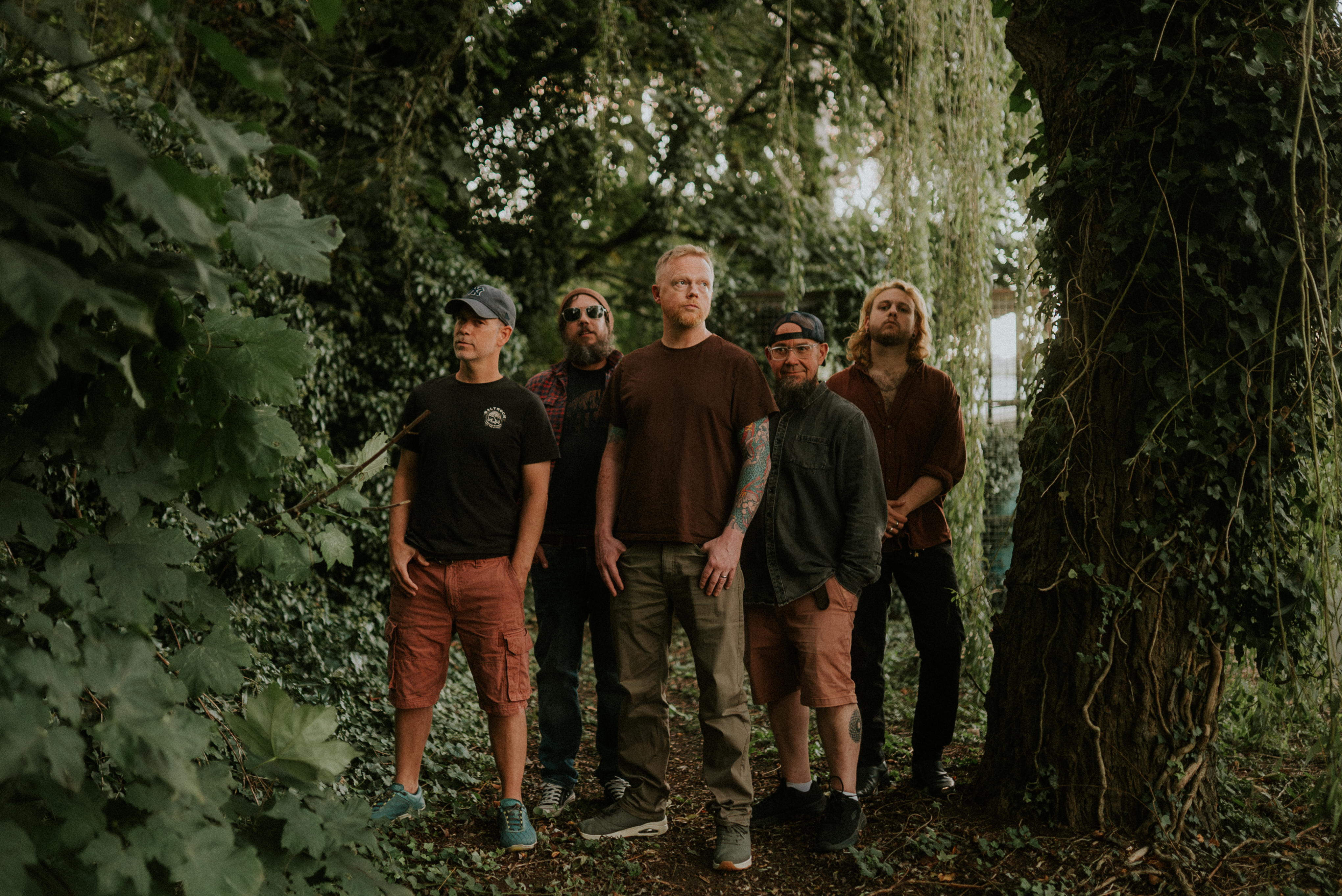
Rock five-piece band Sergeant Thunderhoof released their fifth studio album The Ghost of Badon Hill in late 2024 via Pale Wizard Records. It marks the follow up to 2022’s This Sceptred Veil. As these titles might suggest, they’ve recently been particularly interested in medieval themes, since The Ghost of Badon Hill reveals real-world history and mythology associated with the band’s native Somerset, UK, where in the 4th century, a pivotal battle took place associated with King Arthur. Sonically, it blends heavy elements hailing from the band’s two guitarists, bassist, and drummer with powerful vocals that set the scene and bring dramatic flair to their storytelling.
It was recorded with Josh Gallop, who’s now a member of the band at Stage 2 Studios in Bath and mastered by Tony Reed (Mos Generator). Daniel Flitcroft handles vocals, Mark Sayer plays guitar alongside Josh Gallup, Jim Camp plays bass, and Darren Ashman plays drums. The group has been together for over ten years, but many have known each other via bands for up to 25 years, making for a grounded relationship that can handle the real-world challenges of being indie musicians. I spoke with drummer Darren Ashman about their approach to The Ghost of Badon Hill, what he thinks contributes to their longevity as a band, and the fact that they are playing their first ever US-based show this weekend at Planet Desert Weekend in Las Vegas.

Hannah Means-Shannon: Talking now, just before the holidays, I feel like we can connect with the medieval experience of the darkest time of the year, with the solstice coming up, and the way that thinking affected music and patterns of life.
Darren Ashman: I don’t want to speak for Dan, who’s the vocalist, and I’m just the lowly drummer, but he was thinking back to a lot of those medieval times on the last album, and these historical times affect this album, which is about The Battle of Badon Hill.
HMS: I’m really pleased that I got a chance to hear this album because I really love medieval connections in music, and also heavier music. I think it’s a beautiful album and I’m very interested by the way that you approached it and what plans you have for taking it to live performance.
DA: I think our live performance has changed a little bit these days, certainly with the introduction of Josh Gallop to the lineup. We’ve been working with him for years, producing our albums, and he’s always been like a fifth member of the band. He became available, though he was in another successful band, and we managed to snag him before anyone else did. I think he has added a bit of a different vibe to some of the songs.
There’s a bit more ambience to them, and live, he’s bringing more of that ambience with him, not only in the guitar work that he’s doing. He plays very differently than Mark [Sayer], which is great, because they seem to occupy different parts of the spectrum. He also brings atmospheric keyboard samples that bring a different dynamic to our live sound. The five of us get on really well and there’s a good dynamic on stage. We’re breaking out some of the new songs, and we recently did a mini-tour.
HMS: With this album, was this the first time that you really built songs around having two guitarists, then?
DA: I wouldn’t say that, because with Terra Solus and This Sceptred Veil, we do layer the guitars. We used to think that we couldn’t layer the guitars too much because we wouldn’t be able to do it live. That was on our minds in the early days. But with Sceptred Veil, we thought, “Let’s just write for the album and figure out what’s best.” However, with this album, we certainly noticed when there were two guitarists and thought they sounded great live.
HMS: I find it really interesting how experimental you guys are, moving between Metal elements and Prog Rock, but really there’s far more built in there in the service of the songs.
DA: My favorite bands are bands that do all sorts of things, like Faith No More, Smashing Pumpkins, bands that don’t just play one kind of music, but release a different version of themselves with every album. I’ve always loved that. I’ve always hoped that we could do a similar thing. I’ve hoped that you could pick up one of our albums, and it would sound very different from another one of our albums.

HMS: You’ve just passed the ten-year mark together, right? That’s been a lot of time to explore.
DA: It’s been just over 11 years, I think. We were never really serious when we started out. Although we’ve been together in this band for 11 years, I’ve been in bands with Dan and Jim for coming up to 25 years. This band was just us I’d been jamming with Jim for a couple of years since our old band split up, and I think Dan just said, “Wouldn’t it be cool if we just got together and started jamming with me, you, and Jim. And maybe Mark?”
We had no idea what to expect from Mark. We knew he was in a covers band, but we had no idea that he was a damn good guitarist. I think we started writing our first song with that first jam, and within about a half hour, we realized, “We think we’ve got something here. Let’s just see where this takes us.” We came up with five or six tracks, within six months or so, recorded it and released it. We weren’t really gigging, so we released it, and got some gigs off of that. Then we had to come up with a band and take it from there.
HMS: What do you think that first session together offered you that your other band experiences weren’t providing for you, since you all had other connections at the time?
DA: That EP became the EP/album Ziggurat. Me and Jim were coming from Rock and Doom Rock, Mark and Dan not so much, so what we were doing was a mix. It had all the heavy vibes that we loved, but Dan’s vocals had a little bit of extra depth to them. Aside from the music, the thing that drew me to this band, and why I think we’re still together, is that we’re mates. Above the music, we’re good friends. I think that’s most important. If you try to be in a band with people you don’t get on with, it’s just going to be a disaster. You see so many bands split up because there’s someone in the band that they just can’t stand.
HMS: And the time before breaking up is often a lot of suffering trying not to break up! I’ve known bands who make great efforts to stay together, but there if there’s something undermining it, it can be rough.
DA: I think a lot of bands probably tour too much. They probably play too many shows. They probably invest too much money and don’t get a lot of return. Whereas we’re quite lucky. We play a good number of shows, but not too many. We all have priorities at home with our families. We can’t just take off and tour Europe for six months, as much fun as that would be. We’ve also been quite lucky in the way that we’ve done things. Our first three or four albums were crowd-funded as well. We didn’t lose out financially and haven’t had that stress. We try to keep things as chilled out as possible. If we’re ever offered something that’s going to put stress on one or more of the band members, we just turn it down.
HMS: What can you tell me about how you recorded this album in comparison to your previous ones?
DA: I think very often in this album, we had most of the parts of the song down, but there’s just been one thing missing. The way we recorded it was to come back to it, time and time again, in the studio, and then going away and listening to it, and coming back to the studio. We’d think, “Okay, now we need to add this.”
So if it was missing a chorus, we’d focus on writing that. We’d do that in the studio, maybe come up with some piano melodies, and quickly put those into the song. We’d do that rather than spending four hours getting everyone to learn the parts only to realize that it doesn’t really work. [Laughs] Doing things that way has enabled us to write this album in what was actually a really short time scale. To be honest, it’s the easiest album that we’ve written. I think the rest of band would agree to that.

HMS: I was wondering that since I know that your last record had a big scale and took a while as being quite long. I think for this one, you had to be quite strict with yourselves to get it onto one vinyl LP. Is that right?
DA: There’s a bit of history there, since on the album Terra Solus, we had all the songs, bar one, written, learned, and practiced before we went into the studio, which is how most bands do it who don’t have access to studios for long periods of time. It was quite intense, and I’m very proud of it, but it probably took us a couple of years to write that one.
It was just before that we had been writing, but found that we couldn’t get into a room to jam anymore and had to limit the time that we could spend together. We had half songs, riffs, and bits and pieces that we’d recorded. Then, one or two members would go into the studio and lay down guide tracks, guitars, and vocal melody. We started piecing things together like that, and we realized that songs came together really quickly. Before we knew it, we had our longest album. Then, for The Battle of Badon Hill, we adopted the same process because it had ended up working. It was kind of a happy accident. We’re very lucky because we have access to a studio, and we can go in and work on tracks in a piecemeal process. Then the final part of the process is to go in and lay down the final version of the songs. I’d then come in and lay down live drums.

HMS: I was wondering about that, whether you were the first person in that room. Did you have a particular philosophy this time around?
DA: My approach with this album was actually to do as little as possible. There are parts on the album where, instead of adding more in, I’d take it away, to have a minimalist approach. Because I think there’s enough going on on the album. There’s enough emotion, enough gravitas, and it doesn’t need someone playing drum fills and chops all over it. That was my approach. I was really enjoying the fact that I could just focus on a groove and try to make it feel good. I’m past the stage now where I’m trying to show off what I can do! I’ve never been that kind of drummer anyway, but I don’t even try to be that kind of drummer anymore. I just do what I can to play what’s right for the song.
HMS: It does sound like your approach is about the needs of the song. On the opening track, “Badon”, I noticed that when the drums come in, they sound almost military. But it’s very old school military, which is very minimal. But it makes an impression! It’s very clear and creates the bedrock for the song.
DA: I think that was actually Josh [Gallup’s] idea. He kind of programmed some rudimentary marching drums. I said, “I’ve never played anything like that. I don’t know if I can do that.”
HMS: I’m not surprised!
DA: But I took it away, and I thought, “This could be really cool. It adds to the atmosphere of the track as well.” The military drums are like a call to battle, like it’s taking place on the battlefield. I got to play one of my drums which was more suited to it, which is a vintage thing, and managed to get that sound out of it. It turned out well to try out something that I’d never done before in the studio.
HMS: I noticed that you had a gig coming up in Las Vegas. What’s that about?
DA: We have a gig playing at Planet Desert Rock Weekend in Las Vegas at the end of January. We are super-stoked about that. That’s actually going to be our first show playing in the US. We’re playing with some familiar faces. We’re playing with Valley of the Sun, who we played with last year. It’ll be great to go over there and see some people who we’ve been interacting with over the years who have been saying, “Come to the US!” Even if we played every state, we couldn’t reach every fan. That’s a lot to cover!

