
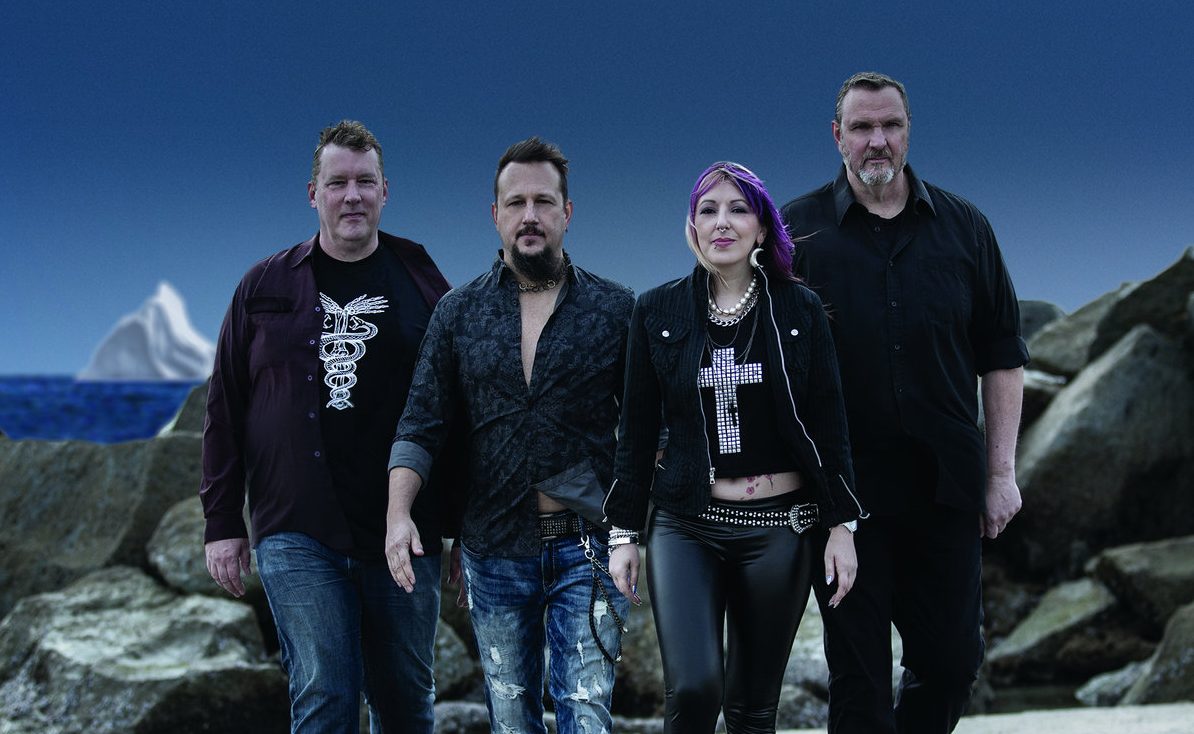
Los Angeles-based Hard Rock, Prog Rock, and Metal band Final Gravity released their new EP, Stormchaser, in late 2024, working with Producer Rich Mouser (Dream Theater, Weezer, Tears for Fears, Transatlantic, Spock’s Beard) for the first time, and building a more layered sound than they had with their past work. Consisting of guitarist Mike Clark, bassist Charles Mumford, drummer John Chominsky and vocalist Melissa Jane Lightning, Final Gravity has previously opened for touring acts including Fates Warning, Zebra, Gary Hoey and Iron Butterfly.
The songs on the Stormchaser EP each bring something a little sonically different to the table, and the EP actually ended up becoming more expansive than originally planned as Mouser helped the band complete songs that were in progress and weave them together into this collection. Many of the songs have emotive and, at times, vulnerable lyrics regarding struggle, agency, and overcoming adversity, while others take on semi-mythological and science fiction themes that stay grounded in emotional terrain. I spoke with guitarist Mike Clark about what led up to the songs on Stormchaser and the ways in which this process has inspired their future plans.

Hannah Means-Shannon: There are a lot of interesting things on your EP both thematically and musically. It’s really obvious that all of the band have had a lot of experience creating music and working together. What’s the timeline for this batch of songs? How far back do they go?
Mike Clark: Originally, we were planning to do a four song EP, and we were going to take a bunch of older material and kind of whip it into shape, get it recorded, and release it. So two of the songs on this EP actually date back to the 90s. The closing song, “Planet Earth”, is one that I wrote way back when. I imagined it as a Yes-style Progressive Rock song, but this time we recorded it by starting off as acoustic, then layering keyboards and vocals on. In the end, it didn’t sound that different than how I’d originally imagined it! When I wrote it, it was when a lot of environmental concerns and climate change were starting to come into the news. It’s interesting to record that song, and see that a lot of what we were worried about has come to pass.
Then “Automatic Pilot” is one that our drummer, John, had primarily co-written with a keyboard player friend of ours. We basically had done a demo of it in the 90s, and didn’t really do anything with it. Then John brought it back, and we changed the key and arrangement, and that has made it a little more modern, but it still has a foot planted firmly in the 80s/90s sound.
We also have the song “Far Away” which was totally different originally, and I think was from the mid-2000s. It was one of those songs that was 70% there, and had a lot of potential, but never completely gelled. So we worked on that one for a while. What’s interesting for the Stormchaser EP, overall, is that it’s the first time that we’ve actually hired a Producer. He worked with Rich Mouser who has Produced side-projects for Dream Theater and Spock’s Beard. He mixed a band called Transatlantic, who I’m really into. So we hired Rich to Produce the EP, and when we took that song in there, we basically had a pre-Production session with him. He made a lot of suggestions, including adding a pre-chorus from another song. We added more parts and the massive echo at the end were crafted with Rich. It took shape with him.
The newest track is the opening one, called “The Deep”. We had originally thought the EP would be all older material, but when we worked with Rich, he asked if we had anything new. He worked with us quite a bit to hone it and craft it. I think our demo was about 6 ½ minutes long, and he basically turned it into one of our shortest songs ever! I think it’s three or three and a half minutes long.
HMS: Since you’re talking about “The Deep”, I do think that song is really important for the EP. I feel like it pulls together different elements I hear on the EP and works well as an opener, also as a kind of introduction to who you all are. I am interested in the imagery in “The Deep” because it seems to draw on a lot of mythologies and stories.
MC: For that one, the lyrics on it were mainly written by Melissa Jane, our singer. Melissa, particularly in the last few years, has been really into spirituality, and healing, and that kind of thing. I think for “The Deep”, one of the themes is about being asleep, or not having your eyes open to potential or possibilities of the world. So I think one of the themes there is about waking up to ways that you can actualize yourself.
HMS: Yes, I can see that. There are different sonic approaches that you could take with the song, and you decided to make it feel rather triumphant. It’s not doom and gloom at all. I think that follows the line “now my soul is free.” It reaches that emotional arc with a rising sound.
MC: Absolutely. I think that’s where Rich really helped us. We had a lot of ideas for the songs on Stormchaser in the original demos that we did, but I think he helped us make it all a little more in-your-face, and aggressive musically, which translates to being a little more triumphant, as you put it.
HMS: When you play live, you all try to reproduce the recordings, or do you allow yourselves to modify the songs?
MC: When we get out there, so far we’re just playing as a four-piece Rock band. We’re not doing any keyboards for the tracks. I think it’s gone over really well, but we are kind of planning next year to add foot pedals and get a little more layering going on. I may increase the backup vocals I’m doing. One thing that Rich did was help to add a lot of layers to our recording, so that it sounds very full.
When you look back at the band Queen in the 70s and 80s, they would do super-layered stuff, with 32 tracks of vocals on the album, then they’d go out and perform as a four-piece Rock band. You can be equally good at those things in different ways. So we’re proud of our ability to create something that’s well-Produced and still be able to get out there and play it live, and still get a good response.
HMS: I want to comment on the song “Far Away”, but first I just want to say that it’s refreshing to hear that you don’t throw away your older songs. Some people act like it has to be written yesterday, or it’s not relevant, and I don’t necessarily agree with that. I think we should value inspiration and allow things to change over time.
MC: Thank you. We do have a bunch of newer material that we’re working on, and what’s interesting is that before we worked on the EP, we were doing that. We’re hoping to put that towards a new album, probably in late 2025. But there’s a quote I’ve heard attributed to Eddie Van Halen, “If it sounds good, it is good.” To me, if I wrote it yesterday, or 20 years ago, if it sounds good, it’s still good. I do think there’s something to be said for moving forward, but I also think things should be evaluated on their quality.
HMS: Somewhere in there, there’s probably a middle ground, where you can ask, “Does this speak to me right now? Is there something here that makes me want to record or play this?” If it does, that’s it.
MC: Actually with “Far Away”, the little pre-chorus bit on the old demo has now become the chorus, and is completely different, but is musically inspired by what we had written before.
HMS: One of the cool things about that song is that it’s distinctive on the EP for having that more confessional feel, a softer feel, that takes things down to a more personal level. It feels like an internal drama is playing out. A lot of the lyrics feel relatable, too, with that sense of being isolated.
MC: You mentioned that some of the songs are more upbeat, and I think “Far Away” is about a difficult situation, but also about being empowered, and breaking out of it. It’s about saying, “I’m not going to put up with this anymore.”
HMS: I think some of these songs admit a degree of vulnerability and that can be very useful for connecting with audiences. A lot of Rock bands try to be very tough, with a lot of swagger, but I see a different approach here.
MC: It’s funny, now that you mention it, I’m trying to think back to see if any song I’ve written had that, “I’m tough!”, feel to it. I guess that I’m a little bit more cerebral, sometimes a little more emotional in terms of what I’m writing about. With the new EP, Melissa wrote the lyrics for four of the six tracks, so that brings a different perspective, too.
HMS: I’m also interested in the song, “The Story of Forever”, which has a more ballad or Folk feel to it. That’s another sonic variation.
MC: That actually started off as something from when we used to rehearse in our drummer’s garage and hang out afterwards. We had a night where our original vocalist had to leave early, and Charles, John, and I were just jamming in the garage and recording. We were doing a Progressive Metal type jam, doing chromatic guitar licks, and trying to be a little more complex.
That’s another one of the ones that took over to Rich Mouser and he worked with us to change quite a few things. Those little licks became instrumental breakdowns with a synth bass. It was interesting how it turned into a new thing, with an acoustic middle part, which I could see it as being a little folky, but also being a little bit like early Rush. There’s some funky and grooving elements that are very different from where it started.
HMS: I think the song “Planet Earth” also has a little bit of a ballad feel, though it incorporates acoustic and electric elements. It’s like the “ballad of the world-leavers.”
MC: The movie Interstellar by Christopher Nolan was re-released in IMAX recently and I took my son to see it in Hollywood. That movie came out after I’d written the song that has similar themes, where they have the blight of the crops, and the planet becoming uninhabitable. Then the movie Wall-E is like the transport taking people away from planet earth. It’s colonization to save the human race.
HMS: The song feels very visual, possibly because of the emotion tied to the images.
MC: It was meant to be a tragic story, having to leave our planet, but it is also hopeful in the sense that some people got away and are going to make the effort to build another world. It’s a hopeful song with sad origins to it.
HMS: Maybe it suggests some resilience from human beings, but I also think it shows that humans can reflect on their mistakes. That’s what the solemn feeling comes from.
MC: It’s the resilience of human beings, and the desire not to give up, but it’s about responsibility. I don’t think any human being wants the world to collapse, but certainly we give that assistance. The collective becomes dysfunctional and we don’t respond to the alarms that are blaring.
HMS: That’s a good point. Most people I know have some sense of caring about the environment. But there can be a sense of, “There’s nothing I can do about it. What can I do?” And that becomes overwhelming. I wanted to ask also about your approach to song length. You don’t go for the three-minute song!
MC: I may be a little guilty of making songs longer and then we cut them down a little bit. But our attitude is that the songs are as long they need to be, and if I have a great idea for a musical part, I’d rather it be there, and have a six-minute song, than chop it up and have it be a five minute song.
HMS: You’re the last bastion! The general trend is to make songs shorter, and shorter, and shorter.
MC: One of the reasons that I wanted to work with Rich Mouser is that he mixed the album SMPT:e by Transatlantic, which has some Prog Rock superstars in there, and it was the first album I’d ever heard by them. I was at a point where I was not playing music a lot, and the album inspired me to get back into it. This was actually before we formed Final Gravity. The opening track on the album is 30 minutes long! That’s a lot of what I go for.
HMS: At that point, it needs to be on vinyl and be one whole side!
MC: Definitely.
