
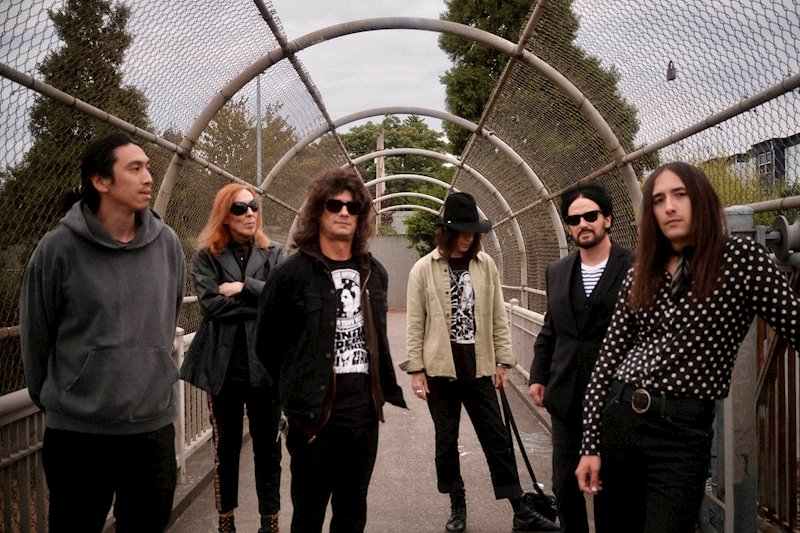
Portland, Oregon-based band Sun Atoms is made up of a pack of uber talented people who have their hands in multiple projects, including vocalist Jsun Atoms (The Upsidedown, Daydream Machine), Producer and bassist Peter G. Holmström (The Dandy Warhols, Pete International Airport), multi-instrumentalist June Kang, saxophonist, trumpeter, and guitarist Mars de Ponte (LoveBomb Go-Go), drummer Eric Rubalcava, and guitarist Derek Spencer Longoria-Gomez (Hi Hazel). Their latest album, Everything Forever, was released in November via Little Cloud Records, and includes guests from Modest Mouse, The Vandelles, and more.
Blending Psychedelic and Dark Wave elements with their varied interests and tastes to create these new songs, Sun Atoms also worked with UK-based powerhouse Jagz (Massive Attack, Primal Scream, Oasis) on mixing at his Stone Circles Studios and had the album mastered by Keith Tenniswood (Spiritualized, Death in Vegas) at Curve Pusher UK. I spoke with Jsun Atoms about the group’s sophomore album and the ways in which some of the songs came together. The band’s openness to being in the moment made for an adventurous approach that brings a compelling energy to Everything Forever.

HMS: I saw that you had been out playing a lot in 2024. Did that affect how you recorded your album at all, or were you all wrapped on the album before that?
Jsun: We did a couple shows this year with Modest Mouse, and we hadn’t finished the album yet. It was the first time for us doing a song called “Bus Stop Gospel.” That song has a lot of horn parts, and our first time doing it was on this amazing stage at Revolution Hall opening for Modest Mouse. I think having to learn it for that show really helped us get it ready for the album.
HMS: Are your songs really locked into format before you perform them live?
Jsun: For that particular song, it’s really structured, so, yes. The other really cool thing that happened with that song was that we played with a band from Los Angeles called Tremors, who’s also on our record label, Little Cloud Records. Their singer, Lauren, sings on the album with us, and so when we toured and played in LA, she sang it with us at The Morroccan Lounge. That was really fun. We have a show coming up where Tremors is the opening band, and she’s going to join us for that.
HMS: You’re a big band. It’s rare to have so many people in a band these days, but it makes for such a full sound.
Jsun: It’s interesting. Personally, I have only been in bands with five or six people, but most of the other band members have only been in bands with four people. Wheneber we’re booking, and looking ahead at shows, we’re always looking at stage size. Mars [de Ponte] who does most of the horn parts, has only been in bigger bands, who have travelled and played in New Orleans. He has a totally different experience.

HMS: Does that affect how you all record songs? Do you try to all be in the same room, or do you record separately?
Jsun: For the first song on this album, “Take This Love”, we actually recorded that song all together in Joshua Tree. We had played in a little town there, Pioneer Town. It’s an old façade where they would shoot Westerns. Gene Autry made actual bars there where the crew could go, with a bowling alley, stages, and bars, after a shoot. We finished our show there, and a friend of ours own Joshua Tree Recording Studios, and we were staying with him. That night, we stayed up recording that first song until, I think, four in the morning. A few months later, I came back and finished the vocals. So that song was recorded all together.
A lot of the other songs were started recording together, and then people came in and re-tracked some of the parts.
HMS: How common is it for you to do a show and then say, “Yeah, let’s stay up until four in the morning recording a song!”?
Jsun: NEVER. [Laughs] For us, it’s the only one we’ve done like that. The plan was, since when you play at Pioneer town, the show ends around nine, to come to the studio right after that. But they have these amazing tacos there. So we had dinner afterwards, and then a few of our friends were there, who live there. We got to talking. So we didn’t show back up to the studio until around 11 o’clock. Tommy Dietrich had everything set up, and he was still up and waiting, which surprised us. He said, “Let’s do this!” So we ended up staying up all night. It was so fun.
HMS: You’ll always remember that. It’s special.
Jsun: It really is.
HMS: Was there a particular reason why that was the song that you chose to record that night?
Jsun: There wasn’t really a plan. Pete and June, who does all of our samples, and the beats, knew what they were doing, but the rest of us were sort of improvising. We didn’t really know what we were going to do, and we definitely didn’t know that it was going to be a song that would end up on the album.
HMS: Much less the album opener!
Jsun: Exactly. I think it was picked to go first because when we tried different sequences on the album, that was the one that really felt like it had all been recorded together, and also it had this beat that I wouldn’t call “dance”, but it’s in that New Order, Joy Division thing that kind of has a driving beat. It just felt like a good start. When we tried starting that sequence with other songs, it would be hard to go from a more mid-tempo song to that one. It just felt like the right song to start the album.
HMS: It feels like a good outreach kind of song, to start things off, but it’s also somewhat surprising, so it breaks the ice and throws people in. It has a crazy video, too.
Jsun: [Laughs] Isn’t that interesting? The location itself is about an hour outside of Portland, and it’s a friend of a friend, Brady, who makes all of our videos. His assistant, Eric, asked if we knew about this airplane that was just out in the forest. We said, “No! Let’s go check it out!” This guy has the idea of living in this plane and refurbishing other planes for people to live in. I think, right now, that’s the only one that’s an actual house that’s an airplane.
HMS: Wow! I don’t even want to think about how they got it into the forest. They must have put it together there, because there are trees all around.
Jsun: I think so. I think they had to. It’s a jet. I think there’s a whole little documentary about this guy, who’s very interesting, and eccentric, and was so welcoming in having us out there to shoot. One of the things, though, when we were out there looking at the site, was that the people that were showing us the plane said, “Over there, that’s our neighbors, and they don’t really love a lot of foot traffic out here, so don’t go past that tree. They’ve shot some people who have been out here with pellet guns!” So we didn’t go past that tree, needless to say!
HMS: I’m relieved that you said, “pellet guns”. I was waiting for you to say something else.
Jsun: Right! I think it was as more of a warning.
HMS: You could have had some live fire and fleeing in your video! It would have been even more exciting. I have to also bring up the song, “Black Ink” from this album, since it is so giant and multi-faceted. Do you usually let song structure determine song length, or is this one special in that way?
Jsun: The funny thing about it is that even though it’s an eight-minute song, when we sent it to Jagz, in the United Kingdom, it was a 12-minute song. So he actually cut four minutes off of it. We had some difficulty cutting down songs. If you listen to the digital version of the album, the album is about five or six minutes longer. Not just because of that one song, but because a lot of the songs had to be cut for vinyl, where you can only have 22 minutes a side.
That song, interestingly enough, was just featured on the KEXP morning show in Portland. Part of the story with that song is that the morning show’s tagline is “You’re not alone.” They do a lot of work and outreach to the community about grief. You’ll notice in the song “Black Ink”, that two of the verses say, “You’re not alone.” That’s a nod to the work that they do on that show.
The other thing I love about that song was working with Jagz, who has mixed Massive Attack, Primal Scream, Oasis, and is an amazing, legendary mixer. He did such a cool thing when it goes from the verse into the choruses and there’s a big wash of phaser. I love how it turned into a kind of spiritualized wash of sound. Then there’s the kind of Beatles trumpet parts that happen. I really feel like the mix that he gave the song took it to another level for us. Trying to emulate that live has been a challenge, but we’re finally able to do it now, and go from quiet, singing verses into the explosive choruses. It has made the song better, I think.
HMS: I’m so glad that you’re going to be playing it live. I think with the brass and marching feeling, it does feel Serjeant Pepper-y.
Jsun: Yay!
HMS: There’s also a feeling of really engaging with difficult things, and working through them to find a resolution. I can see why people might see that as a therapeutic thing.
Jsun: Thank you for noticing that.
HMS: The bonus track “Stand Up Citizen” is just on the CD, but like every song on the album, it has its own sonic world. It has almost an R&B feeling, and a noir setting to the narrative. How did that happen?
Jsun: That was a song that June Kang brought to the band, who does the keyboards, and the samples, and the beats. He has a really deep love of Portishead, and to me, the feel is almost like a Trip-Hop thing. I love the flute in it that really loosens things up a little about half-way through. That one was a hard one to leave off the [vinyl] album. I just wish there had been one more place, one more spot on the [vinyl] record. Ultimately, we had to make that decision, but I love that one. And it’s gotten a lot of attention and feedback. It’s also the b-side for “Narco Polo” and it’s on the compact disk.
HMS: People love little extras, and it’s nice to also have the expanded version of the album.
