
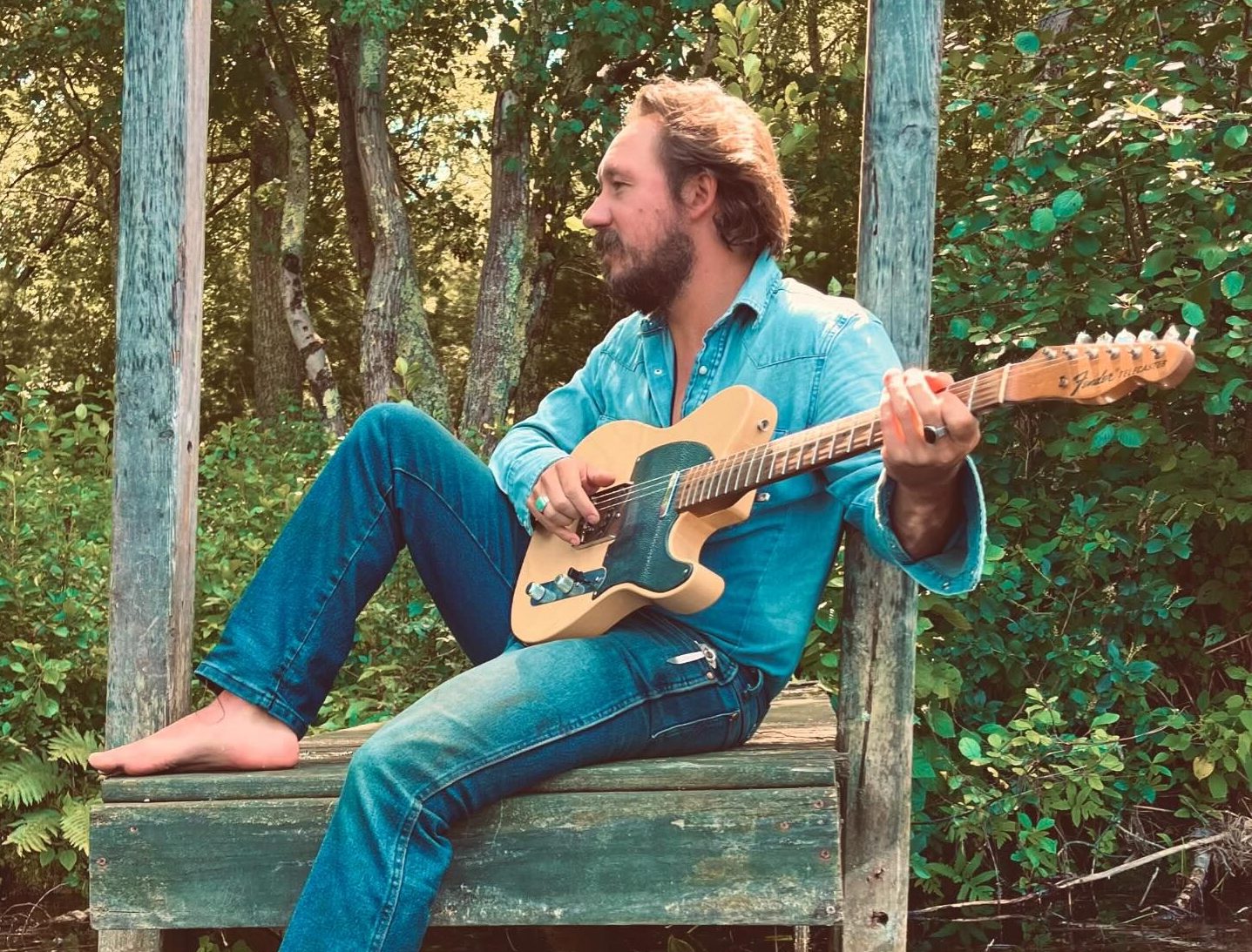
Tyler-James Kelly recently released his debut solo album, Dream River, via Clover Music Group. A very experienced songwriter, guitarist, and vocalist, as well as Producer, Kelly nevertheless has only now made the shift toward solo work and has spent the last three years moving toward this first collection. The standards that Kelly set for himself surrounding the album honed in on personal authenticity, being very cautious of presenting any kind of public image that doesn’t suit the Country music he most reveres or the creative call that he feels right now.
The result are emotive and approachable tracks that were filled out by working with other experienced musicians like Will Van Horn (Pedal Steel), and former Dixie Chicks drummer, Bart Lingley, while recording at at Dead Pop Studios in Providence, Rhode Island. I spoke with Tyler-James Kelly about his move into solo work, working with longtime friend and Blues artist Jonah Tolchin on his new label Clover Music Group, the real roots of Country music, and why he pays close attention to music interviews with his heroes.

Hannah Means-Shannon: I can see that you’ve had a long history in bands for many years, so this isn’t new territory for you, and the music shows that, too. How is this solo project different for you?
Tyler-James Kelly: I was in the band Yesteryear, which broke up. But I’m a move-forward kind of guy. I’ve been writing songs for a long time. I wasn’t digging too deep on the band project. I was always writing separately, which is what I’m doing now. Something clicked in me, the last three years, that said, “You have to be authentically you, and cut any character version of yourself. Get ride of that!” I don’t know if it was Covid, or a couple of my friends dying…Actually, I think it was all of it. I believe everything is connected in that way. That’s where I’ve been at. It’s not a “rebirth”, because I’ve always been me, but it’s more of a footing of who I actually am.
HMS: I feel like so much of life is about that movement outward from where we started, but at some point, we begin to realize that we’re returning to who we are. It’s pretty crazy.
TJK: Isn’t it amazing? Like all the things that drove you crazy about yourself, you actually grow to have an appreciation for?
HMS: Right! All the things that you were running away from.
TJK: I joke with my friends that I do my own therapy these days. When you’ve made as many mistakes as I’ve made, you just get really good at doing your own therapy.
HMS: You mean that creating music is your therapy?
TJK: No, I mean that if you make a lot of mistakes, you learn to not do them again! [Laughs]
HMS: You can check them off the list.
TJK: There’s some truth to that, but I think if you grow to accept that, that’s the only way that you actually grow. I used to make fun of all this hippie shit, but here I am talking about it. It is interesting.
HMS: Having listened to the album, I feel like it’s been a long-time coming. Do you have a long relationship with Jonah Tolchin?
TJK: I’ve always known Jonah through his music, and we’ve played a few places together, but we’ve never worked together. It’s been wonderful getting to know Jonah more. We have so much in common, it’s wild. But we also are very different, by the same token. I’m a road-dog on the highway. He hates it! He’s like, “Please don’t put me on the road.” [Laughs] But what I find charming, and so lovely, is that we both know exactly who we are. He knows and respects himself enough to say, “I’m not going on the road. It’s not where I belong.”
HMS: Everyone’s got their own “real” that’s most true to their own character and nature. The whole truism of “finding yourself” or “figuring out who you are” that we tell young people sounds so simple, and yet is the hardest thing.
TJK: You aren’t kidding. Some people create these narratives for themselves that are completely fabricated, and I feel so bad for them. If they are full of shit, you can always hear it in their music, too. In my world, I want people to be able to see authenticity. I’m older now, and I’m a weirdo, and I get it. But even being able to admit that now, and I can go and find my community. Which I do have. Every time I go to Nashville, those are my people. We don’t believe in Pop Country. We are small, but we are mighty.
HMS: Would you feel comfortable sharing with me what your definition of Pop Country is? Because I struggle with pinning it down, myself, though I know it when I hear it.
TJK: I’ll tell you exactly what it is. I say to people, “It is a three-and-a-half minute advertisement.” That’s what it is. You are being sold something. You are not connecting. Country music is so dear to me, and my community. To say I’m “passionate” about it is not the right word. I don’t even know the right word. Country music is bigger than all of us, and I feel terrible for folks who don’t know that. I feel like their quality of life is poorer because of that, because they don’t know. You’re not being sold something in Country music, you’re actually connecting with something, together. It’s a community.
We’re flawed people, every single one of us. With these songs about cheating, temptation is a real thing. Temptation is real, guilt is real. Some of us, sadly, are born into these situations where these things are present, like domestic violence, guns, and awful things you see when you’re a kid. You can connect with my songs, is my point. You’re not being sold something, but you’re connecting with something, and it tears your heart out. It’s almost like a movie plays before your eyes in three-and-a-half minutes. We’re constantly being sold shit, our phones are selling us shit, and I think people are tired of it, honestly.
HMS: Do you think Country music is Folk music, meaning “of the people”?
TJK: I would say that it is that. That’s a fact. Country music used to be called Folk music. The word “Country” showed up because of marketing. They wanted to market the music better, and they couldn’t use a boring word like “Folk”. I try not to look at these boxes, because on paper, you just want to create, but we do live in a society that has boxes. If you’re cooking your own chili, it needs certain ingredients. Country is that way. Someone ignorant would say that they could write a song about a truck, but that has nothing to do with my point. Country music means music of the people. It wasn’t cool in the 1970s, and even in the 1980s, there were a few people doing well, but it’s nowhere near what people are making now, and now it is cool, but what they are making isn’t Country music.
HMS: When you’re songwriting, are you someone who is measuring all this up and policing yourself to avoid anything that’s not “real” enough?
TJK: I “police” lines. Certain lyrics. If a lyric doesn’t hit me that way, but it gets me to that line, I’ll live with it for a couple weeks, or whatever. But I’ll be “policing” that one line, that third line.
HMS: You’re getting it into its correct shape?
TJK: There’s always a smoother way to say something, and you’ll know it when it comes out, because it just feels right. It’s that nagging thing that happens. Some people might not even understand a song right away, but those are often my favorite. Friends will say, “I really didn’t care for that song when I first heard it, but it’s now my favorite song. Once I actually listened to it.” I really appreciate that honesty. It doesn’t change my perspective that much because I already love this album, though. I already like it, and I think that positivity really is all connected. I think people can feel that. It creates a beautiful energy.
HMS: Something that I feel about the album is that it’s not spare or stripped back. Each song has what it needs to have, and the album is quite varied. But at the same time, I feel like you didn’t let yourself overdo anything.
TJK: I Produced it, and I’m very good and standing outside of myself. Again, that comes down to making enough mistakes that you get better at it. I’m a guitar player, first, and a singer second, and then songwriter, third. I grew up infatuated with guitar music, like Chuck Berry, Jerry Reed, and Chet Atkins, any guitar music. I was guitar-forward. I had a love affair with the guitar, but when I got a little older, I realized that none of my friends wanted to step up to the plate and sing. So if we wanted to do anything, I had to get that going. Everybody and their brother has that story; it’s very common.
HMS: I wondered how long you’d been a vocalist because on this album, the vocals all feel like very specific choices. There’s a lot of forethought.
TJK: Yes and no. I’m conscious of simplicity and melody, and getting the story across. Just ‘cause I can sing sometimes, doesn’t mean I have to sing on this song like Beyonce. Merle Haggard has taught me that by listening to his records. It’s a feeling. This isn’t doing karaoke of yourself. I’m very cautious about that. On the other shoulder, I do like singing. It’s pleasing to hear hooks and melodies. I personally like that sweet-spot blend. Whether or not I’m doing that, who knows? But I’m trying to.
HMS: Are there songs that you have to leave behind? How do you decide what you carry forward to recording?
TJK: Some songs don’t make the cut. It’s like cooking. You’ve got to let some tunes be ones where you have to knead the dough a little longer. I’m so passionate about this that I listen to peoples’ interviews, my heroes, just as much as I listen to their records. There’s so many little nuggets of information that most people would just glaze over. I love these people so much that, when they say something that sounds totally out there, to me, it can be life-changing. I remember the first time I heard a Billy Joe Shaver interview about writing. He was saying that Hank Williams, Sr. used to say that if you don’t write a song in 15 minutes, it ain’t worth shit! That’s heartbreaking, since he’s like our godfather.
“Big Dreams”, my single that’s out right now, took me 20 minutes to write, so I’m five minutes over! I feel that. We feel that way because we love the guy so much. But what I’m trying to say is that Billy Joe Shaver is a huge fan of Hank Williams, Sr., and Billy Joe is one of my favorite writers of all time. He then said, “Some of my songs took two years.” To hear him say that, and yet be okay with his hero saying, “fifteen minutes”, made me feel good. Looking deeper shows what it takes.
HMS: Bless him for saying that. That is so important for people to hear, both songwriters and fans.
