
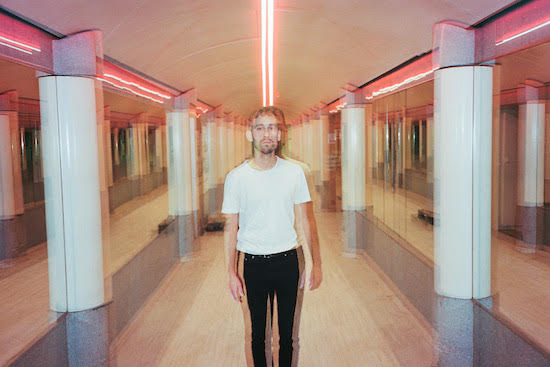
The artist Plàsi (aka Mikael Bitzarakis) was born in Crete and is a Greco-Swedish singer, songwriter, and multi-instrumentalist who released his latest EP, Salamina, this summer, via Nettwerk. Having come off touring for his previous album, Foreign Sea, Plàsi found himself with a few days break alongside his writing partner, Linus Hasselberg. In a surprising period of fast-paced creative inspiration, they wrote many songs together on the Greek island of Salamina, a place devoid of tourists and smitten by inclement weather. The results were the start of something a little different for Plàsi, as he made space to try something new by stepping into broader instrumentation for the EP.
Since the Plàsi project was born in self-Production, it was by nature sparse and solo-driven, but for this new batch of songs, he approached Producer Björn Yttling to help him build a bigger soundscape for these tracks. Yttling not only saw the potential of the approach, but encouraged Plàsi to be even more daring in terms of experimentation. The result is a soaring, often surprising, and highly energetic collection that captures a dramatic attitude and engages with intense emotions. He also has an acoustic tour of Salamina coming up in December in Europe.
I spoke with Plàsi by e-mail interview and audio memo about how this project came to life and the perspective it’s granted him on his past and future work.

Hannah Means-Shannon: I had previously spoken with you about the creation and release of your album, Foreign Sea, so I’m interested to see this development with the Salamina EP. It’s a big jump in a new direction to work with a full band sound. Had you ever worked with a fuller band sound before, for instance, on other projects with friends?
Plàsi: Actually, not in recent years, or since I started writing music as Plàsi. I think I’d have to go back all the way to high school, when I was 16 or 17 years old. Then I used to write music in Swedish, and I had a band behind me. We did record an EP back then, as well, and that was more of a full band sound. So it has always been in me that I wanted to do it, but I didn’t think really think that we would reach that point with Plàsi. But I’m very happy that I did, and that I got a chance to work with Björn Yttling. I think I needed that change, to work with someone new, to bring the project to this soundscape.
HMS: You’ve traveled a lot, so I’m wondering if there was there something so unusual about Salamina as a place that you feel impacted you creatively, or was it more a combination of a place and a specific time in your life that led to this new work?
Plàsi: I do think it’s definitely a combination of factors. The time and place was very different than I was used to in terms of a Greek island. Usually you would go to a Greek island when the weather is good, but this time I just happened to be in Athens because I was playing a show, and we had a few days in the Spring. I still found it interesting to go somewhere close, and it happened to be bad weather during those days. That created a very different environment than I expected and it triggered a large amount of inspiration.
Also, Salamina was a place that also felt very different than a traditional Greek island. It was more untouched and more local, not a typical place for a tourist to go to. There were a lot of factors, including the weather and the island itself that inspired me, but if I think back to it, it was also after a long period of time with Covid in this world, and it was one of the first times that we could travel more freely. There were periods before when you could travel, like when we recorded the Foreign Sea album in Greece, but this time I was supporting the Danish band Efterclang in Athens, and it was a time after a lot of restrictions, but we were able to enter the world again as musicians and performers. So we came to Salamina, me and my co-writer Linus Hasselberg, with a lot of energy.
HMS: What were your first conversations with Producer Björn Yttling like about this group of songs. What form were they in when he heard them?
Plàsi: The starting point was that I sent a few demos to Björn. That was in the beginning, when we began to speak about potential collaboration, so I wanted to see if he was interested, since he’s a man with a busy schedule and doesn’t have a lot of space in it. They were basically demos that I’d recorded starting the songs, they were not finished. They were basically just acoustic guitar and my voice. Based on this, Björn got an idea about where he could take them, and that was the start. When we entered the studio later on, we began to finish writing the songs and arranging them. We also talked about the Production.
HMS: I do find an interesting contrast in your step to sing in Swedish for the first time happening while you were in Greece. I know that wasn’t planned, but do you think elements of “Ordna Sig” arise from being able to see a place better from a distance than close-up?
Plàsi: Perhaps that’s the case. I think song wasn’t really planned, and also, I didn’t analyze very much why I started writing that song in Swedish. But yes, I had been living away from Sweden. I don’t think this song was written because I was in Greece, because it wasn’t written in Greece, but the start of the song was written in The Netherlands. But that still speaks to your point, that being able to see a place better from a distance than close-up is definitely true. It’s very hard, sometimes, when you’re in it, to analyze your situation, or even get inspiration. I don’t want to say that the specific lyrics or the story of the song necessarily arose because of distance, but the idea that I’m even singing in Swedish was affected by the fact that I don’t live in Sweden anymore.
Being in Sweden when I started on the project, I wasn’t affected by the idea of singing in Swedish anymore. With Plàsi, I found the need to express myself in English, and in Sweden, at the time that I started it, and outside of Sweden, I had started to get a more international following, so it made sense. Having lived abroad, and made English my daily language most days, there was something in me that must have triggered the need to express myself again in one of my native languages. If I hadn’t been living abroad, that probably wouldn’t have happened as easily.
HMS: When you were writing the song “Salamina”, which I understand was the beginning of the EP and journey for you, was there any time where you might have felt a bit nervous about following where the song wanted to go?
Plàsi: At the time, in Salamina, me and Linus, who started writing the song, were in an incredible flow. We tend to say that when we meet each other, that it’s incredible how many songs we wrote together on Salamina. There are also songs that are not on this EP but might be released further down the road that were started on the island. We didn’t, honestly, think very much of concepts while we were giving life to these ideas. We were very much in the moment, and trying to describe the situation that we were in, and what we saw, heard, and felt.
It was not really the plan to go to Salamina and write my next EP. It was the plan to go there and try to write some songs. We ended up with a bunch of good material, and afterwards, you always become a bit nervous. I asked, “Is what I felt on that island, on those days, in that limited amount of time, with that crazy amount of inspiration, really true? Can it really be as good as I think it is? Or is it only in my own head?”
For sure, there have been something like doubts, but at the same time, I know from previous experiences and releases that a good song, or a good concept, can really be born in a very short period of time. It’s not something that you need to necessarily look at for a long time, it’s about being curious, and out there, and open, and then maybe catching that inspiration when it comes. That’s what we did when we were on Salamina, probably because we were more open to those experiences than we might have been at home.
HMS: Can you tell me more about how “Avignon” took shape in the studio? Did you have a solid idea of what you wanted beforehand, or were there discoveries made with Björn? There are instrumental passages that seem quite important, for instance.
Plàsi: “Avignon” is probably the most experimental song on the whole EP, also in the way that it was written. I’m still amazed by how it went, and the outcome. It was quite a different process from “Salamina.” “Salamina” created the foundation for this EP, which in the end was about daring to take steps in new dimensions. “Avignon” really pin-pointed that. It’s the only song on the EP where me and Björn sat down and wrote it from scratch in the studio, without any starting point. The other songs on the EP were ones I had made myself, or with Linus.
For “Avignon”, it was Björn who started with an idea, which was the melody of the verse. It was a mix of the melody of the verse and the intro. It was like an intro in Björn’s head which he had for a long time, and I got hooked on the idea from the start. We tried going back and forth, writing separate parts, and adding them onto each other. It went pretty fast. So we did have a small starting point, but a very important one, because it was the hook. Somehow that ties together the song.
The melody has three different parts, kind of like a verse, bridge, and chorus, but the intro and the melody that comes up over and over again, somehow binds it together. It was a fantastic process. The bulk of this song was made it one day, and the whole concept was to be experimental. The melody itself gives you the feeling of being experimental.
HMS: Is there a particular reason, sonically, or thematically, why “Innocent” appears last on the EP? I can see how it could form a kind of loop with “Salamina” as the first song, but also how it might be a strong concluding statement.
Plàsi: Yes, I think you’re pin-pointing the two reasons there. Sonically, it definitely feels good to put “Salamina” and “Innocent” a bit further from each other, because they are the most similar in Production style. So it reminds of where we started with the EP, but also the bottom line of the story of the EP is to dare to take new steps and challenge yourself. Maybe it’s not that apparent in the other songs on the EP, it’s more that I dared to take new steps. But with “Innocent”, the song verbally, literally, talks about daring to take new steps, and especially says that you shouldn’t be afraid to do that while you’re innocent, before you have too many things blocking your way later in life.
HMS: Does having created the Salamina EP make you see your previous work differently?
Plàsi: Yes and no. That’s a hard question. I think when you grow your sound in terms of the number of instruments, or the soundscape feels bigger, many people might say, “Whoa! This sounds like Plàsi 2.0!” That’s a comment I’ve heard. Maybe it’s also something I’ve felt, that it feels bigger. That could make you feel that what you did before is not as big, or special, but that’s something that I would say is not the case. It’s rather that you also understand how much a stripped and acoustic Production has been able to touch other people, also. Because that’s how I started.
My musical journey as Plàsi started with very simple Production that I did myself. That’s actually what grew. Slowly, as an artist, you evolve and want to make new things, so I believe every phase is important and special. What was touching me in the beginning is not what’s touching me now, and probably a listener will feel the same thing, following my journey. Hopefully, they can still have moments when they feel that a simpler Production fits a particular moment in their day, or life, and that the Salamina EP, or another album, fits another moment and their taste. It makes you reflect on the fact that you, as an artist, can have a lot of different sounds on different projects, but somehow it all ties together.
It’s still me, through my voice and lyrics, and it’s very interesting to place that in different environments. I think that I will do so, going forward, as well. Because I dared to take these steps, in this instance, making myself bigger, does not mean that I will not make it smaller, at some point, going forward. What I find exciting is more about daring to do something different, and not get stuck in the same pattern.
HMS: Do you have ideas of how you would play the songs from Salamina live even though they have broader instrumentation than you usually work with?
Plàsi: In May, I did a headline tour with the Salamina EP. I played that with a full band. Indeed, before I have mostly been touring with an acoustic set-up, but on this tour, we were able to mix a bigger sound for some of the songs, and also play some older songs. With a bigger band, you can be more diverse when you play. With less people, you have more limitations. Bringing a full band brought more possibilities. However, that’s not always going to be the case that I can tour with a full band, depending on the concerts and shows.
I’m mostly very curious to see how we would arrange the songs on the Salamina EP in a more acoustic setting. Now, in December, I’m doing a few shows, which are labelled as “acoustic” and we will try to bring in the Salamina sound in a more acoustic setting. I think that’s going to be something interesting, as well, for the audience.
