
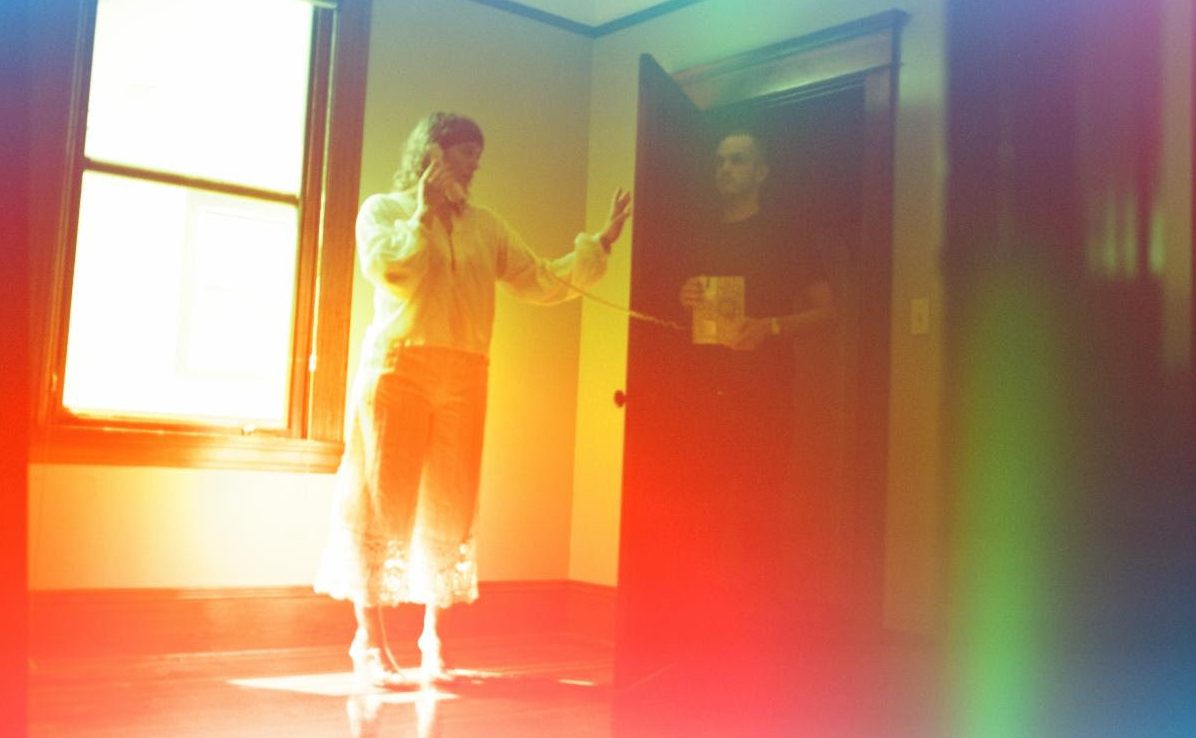
Portland, Oregon based band Death Doula are releasing their debut album, Love Spells, this Friday, October 11th, 2024, and are playing two shows to celebrate, the first tonight, October 10th, at Lollipop Shop, and the second on Friday, October 11th at Bad Bar.
The band’s songwriting stems from Kyle Alexander (guitar) and Kerry Jones (vocals, guitar) who got together musically, and as a couple, through collaborating on their first song together. That song, “Disembark” is one you’ll find on their first album. They are joined by Keith Vidal on bass (Marjorie Faire, Nyles Lannon) and Adam Kozie on drums (Pollens, Crystal Beth) on Love Spells. The album was was recorded at Jackpot Studios by Adam Lee (Built to Spill, Sleater-Kinney) and mixed by Bob Cheek, (Deftones, Band of Horses).
Side-stepping genre, the music of Death Doula is undeniably heavy, slow, textured, and at times, meditative. It creates a subtle space and mood that’s often dream-like but always emotive. I spoke with Kyle Alexander about the genesis of the songs and about his first experience recording in a studio. You’ll see that we both also have plenty of fandom for The Rolling Stones, as all reasonable people surely do.

Hannah Means-Shannon: The songs on Love Spells really seem to bring together constrasting elements that work very well together. Is that something you were thinking about?
Kyle Alexander: This project is spearheaded by myself and my partner Kerry, who is the singer, and she plays guitar as well. Our creative duo is, a lot of times, the meeting of different elements. Somewhere in the middle, it creates the songs of Death Doula.
HMS: What do you think about negotiating between different elements? Is it both being committed to the final product which helps pave the way?
KA: Kerry and I being a couple, and being deeply connected, we’re sort of always “on” and we’ve had to find ways to work together. Sometimes it’ll start with some chords that she’s written, and I’ll write the melody to it. Sometimes I’ll write separately from her, and then I’ll bring something to her. One song that ended up making it onto the record is called “Poet for Hire.” I was down in the basement playing guitar, and she ran downstairs and said, “Play that again!” In that moment, she’s the tastemaker, and I’m just the raw, organic material to be sifted through. It’s great to have someone be the watcher, and the other person to be the pusher, to bring it out.
HMS: If either of you is bringing stuff out of your unconscious, it makes sense that there needs to be a way to capture it. To have an outside person observing is really helpful, I think.
KA: I also think it’s really important to not judge the work at that point. In not judging the work, and just allowing it, that can lead to stuff that’s not good at some points. But you let that be. Not everything needs to be released. Sometimes it’s just part of your own creative or spiritual practice and it moves you on to another place. We’re basically always creating. In the creative process, you can also “cheat” a little, like use a voice memo that you creted six months ago, combining it with something you’ve just created, and put it together like legos.
HMS: Something I’ve come across before in talking with creators is the idea of “bad art.” You have to let yourself make bad art. If you’re constantly censoring stuff because you don’t think it’s good enough, you never get anywhere.
KA: That’s interesting. One of the things I love about Rock music is that there’s this community process. The songwriter, or in our case, the songwriter duo, will bring a seed of a song to the band in the practice room, and the band will flesh it out in a way. Then they’ll play it around live and see how people respond to it. Then it goes to the studio, and gets worked on some more, then it goes to mastering, and gets worked on some more. There are all these layers of being able to analyze whether something works. If you’re just making stuff on your computer, by yourself, and just putting it out into the world, there is that chance that you’ll become too self-conscious instead of allowing it to resonate.
That’s how we did the record. We recorded ten songs in the studio, and one of them got cut, not because it wasn’t a good song, but because it didn’t necessarily flow with the vibe of the record. So we’re saving that for another day.
HMS: I saw that you have been playing out a fair amount over the past year and more. Did those experiences of playing live impact what you put on the album?
KA: Yes. I would say that knowing how to sequence the album was inspired by the live shows. We’d have an intro song, then a faster song to keep people from zoning out. It’s trying to keep energy flowing throughout a set, which can be challenging. These days you’re trying to compete against peoples’ phones, or talking with friends, so it can be a challenge. Also, playing out helps you through doing a lot of reps, like working out, which enables you to be more instinctual in the studio, perhaps. Because you’ve already been through the stressful experience of performing them live.

HMS: I found the song “Dory Joins Alfred” very interesting, which is about death. It’s very direct whereas people often find it hard to speak in direct terms about death.
KA: With that song, Kerry was going through some challenging feelings which she didn’t know how to process, and I said, “Well, maybe write a song about it. Maybe through writing a song about it, you’ll learn how you feel.” That’s how the lyrics came out to be so specific.
HMS: You mentioned earlier that having other people to weigh in on songs helped you make decisions. Did having Adam Lee and Bob Cheek’s perspective help, too?
KA: Adam Lee was great to work with. He’s worked with some dreamboat people and he was super-fast. It was amazing to work with him. Any idea that we had, he’d say, “Do it!” Ideas would come so fast and be recorded so fast. He’s so good at engineering that I never once in the studio had to think, “Is the microphone placement correct?” Bob Cheek mixed the songs and his mixes sounded better than I imagined the songs sounding in my mind when we were making them. It’s such an honor to work with people who are so talented.
HMS: Was that the time that you, personally, had worked in a studio?
KA: Yes, for me, it was. Keith Vidal, our bass player, had played in the studio before. I was the newbee. I had to bring it extra hard to keep up with these super-talented people! But thankfully no one seemed to notice.
HMS: Everyone has to start somewhere. That’s the point of doing things, to learn more.
KA: There were a couple of times when I wanted to do things the “wrong way” and we ended up doing them anyway, so they ended up creating a thing that was more unique. At the end of “Dory”, I do feedback with the guitar after a big rocking section, and I opened the door for the booth where my amplifier was. The engineer said not to do that because it would cause bleed issues that couldn’t be fixed later.
But I said, “Too bad! We’re just going to have to get it right.” It made us have to get it right. On another song, “Poet for Hire”, the guitar amp was distorting in a weird way that sounds kind of like The Kinks’ song “You Really Got Me.” I decided, “That’s how it’s going to sound!” Sometimes doing things the wrong way means that no one has done it that way. It becomes an original texture.
HMS: Well, that’s how The Rolling Stones created a lot of sounds that people hadn’t heard before.
KA: I love The Rolling Stones. I hadn’t really got into The Stones until a few years ago, and now I’m obsessed. Their 1968-1978 era is my favorite. I started playing another guitar in that open G guitar tuning that Keith Richards uses, and that’s how I wrote the song “Loom.” The song “Dory Joins Alfred” is also written in open G tuning. In between songs, I just start playing Rolling Stones licks, and the band gets so mad at me. Even though I don’t think that you can hear it in the music, I think that’s my main foundational inspiration.
HMS: I would say that there might be something about the guitar that sounds a little like The Rolling Stones, because on “Loom”, I found the guitar had an interesting texture. When you get a melodic thing going, but it’s got a grittier edge to it, to me that’s a very Rolling Stones thing to do.
KA: That’s far. Totally. On “Loom”, I came up with that riff, and it made me think of the band Duster. One of the things I’m always looking to do is try to create really interesting dynamics. I have some guitar pedals and effects, but in a perfect world, all the dynamics would just come from the songs. I don’t want to have to think about activating an effect. I just want people to hear the songs. That’s one of the things I love about The Stones, I just hear the songs.
I love the way that Keith Richards plays the guitar because it’s very ego-free, and very minimal. His stuff is super-easy to play, but instantly memorable. With that song, on the choruses, Kerry plays a doubled part, with the same part that I’m playing, but in a different tuning, which is very Stonesey, because they’d have multiple guitar players playing. That was me trying to do a Mick Taylor and Keith Richards thing. That’s so funny to talk about.
Another open G guitar tuning player who I’ve been really obsessed with over the years is Alan Sparhawk from the band Low. That band is really fantastic and I saw then a bunch of times. Guitar is a texture. There are people who say things like, “Guitar is dead.” They are just projecting because of some kind of emotional block. What guitar does that other instruments can’t do is that it has a very, very wide dynamic range. It can be super-quiet and also be really loud. The louder it gets, the more fuzzy, and driven it gets. To me, that’s a very powerful, artistic form of expression. It’s almost like a paint brush that changes its size. You can do all these little textures.

HMS: How do you feel about genre terminology? I see the term “Doom Pop” applied.
KA: We really, as a band, don’t think about genre. I have this philosophy that songs exist outside of genre categorization. There’s a record that I heard when I was a teenager that just blew my mind, this Reggae band, The Easy Star All-Stars. They do Reggae covers of classic Rock records. They did a “Karma Police” cover that’s so well done that, if it was the first time you ever heard it, you’d think it was their song. A great song can be interpreted in any number of ways, and style is added later as part of that multi-layer process that we were talking about. We kind of write irrespective of what a genre should be, and we have so many influences.
Sometimes we’ll write a riff and say, “Let’s do it like The Velvet Underground.” But we’ll do it wrong, and it totally becomes its own thing. So we’ve said Doom Pop, we’ve said Dream Doom. We’ve said Dusky Art Rock. Personally, I’d love not to have to put a name for what it is. When I listen to Jeff Buckley, some call it Indie Rock, some call him singer/songwriter, but there are really heavy songs, and songs with World music influence, and songs that are Jazz. A lot of the stuff that we’re inspired by is very genre-bending.
HMS: With Jeff Buckley, what I think of the most is that is music is an emotional landscape. And I can see how that’s true of the songs on Love Spell, too. I can see that they are emotional journeys. It does have a dream-like atmosphere, but that’s mainly because its surreal. The Doom Pop thing works because there’s a heaviness and a slowness to these songs that sets them apart.
KA: The band Low, who I love, are originators of Slowcore, and Duster, who I mentioned, are Slowcore. I love slow Rock. I love downtempo, droney, moody music. People really love uptempo music, and we’re not that. If we play after a fast band, we bring down the vibe a little bit! That’s one of those things that’s come naturally. I love to find some really pretty chord progression and stay on it for a long time. I love to listen to songs over and over and absorb every detail of them, and maybe that’s part of it.
