
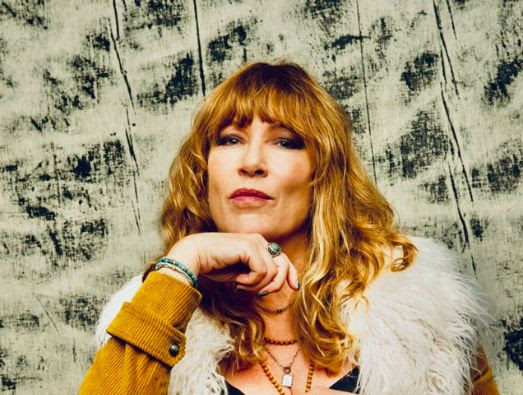
Singer, songwriter, and memoirist, Zoe FitzGerald Carter, released her newest LP, Before the Machine, this summer. The songwriting on the album was born during the Covid lockdown period, a time of increased creativity for Zoe, and the album features nine original Americana songs that bring in her trademark blend of Folk, Jazz, Blues, and Rock. In particular, the album leans more towards Rock than her previous releases. The album was produced by Jeffrey Wood, mixed by Alberto Hernandez, mastered by Ken Lee, and recorded at Opus Studio and Alberto Hernandez Audio, in the singer’s hometown of Berkeley, California.
We’re very pleased to premier the video for one of the tracks from Before the Machine, titled “Starlight Blue”, here on Wildfire Music + News today.
The subject matter behind the song and the video are very up-front and approachable, with Zoe taking a hard look at things that we all know about, but rarely see as fully discussed as they deserve to be. Women are a minority in music, and particularly in leadership or executive roles, and the long history of misogyny and abuse in music is so patent that well-known examples could be cited in the thousands without even having to tax the memory. But Zoe was particularly inspired by the chilling examples of a few very well-known cases, and it enabled her to take on the voice of an abuser for this track. Digging deep, she endowed the story with a coldness and sharpness that may be necessary to get the message across in an era where we may become too used to these stories to react properly. Remarkably, Zoe manages to preserve the tone of a mesmerizing lullaby throughout, carried by a haunting western atmosphere, that suggests the elusiveness of the people in power and the total agency they hold over young women.
The video takes multiple approaches to convey both the spell-binding atmosphere of the song and its at wistful, disturbing subject matter. Zoe performing in a wide-brimmed, shadow-casting hat as the nefarious speaker of the song, to the romantic atmosphere of a dramatic dance, suggesting gender roles and perhaps a pattern that’s hard to break out of. This is inter-cut with occasional footage of Britney Spears and Amy Winehouse in their objectified and maligned characterization by the press. It’s interesting that this doesn’t make up the bulk of the video, but comes in to punctuate the reality of the narrator’s words and actions. It’s a real-life consequence of the attitudes delivered in the song. This is a song from Before the Machine that particularly needed a video, not because it can’t be appreciated without one, but because the visual world of music has played such a big part in the harm done to young women in the industry that its message is most powerfully conveyed in a combination of sound and images.
Zoe shares this insightful and detailed essay about the issues behind this song, the writing of the track, and the making of the video:
“‘Starlight Blue‘ was inspired by watching the New York Times documentary about Britney Spears (Framing Britney Spears) a couple of years ago. I was never a huge fan of Spears’ music but had read and been disturbed by stories about how Spears’s father had been financially and even physically controlling her through a long and highly unusual conservatorship. Watching the doc, I was struck by the relentless, leering misogyny she’d faced from the time she was a child, growing up in Kentwood, Louisiana. Ed McMahon asked her — on national television — if she had a boyfriend and seemed to suggest himself as a possibility when she was ten years old. As a teen, she was asked about her breasts, her virginity and whether she had cheated on Justin Timberlake — all in front of huge television audiences and despite her obvious distress. After years of this, and dogged by a mob of paparazzi wherever she went, she famously shaved her head and attacked a paparazzi’s car with an umbrella, images of which made the photographers and the magazines even richer.
Obviously, there are many villains in a story like this and the story itself is so common as to be cliche. Fame in this culture is the ultimate Faustian bargain — perform for us and we will love and elevate you but we will also overwhelm and burden you with our obsessive fixation and then come for you when you fail in any way. Bright, talented, ambitious young women like Britney experience some form of this story everyday and not just in the music industry; film is rife with the same ugly dynamics. The story is about power and, as is the case more generally in this society, that power resides with men. According to a 2020 piece in Rolling Stone, women comprised just 5% of music producers in 2019 and, in their survey of music professionals, they found that “the main barriers to career success for female songwriters and producers had to do with objectification, stereotyping, and being a statistical minority.”
At the time of this piece, only 22% of top songs were made by women. Is it any wonder that women feel like they have to put up or shut up when male music executives offer them opportunities? High profile female artists who have spoken out about being exploited, manipulated and abused include Kesha, Alanis Morisette, and even girlboss Taylor Swift and there are many lesser known women artists who experienced the same thing or worse. R. Kelly was a master manipulator, promising to promote the careers of the young women he entrapped and abused, and music producer Sean “Diddy” Combs’s horrific abuse of women, including some very successful women artists, is exploding in the news even as I write this. (Just today, The Washington Post announced that 120 additional sexual assault lawsuits were being filed against him.)
While all these stories inform the narrative backdrop for ‘Starlight Blue,’ the late Amy Winehouse, an artist I hugely admire both as a singer and songwriter, was more specifically on my mind. Interestingly, she shares with Spears a largely absent but then over-involved and exploitative father, some terrible and destructive romantic partners, and abusive treatment by the press, especially as she descended into drug and alcohol addiction. Being pushed to perform by her handlers when she was clearly in crisis was at least partially responsible for her deterioration and death. (I highly recommend the 2015 documentary, Amy, that beautifully integrates her own lyrics to tell her story.)
One thing that makes ‘Starlight Blue’ unusual is that I chose not to tell the story from the woman’s point of view. As someone who has written a memoir and first person essays, I’m a big believer in the power of a first person narrative, but I felt that the story of female victimization was perhaps overly familiar. I decided to approach the topic from the point of view of the exploiter, to try and capture the voice and the power dynamic of the “other side.” So we hear the narrator telling the star things like “Keep your smile on, take your dress off. Don’t worry about the money ‘cause I’m keeping it for you.” The song’s refrain, “Starlight, starbright, first star I see tonight,” evokes the childhood innocence that has been stolen from her.
As a performer playing a part, I had to find a sneer in my voice, which was actually pretty difficult and I’m not sure I succeeded. (A reviewer seemed to think the song was about hanging out in cafes in Paris!) Musically, the song’s motifs are grounded in a series of minor/melancholic walk ups on the verses, and some Klezmer-esque descending half-steps in the melody of the chorus. I recorded the song in my hometown of Berkeley, California, at the old Fantasy Records building, with my producer Jeffrey Wood and sound engineer Alberto Hernandez, and it’s featured on my recently released album, Before the Machine. Jeffrey had the brilliant idea of bringing in Oakland violinist Lila Skar, who plays in the Klezmer style, to add a killer solo. And my long time vocal collaborator, Pam Delgado, added her powerful background vocals.
When it came to making the video, I had the great good fortune of being introduced to a young videographer, Bria Light. We had so much fun collaborating on shoots, including driving around a seedy part of San Francisco at night with me in a hat and sunglasses. We also shot at my beloved rehearsal space, Music City, also in San Francisco. She came up with the brilliant idea of asking two dancer friends, Miranda Lindelow and Mungai Waweru, to do a tango in this beautiful space, also in San Francisco, called Galleria Boheme. Although Miranda and Mungai are a couple in real life, there is something about the tango that captures the complex power dynamic and tension between men and women. She also made use of some of the Galleria’s random props, including a naked female mannequin, the symbolism of which worked well for the video.
I loved the dance sequences and the footage of me in various hats conjuring my sinister narrator’s persona but, as the original inspiration for the song, I wanted to reference Spears and Winehouse more directly. So Bria found old footage of both of the two of them and artfully wove it into the video. The final step was coming up with an opening statement so for anyone watching it is clear right from the start that the song — and the video — is NOT about Parisian cafes!
This song goes out to the many young women in the music industry whose lives have been damaged by the unscrupulous, manipulative men around them. May their stars always shine.”

For the album Before the Machine, in addition to Zoe’s acoustic guitar and vocals, she is joined by drummer Dawn Richardson (4NonBlonds, Tracy Chapman), bassist Paul Olguin (Maria Muldaur), flugelhorn player Erik “Mr Tasty” Jekabson (John Mayer), keyboardist Greg Sankovich (Times 4), electric guitar/lap steel player Michael Papenburg (Petty Theft), violinist Lila Sklar (Joanna Newsom, Bjork), and vocalists Pam Delgado (Blame Sally), and Vicki Randle (Mavis Staples).
Zoe FitzGerald Carter also has some live events coming up in California in October and November, which you can find out more about here.
