
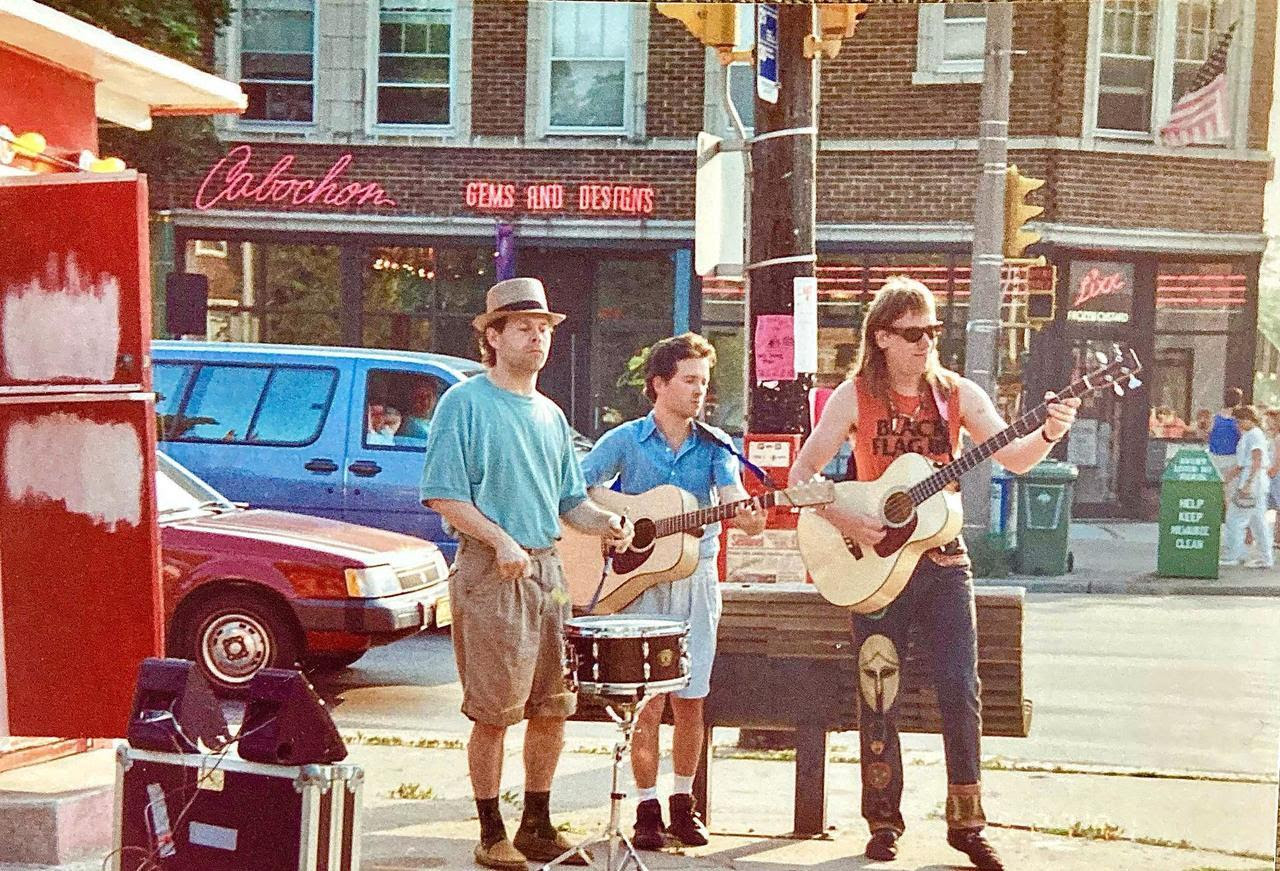
[Cover photo features the Violent Femmes in Milwaukee, photo by Karen Keene, courtesy Victor DeLorenzo]
Industry veteran, writer, and journalist Cary Baker draws on years of interviews and eyewitness accounts for upcoming book Down On The Corner: Adventures in Busking and Street Music. The significant work is due out November 12, 2024, from Jawbone Press and explores street singers in a myriad of musical genres, from Folk to Rock ’n’ Roll, Blues, Bluegrass, Doo-Wop, and Indie Rock.
Baker also makes sure to survey busking “hotspots” in the book, including New Orleans’ French Quarter, Chicago’s Maxwell Street, New York’s Washington Square, San Francisco’s Fisherman’s Wharf and London’s Tube, among others.
Seeing buskers in cities and hearing their work makes us all wonder about their backstory and whether any of them will make it into the music industry. Some of the performers Baker features in the book are major names like Lucinda Williams, Billy Bragg, and the Violent Femmes, while others continued busking as a way of life.
In all, the book features interviews with Lucinda Williams, Billy Bragg, Violent Femmes, Ramblin’ Jack Elliott, Mary Lou Lord, Peter Case, Poi Dog Pondering, Madeleine Peyroux, Old Crow Medicine Show, Mojo Nixon, Satan & Adam, and more, plus eyewitnesses of busking through two centuries.

Baker explains his longtime affinity for street music:
One day around 1970, my father said he’d like to take me to Maxwell Street Market, an open-air flea market adjacent to Downtown Chicago. He wanted to show me where his parents used to take him shopping as a child. When he parked his car in the University of Illinois lot, the first thing I heard, long before I could see where it was coming from, was the sound of a slide guitar – not just any guitar but a National steel resonator guitar. We followed the music and found ourselves standing on the west side of Halsted Street, midway between Roosevelt and Maxwell, where Blind Arvella Gray was playing the folk/blues song ‘John Henry’ – a song that seemed to have no beginning and no end. In that moment, I developed a lifelong affinity for the informality, spontaneity, and audience participation of busking.
The foreword for the book was written by Dom Flemons, who as a member of The Carolina Chocolate Drops won a Grammy Award for the album Genuine Negro Jig, and who has since been nominated for two of his own albums. He’s also received a Blues Music Award.
Flemons, as it happens, has busked in New York City, the Carolinas, Europe, and his native Phoenix.
He writes:
If you are a good busker, you can bring the crowd, give them a thrill and finally disperse everyone in a timely manner with a few extra dollars in your hat.
More about Cary Baker:
Cary Baker is a writer based in the Southern California desert. Born on Chicago’s South Side, he began his writing career at age 16 with an on-spec feature about Chicago street singer Blind Arvella Gray for the Chicago Reader. His return to writing follows a 42-year hiatus during which Baker, by 1984 based in Los Angeles, directed publicity for six labels (including Capitol and I.R.S.) and two of his own companies, working with acclaimed artists and labels such as R.E.M., Bonnie Raitt, the Smithereens, James McMurtry, the Mavericks, Bobby Rush, Willie Nile, and Omnivore Recordings. Prior to his PR years, Baker wrote for the Chicago Reader, Creem, Trouser Press, Bomp!, Goldmine, Billboard, Mix, Illinois Entertainer, and Record magazine. He has also produced and/or written liner notes for historical reissues from Universal, Capitol-EMI, Numero Group and Omnivore. He has been a voting member of the Recording Academy since 1979.
