
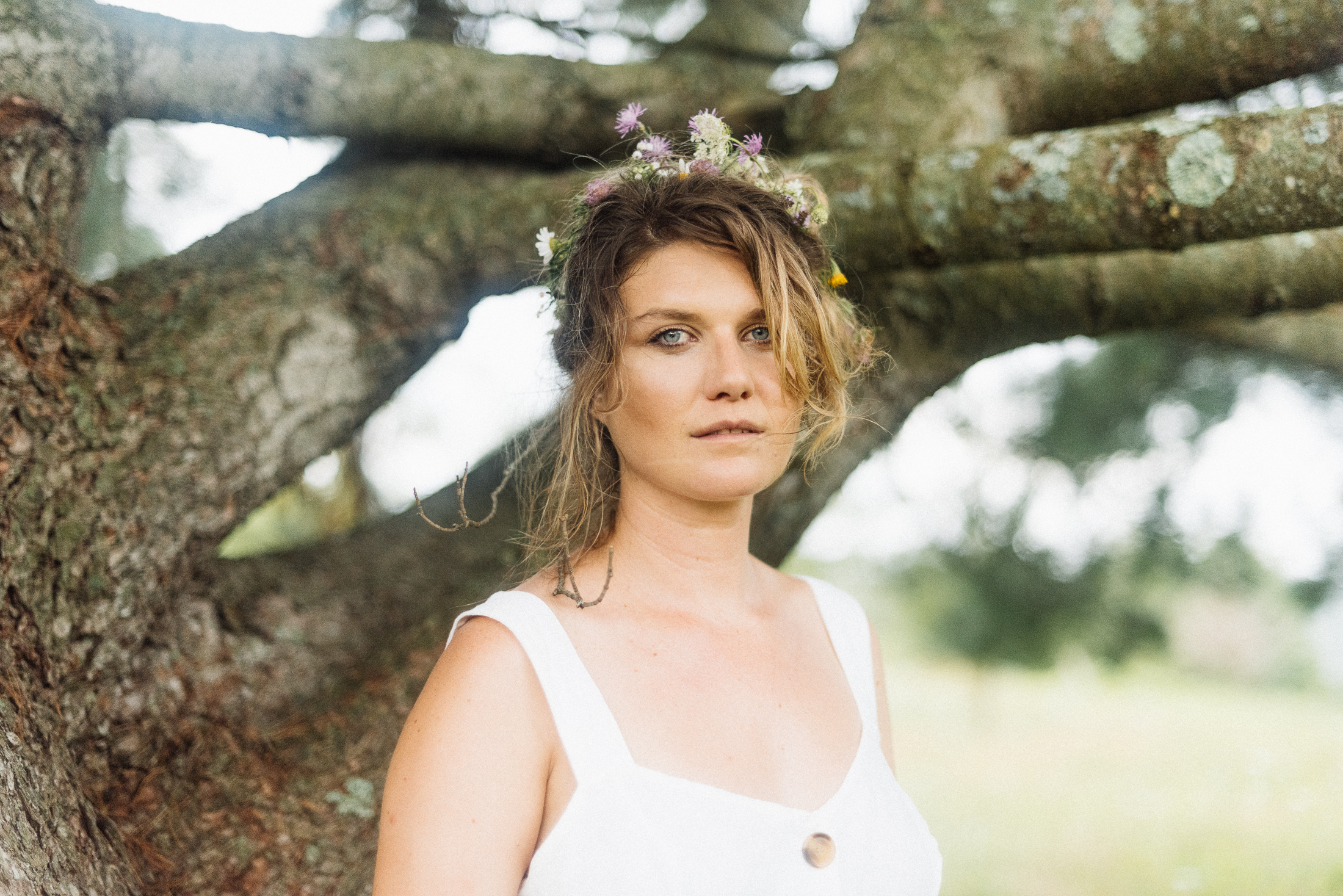
Singer/songwriter Helen Rose is releasing her second album today, which also her first with the newcomer label Clover Music Group, titled Rugged Elegance. Rose’s album is actually the first to be released by a separate artist from Blues/Americana artist Jonah Tolchin’s new label, and gives a welcome preview of the kind of artists the label will support. Rose is not only an independent artist, but independently minded, putting a high value on personal expression and uniqueness in sound and vision, and that’s what we hear on Rugged Elegance, which was also Produced by Tolchin.
The album presents all-new music from Rose, giving Tolchin a co-writing credit for his careful input, and also features artists Greg Leisz (Robert Plant & Allison Krauss) on pedal steel and lap steel, Marley Munroe (Lady Blackbird) and Valerie Pinkston (Diana Ross) on background vocals, and Carey Frank (Tedeschi Trucks) on piano. These collaborating artists were recorded at Carriage House Studios with Sheldon Gomberg. Thematically, Helen Rose found herself drawing on a welter of intense emotions and soul-searching regarding changes and revelations in her family, suggesting to her the ways in which family roots run deep. I spoke with Helen Rose about working with Jonah Tolchin and Clover Music Group, and about the intense changes and elevated productivity that led to this period of songwriting for her.

Hannah Means-Shannon: Are you inspired by landscape for you music? I saw that the location in the video for “Where Is My Home”, looked quite beautiful.
Helen Rose: Yes, that video was shot where I live. We’re up in the Northwest Catskills, in a really cool, historic town, with a population of me, my dogs, and my fiancé. It’s called Potter Hollow. It used to have an amazing economy with lots of small farms with its own ecosystem, and then corporate stuff took over. Now it’s all abandoned and kind of hauntingly beautiful. You can see the old general store and it still has 1980s products in it. There are a couple families around, but we live at the hop of the “holler” and can see mountains. Our neighbor keeps his cows on our property, so those are the cows in the video!
HMS: It was really compelling, with the bonfire scene, too. It made me want to get back to my native Western North Carolina.
Helen: It’s similar to Appalachia up here. We have ties to the trail, and there is a cultural similarity, as well as in the terrain. It is rich with a haunting history.
HMS: How did you come to know Jonah Tolchin and be the first artist released by his Clover Music Group?
Helen: We’ve known each other since high school, and we’ve seen each other through a lot of life stuff, and it’s music that’s always brought us together. That’s what feels good and right, no matter what either of us is going through. That collaboration is something that’s easy, and I try not to think about it too much. We can finish each other’s sentences without really having to say much. I’m really happy that we finally got to work together and make a record together. It’s been a long time coming! [Laughs]
HMS: Absolutely, I was thinking that. I had heard about Clover Music Group from Jonah before, and it’s exciting for me to see who will be on the label. What were you thinking when it came to recording and releasing together? What goals did you have?
Helen: I really wanted help with this record, and it’s just so hard to feel safe in the industry, I’ve come to realize. For a lot of my 20s, and when I released my album, Trouble Holding Back, I was by myself, and single, and I felt very much alone in the whole process of releasing it. I also came across situations where I didn’t feel safe a lot, didn’t know who to trust, and didn’t know what was “real”. There’s a lot of fluff in the music industry, and there’s a lot of weird dynamics in the music industry between males and females. There’s a lot to navigate to create and release this sacred art that is music. You’re creating something that’s your truth, hopefully, and it’s helpful for other people because of that.
When Jonah said he was starting a record label, I didn’t push it at all, but I was thrilled when he approached me about it because I feel really safe with him, and I trust him ten-fold, and that’s really important to me. You need a trusting relationship when you have to create a business out of something that’s your art.
HMS: My feeling, as someone who has a lot of interaction with the media, is that there’s a lot of unreality in the music industry. Then there are the human interactions, too, and we have all heard many horror stories of people behaving badly. It’s enough to make someone stop releasing music, for sure, and I’m glad that wasn’t the outcome for you.
Helen: Thank you. It all happened so serendipitously, and I feel so lucky to be the first artist that Jonah is releasing, too, and support my friend in that way. We are our own entities and that feels good. It’s interesting that you say there’s a lot of fabrication of reality. That’s how I feel it is booking shows these days, relating to social media. I don’t have a lot of social media followers because I don’t like being on the screen all the time, and that might have been a make-or-break for a different label. [Laughs] Of course, I try to promote, but I’d rather be in the garden, or with the dogs. I’d rather have that time to tend to my creative garden.
HMS: There’s the bottomless well of time that social media can take, then there’s also the climate that it introduces, which makes me too edgy to feel like I can be creative. Those are just different worlds. Sometimes you have to shut that door for a while.
Helen: It feels so good, too. I did a media cleanse after releasing Trouble Holding Back, and I’d done a couple of tours. I said, “I’m going to take a month off.” I posted something about that, and then, when I logged back in, I saw all these messages say, “Are you okay??” I was just living my life!
HMS: It’s so foreign to our way of living now that it’s hard to comprehend! With this collection, did you have a of songs that you had to pick from?
Helen: To be quite honest, I had daydreamed about working with Jonah for so long that I had some skeletons of songs that I’d pieced together, lots of lyrics with basic chord structures. I had these for about four years. I’m hit by inspiration randomly, so thank God for iPhone voice memos. I’ll talk about a concept that I’ve had. There are a couple of songs that didn’t make it on the record because we ran out of recording time, but they could be good for the next record, which I’m already excited about.
I think it was just a classic situation of having some skeletons of songs and deciding what to work on. You kind of get a weird “ping” when you feel like something is a real song. “Ping” is a strange way to say it, but I’m not sure how else to say it. You get a spark. There’s a light, a settling, and a groundedness. It was like that with “Raspberry Plain”. I knew that it was something that wanted to be created.
A lot of the songs on the record came right after my uncle, who the song “King of this Town” is about, passed away. There’s a lot about my uncle and processing his passing here, because we were very close. It was a difficult time when he died, because it was still during the pandemic, and I also felt like I was at a place where I didn’t know my own voice, and I felt like I didn’t know myself at all. It was very strange and unsettling. I had lost a lot of people very quickly and I didn’t know who I was. It’s crazy, but it was during this time that all these songs just started coming to me. I said, “Jonah, I think it’s time. Let’s do it. I feel it.”
HMS: I could pick up on a theme of past times and family on the album, but I wasn’t sure if it was directly from your life.
Helen: When my uncle passed, I was also inspired to learn more about my family history, which is a pretty interesting history. My family is very full of wild characters who live life like it’s still the time of wild, pagan Vikings! [Laughs] But we have to continue to live in modern society. I was overwhelmed with the feeling of wanting to honor those that I love, and also dive into the question, “Who the fuck am I? And where does all of this come from??”

HMS: How did you start work on finishing the songs and recording them?
Helen: Basically, I just set up sessions with Jonah and we would Zoom. I’d play him the songs, and he’d suggest moving verses, or using certain chord structures, which would help me tie things together. That’s why he gets co-writes on all the songs! I’m a big fan of giving credit to anyone who works on a song, no matter how small.
HMS: It’s funny how sometimes when we’re asking a lot of big questions in life, creative work turns up in its own way to answer that. I think with these songs, they do feel like they answer questions. The mood and atmosphere is very meditative. “Raspberry Plain”, for instance, feels dream-like and how long that vibe is continued in the song. That mood is never shattered, and the sound continues it. It’s really beautiful.
Helen: I actually wrote that song while I was on the screen porch, while it was raining, at my uncle’s house, when I went back to help out after he passed. I was looking at all these pictures. He wasn’t emotive as a person, but he talked in prose and haikus. You knew he loved you if he gave you a rock or some bizarre thing he found on Canal Street in China Town! [Laughs] That’s how he expressed his feelings. I was looking at a picture of him at the farm in Maryland where he and his brothers grew up, and though he lived in the city, he moved back after his mother passed.
I was contemplating how that must have been for him. This person would never tell you, “I’m grieving,” but he loved his mom. I had heard stories here and there about her, and I knew that she was a colorful person who loved horses. She also drank a lot, and if a guy hit on her, she’d throw her drink in their face! She and my grandfather had six kids together, but I never heard the stories of them being in love. My grandfather was in the CIA and was gone a lot, and my grandfather and grandmother divorced when they were still pretty young. It was a different era in the 1950s, and I think that time was scary and lonesome for their sons. “Raspberry Plain” comes from a grieving state and when I was sitting on the porch, I grabbed my 15-year-old-cousin’s guitar, and it just came to me. I was thinking of how much my uncle loved his mom.
The sweeping, pretty pedal steel was something that I had in my head as soon as the song was done. There was a lot more to the story, and it was hard to leave a lot out, but I think we did a good job.
HMS: It feels detailed, but the mood is inclusive. That’s not excluding. The fact of the matter is that song could refer to a lot of different time periods and still have the same feeling. I’m beginning to see how the family elements inspired the songs, even if it’s not evident right on the surface. You were sinking down into areas of the past and thinking of those stories.
Helen: I never got to meet my grandmother, but I feel like I somehow got to meet her in that moment. When the feeling and the song came to me, I was really feeling that powerfully.
HMS: It’s also spooky, in a lot of ways, how much we are like our ancestors and relatives, even if we don’t know it. Is “Where Is My Home” about questioning that feeling for yourself?
Helen: That one comes more from me. I wrote that one on a plane, and me and my fiancé had become uprooted by the pandemic, as so many people were. We had been living in LA, and didn’t necessarily want to be there. Jonah had actually given me an assignment when I was flying back to record the record. He said, “Make sure that you journal on the plane.” And this is what came out. I showed it to Jonah and he said, “Whoah! Let’s work on this.” Kevin, Nick, and Jonah, and I, all sat on Nick’s porch and worked out the song. Then we just went and recorded it! It was pretty cool. The muse was on our side that day.

