
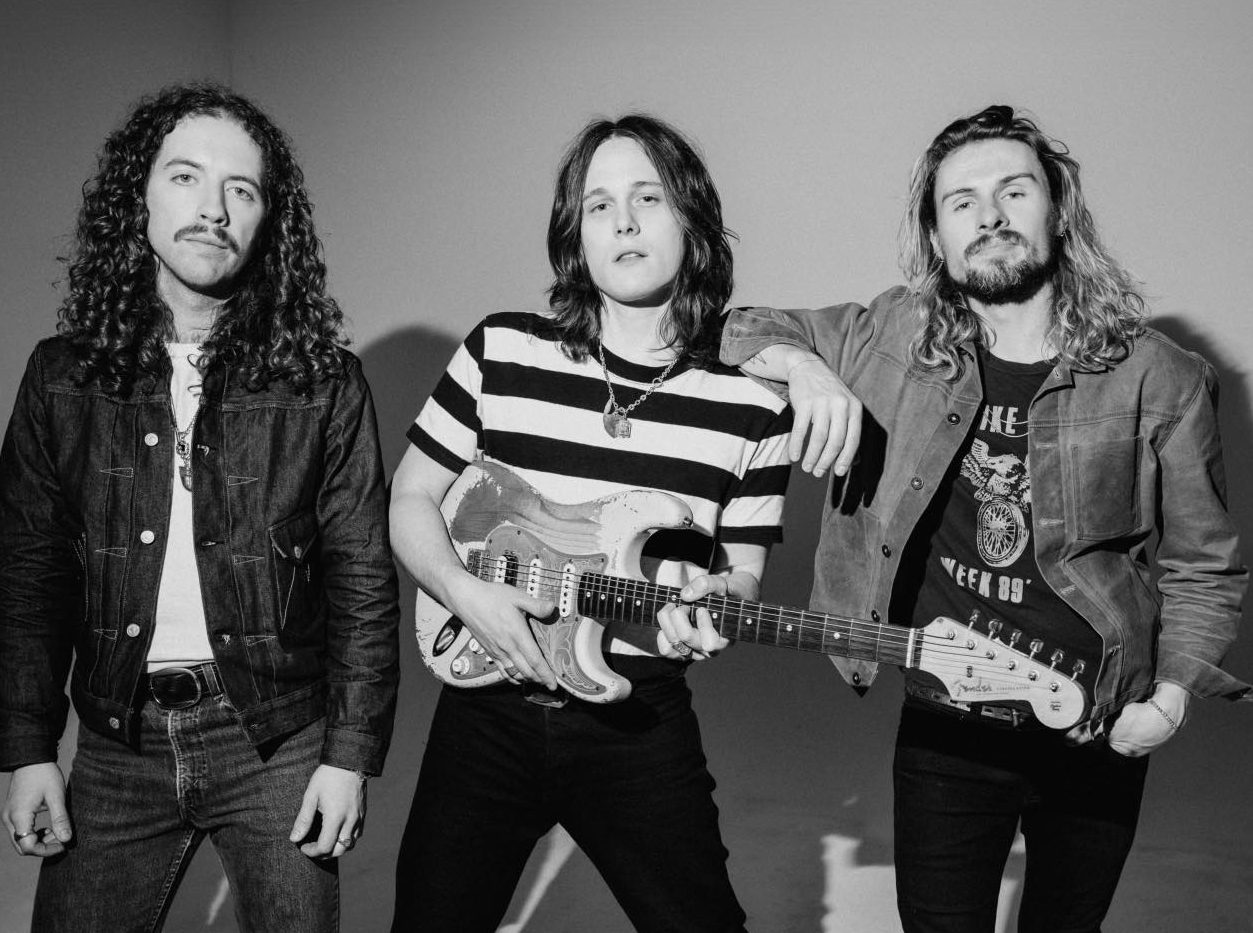
[Cover photo credit to Zack Whitford]
Nashville-based Rock band Tyler Bryant & The Shakedown recently released their sixth studio album and fourth on their own label, Rattle Shake Records, titled Electrified, in both physical and digital formats. Featuring Tyler Bryant on lead vocals and guitar, Caleb Crosby on drums, and Graham Whitford on guitar and backing vocals, the group have amassed not only quite a catalog of original music, but thousands of hours as live performers, focusing on shows that change from night to night.
In addition, Tyler Bryant not only handled Production for Electrified, but also co-Produced Larkin Poe’s latest album, Blood Harmony, of which his wife, Emily Lovell is a member. For Blood Harmony, Larkin Poe took home a well-deserved Grammy Award. Both Larkin Poe, and another artist for whom Bryant has handled Production, Ruthie Foster, make appearances on the album Electrified.
Between their focus on solid Production and creating a collaborative musical community, Tyler Bryant & The Shakedown have also shared stages with acts like AC/DC, Jeff Beck, Guns N’ Roses, Alice Cooper, ZZ Top, Clutch, and Blackberry Smoke, among many others. I spoke with Tyler Bryant about his approach to live performance, building his studio while handling even more Production work, and why collaboration inspires him creatively.

Hannah Means-Shannon: People are going to get a chance to hear a lot of these new tracks live this summer, including a performance at Graceland, which is great. How long have you been playing these for?
Tyler Bryant: We wrote a lot of these tracks as we were recording, because we’re not really a band who’s making records when we’re on the road. We’re really just getting to play a lot of them for the first time now. We’ll catch a wave in the studio and start playing them together, but the moment we get out of the studio, they start taking on their next life, then five shows later, they are taking on a new life.
HMS: Do you find that your feelings and perspectives on the songs changes as you play them, over time?
TB: Absolutely. The older I’ve gotten, the more I’ve tried to leave some space in the lyrics for myself, to grow and change, and still have room to fit into the lyric emotionally. I also get really excited by playing a song exactly as it is on the record at first, but then I get a bit ADD and have to change it up. There’s a song on the record called “Movin’” and we’d worked it up, then by about show three, we started doing a wonderful, broken-down moment in the middle of the show, where we’d pull out the acoustic guitars. I’m just excited to have new songs to play with. We do like to shake things up a little bit and improvise. That changes night to night. One night, we open the show with “Shake You Down” and the next night, it could be totally different.
HMS: You all are getting to the point in your catalog where you have a lot to choose from!
TB: [Laughs] It’s a real pain to make a setlist. I’ve actually been petitioning for us not to make setlist. We used to never make a setlist, but then I’d get to the end of a show and think, “Oh, we should have played this!” Now, there are so many different guitar tunings and changes that, really, the setlist is really not for us, but for our crew. But however many times I make a setlist, I never stick to it! When we played in Nashville, I think the first six songs that we did were on the setlist, but then we started calling them out, because the moment feels like it’s asking you to do that. It’s not what you thought the moment was going to ask you to do. I try to pay attention to that. I also want to play something that excites me, since that’s the best way, I think, to give someone an interesting show.
HMS: That’s really two different ideas that are put together in an interesting way that I don’t often hear from artists. Firstly, I think it’s very brave not to have a setlist. But usually, the reason for that is that is that they tend to drift in terms of what they want to do as a band as the performance progresses. Then, there are artists who don’t make setlists because it’s very much about reading the room, as you’ve said. You seem to bring both of those things together and it’s about the place and the time.
TB: Totally. If you have a rowdy crowd, then you might have to wear them out a little bit before you can have an intimate moment. This is something that I noticed between 2016 and 2019, when we were doing these really big support slots for these big bands. We had 30 minutes to try and win over a big audience who didn’t know who we were. We crafted a setlist that we felt was putting our best foot forward. But what I found, by the end of a tour, was that it was so much muscle memory that my mind could tune out, and I didn’t like that.
For me, whenever things are a little less predictable, I stay in the moment. I need a fight or flight mentality! But that’s what I love about Rock’n Roll. I love it when it’s a little bit reckless. We don’t play to a click track. We don’t have a computer on stage. We’re one of the last bands that doesn’t use in-ear monitors! [Laughs] Though we have before. I think there’s something romantic about being loud, and in the moment, then it’s gone. We have a short allotment of time, and that’s enough.
HMS: There’s a flipside to that, which means that each show is a different experience, and that’s kind to fans because they can come to multiple shows if they want. That kind of spontaneity may be on the wane, but it’s still there for some people. I hope it doesn’t go away.
TB: I get really excited about little moments. If we’re all listening to a band member doing a riff, there might be a little door that we can walk through to create a new moment. And maybe the next night, you elaborate on that a little more. All of that’s fun.
HMS: Does that more reckless approach mean that you have to be willing to look a little silly if something goes awry? Do you ever talk to the audience if something goes a bit wrong?
TB: There was one show, in particular, on this last run, where I was trying a new song from the record for the first time. I had a little lyric flub. I don’t think anyone would really know, but you just keep going. Our little loyal fanbase know that they are going to get everything that we’ve got, and sometimes everything that you have got is a humble offering. For the longest time, I got really in my head about forgetting lyrics. I developed a fear and anxiety.
Almost any entertainer will have those dreams of waking up in their pyjamas two minutes before showtime and having to walk through a sold-out crowd and they are going to know it. There was a period where I was printing out the first lines of every song, but I would never look at it. At one point, there were a couple of shakedown fans that had come to a handful of shows who noticed that I’d told the guitar tech not to put out the lyrics, that I didn’t want them. The fans came to me after the show and said, “You don’t need those cheat-sheets! You never look at them.” That made me feel really good. However my mind and heart are wired, not having those allows me to think less, and know that I don’t have to exist within some kind of box that I’ve created.
HMS: I’m sure that having played together as a band for some time now helps. That makes for a supportive atmosphere.
TB: I’ve been playing with the guys in the Shakedown for a long time. We keep reminding ourselves about what it’s about for us, and trying to figure out how we will continue to do it. That was a big catalyst for us starting our own record label. I’m in the process of building a full-on recording studio in Nashville for myself, for my wife’s band [Larkin Poe], and for all the other artists who I love. The industry is changing so rapidly, and labels are giving fans less money, so I want to have a community where artists can make badass records and actually own what they are doing. I want us all to be able to put together careers that have longevity.
HMS: That’s amazing. I didn’t know that you were building a studio, but I knew that you had your own label. Does that also mean that you’re the Producer on this album? Have you been doing that for a while?
TB: Yes, we actually recorded this record, the last EP Dirty Work, and the Shake the Roots record completely on our own in my current studio. My current studio is humble, but pretty much every dollar I’ve made for the past ten years has gone into buying gear, buying microphones, and all the stuff I need to make records that sound like how I want them to sound.
My wife’s band, Larkin Poe, is one whose last record we recorded in the studio, and then that went and won a Grammy. That was cool. It made me realize that the possibilities are endless, but that we really should be intentional about what the next steps are. It’s exciting for me to be able to have a space that’s always “on.”
HMS: Congratulations on that! Do you mean that your studio will be for other artists to use, also, or mainly for family and close friends?
TB: It’s probably not going to be a commercial studio. It’s for us. But I’ve been doing Production for a lot of bands outside The Shakedown. I just Produced a Ruthie Foster record coming out on Sun Records. It’s a completely different thing for me getting to work with these other artists like Frankie Ballard, Caleb Johnson, and currently, Rodney Crowell, who’s one of my favorite songwriters. To me, it’s been breathing inspiration into anything I do that’s my own music. Then I have this whole other well of inspiration to draw from, just from being inside other peoples’ creative processes.
HMS: That’s a great way to put it. A lot of people who create their own music, but also do Production work for others, say that that it exposes them to new ideas that they might not have come across otherwise. That keeps their mind turning. And, of course, you’ve collaborated with people on some Shakedown songs, and I can see that connection also.
TB: I used to work in a guitar shops when I was 15 years old, and people would pull guitars down off the wall and talk about their favorite records. I would always learn about music that way. I like to think about music as a community thing. I think it was Robbie Robertson, talking about The Band shows, who said something like, “We like to think about our shows like a celebration.” It’s just fun to get together with other people and hear what they are excited by. If I’m over-thinking something, to have a collaborator around allows you to ride someone else’s wave.
HMS: I can see how it would make you more open to ideas, and more open-minded about a what a song might turn out to be.
TB: There’s another great thing, which is that when we were finishing this record, I thought that we were missing one song. I sent it to my band and got crickets in response, which is never a good thing. But I felt like the song had something. I was working on the Ruthie Foster record simultaneously, and she came over, and I played it for her. She started singing it, and I realized instantly that the song was not for me, it was for her. Following that session, I wrote the lyrics for “Happy Gets Made.” That’s one of my favorite tunes on the record. Ruthie said, “Hey, I stole your song, so maybe I should sing one of your tunes.” I said, “Go in there and take a stab at this!” Sometimes, getting out of your own way is important.
Once, I was writing a song called “Crossfire” with Avi Kaplan, who’s a phenomenal singer. We finished it, and I did a version where he was singing it, and I thought it would make his record. We were just throwing paint at the wall, hoping something was pretty. Then it didn’t make his record, so I texted him and said, “I’d kind of like to try this tune. Is that cool?” He wanted to put it on his next record, but we had already tried it! [Laughs] I really loved that tune, and I don’t think I could have gotten there on my own. Sometimes writing with other people helps you get out of your own way and try things that you never would have tried on your own!
