
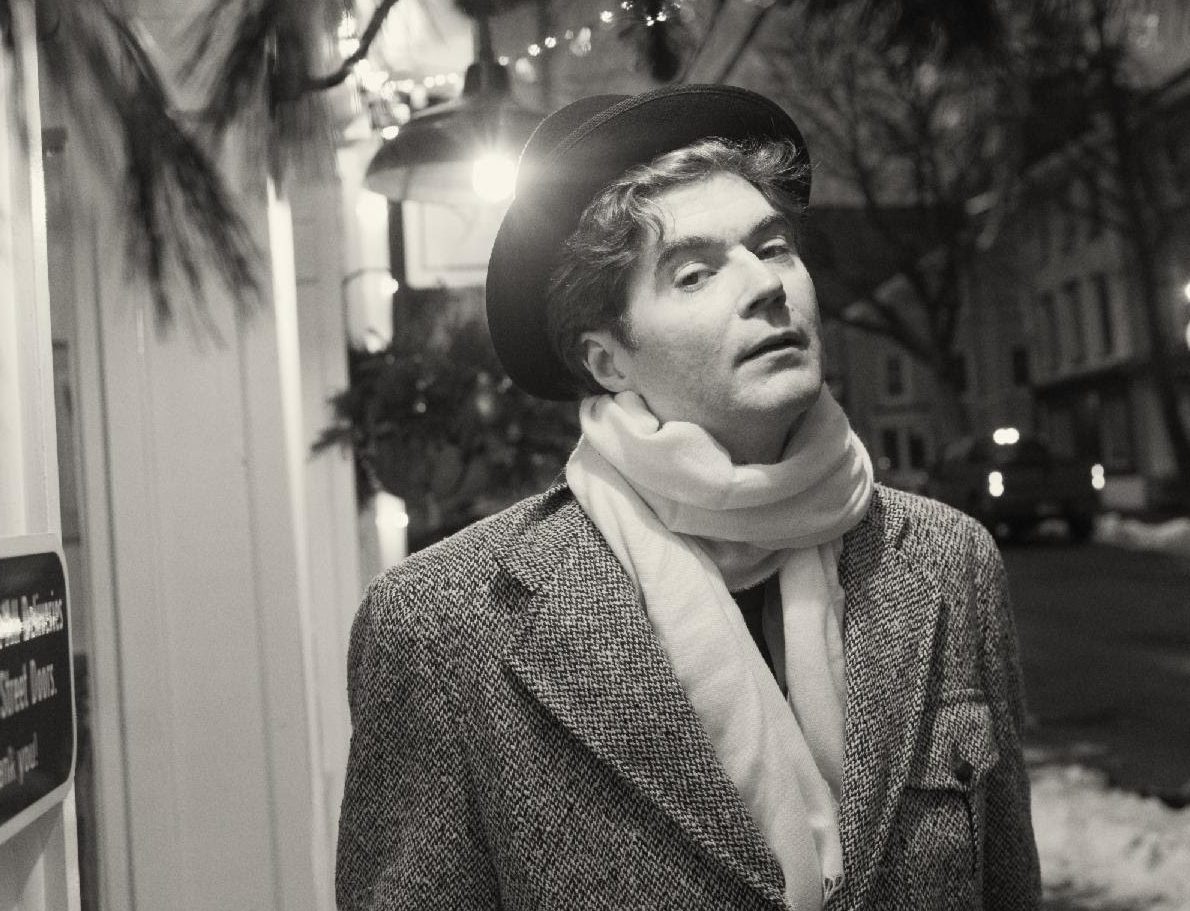
Singer/songwriter and composer Stephen Bluhm recently released his second full-length album, Out of the Nowhere. Into The Here. Whereas his previous self-titled album was more inclined towards Synth-Pop, for this new collection, Bluhm took a pretty different approach, at least on the surface, by creating Chamber Pop and following organic instrumentation. The album has been released in several formats, but is actually being released in a second, purely instrumental version, showcasing the intricate interaction of the instruments. Bluhm will also be performing with several instrumentalists on May 22nd, 2024 in Kingston, New York, as well as livestreaming the event for distant audiences. Other performances are to follow.
Bluhm wrote all of the instrumental parts on the album himself, but also enlisted help from local instrumentalists to perform them, and called in favors to help translate his compositions into necessary sheet-music to see things through to their final incarnation. Also notable on the album are Bluhm’s haunting vocals, carefully keyed in to the tone and atmosphere of each track, responding to the careful instrumentation. Out of the Nowhere. Into the Here, as the title might suggest, actually does give a strong sense of the permeability of time and place, and an interweaving of profound impressions with the normality of daily life. For that reason, it reminds us that joy and intrigue could be lurking around every corner of our familiar world.
I spoke with Stephen Bluhm about the relative complexity of approaching this ambitious album and some of the goals he had in mind with his songwriting, orchestration, and recording.

Hannah Means-Shannon: For this whole album, the piano is obviously important. Was that necessary to create a kind of backbone for all the more experimental stuff?
Stephen Bluhm: There are a lot of instruments on the record, but rarely are they playing at the same time. The arrangements are lush but sparse, oddly. Things will come in and out. I often use arrangements as part of the melody and part of the structure of the song. Probably that comes from a lot of listening to Classical, and a lot of listening to Burt Bacharach, who I think does that a lot.
HMS: In some ways, that’s contradictory to modern songwriting, so that’s interesting. I wondered if your willingness to use that as a song structuring element came from your Synth-Pop enthusiasm.
SB: That could be! Really, I didn’t find the process different doing the Synth-Pop stuff. I’d had so much experience doing those arrangements, that this was pretty much the same process. Instead of assigning a part to a bass synth, it would be to a double bass or a cello. You just run into things with orchestration where parts that are easy on a keyboard are tricky on an instrument, for instance being too low for an oboe, so you have to get an English horn, like I did.
HMS: So you were up against some ideas that you didn’t know how to get into audible form?
SB: This was my first time orchestrating a lot of these instruments, and fortunately I had help. I wrote the parts on a synthesizer, basically with Midi, so I could hear the parts being played back. Then, I didn’t want to use any samples on the actual album. I wanted it to feel organic and to hear the sound of actual air. I ended up getting fantastic musicians, many from Bard College, and their post-grad orchestra.
One of my collaborators’ father is an orchestra teacher, and he helped me take these parts and make sheet music so I could hire these players. We did it at my house. I have an audio engineering background, I studied at Temple University, and my brother is a Producer also, so he helped me a good deal. I don’t think it’s a lo-fi sounding record, but I liked the sound of it being made in a living room, and going from there to the listener’s living room, basically.
HMS: I wouldn’t have necessarily known from listening that it wasn’t recorded in a studio, but I do get what you’re saying about the air. I can hear it there. It doesn’t feel too contained.
SB: I didn’t use any Pop music effects that I might have used on other recordings, either. There’s no doubling of vocals or instruments. Every time you hear a cello, it’s also panned in the same place so the instruments aren’t bouncing around. I used some effects when mixing, but nothing else. I had it mastered at a great mastering studio to compensate for the fact that it was home recorded.
HMS: I think the sound approach contributes to a feeling that you’re in the presence of the music. The song “Easter” has a vocal approach, too, that’s very emotional, so I can see the vocals following these trends. Given how unusual the vocals are on the songs, how did you map them out for recording?
SB: I made demos. I don’t know if I thought about it that strictly. The process was, yes, making demos, with the arrangement mapped out. There would sometimes be a few different versions to find out what worked well. I’d edit the lyrics. I got feedback on enunciation and it was nice to share early demos with people. I also did a few vocal lessons with my friend Andrew Stein who is a vocal teacher and does a lot of local theater as a musician. He backed me up on a lot of decisions, like tempo, and vocal performance.
Then, recording the vocals was me in my home studio after the other musicians had fully recorded. That was because I wanted to sing along with the complete song. I wanted to get into the full emotion of the song that way. There were little bits where I might have had certain things from the demo that I wanted to keep, but I might sing it a different way. Some of it was how it came out. I’d also do a number of vocal takes. I’d do five to ten vocal takes in a sitting.
HMS: That makes sense because certain things are really key to the vocal lines, but others are more like variables or possibilities.
SB: Yes, that sounds right.
HMS: That does open another question, which is what happens when you play these songs live. I’ve seen that you’ve been doing some performances. Do you have friends come and help?
SB: I played at a church in Hudson. It can go either way. The songs certainly sound good with just me, a guitar or piano, and my voice, solo. I’m a traditional songwriter in that I think that if you strip away everything and it doesn’t sound good, maybe it’s not a good song. The songs work that way. But I do like having instruments, the extra orchestral elements. It’s exciting for the audience to hear and see something different.
So I’ve been playing live. I’m playing a big opening show [on April 25th] with clarinetist and saxophonist, a flautist, a cellist, and a violinist. Then, we’ll be doing the same show again in Kingston, New York, on May 22nd, which will be live in person, and also livestreamed for anyone in the world to tune in. I’ll have another show on June 1st in Philadelphia with a cellist. It’s a mix.
HMS: One of the songs that’s had a video released, “Wissahickon”, has a nice combination of archaic elements, suggesting the past, and also modern life, like references to missing a meeting. But it’s also kind of like a walk into the primordial world or fairy land. Is that kind of combination of the past and present important to you?
SB: Yes, that’s spot-on. It is a like a day-dream. The characters suddenly find out that their meeting is cancelled at their day job, and they have a day-dream back to the time of Wissahickon, but it’s not like it is now. It’s like it was in the late 1600s where there were these cults there getting baptized in the creek. It’s like a dream within a dream. Then they are jostled awake by the local Philadelphia SEPTA bus. One of my favorite lines on the album is towards the end of the song, “You look back and smile at us.” This reveals that the narrator is sort of one of the characters of the woods.
HMS: It made me think almost of Washington Irving’s story of Rip Van Winkle, where he falls asleep in the Hudson hills, and wakes up an old man.
SB: That’s right where I live, now. I cross the Rip Van Winkle bridge every day. That wasn’t intentional, but it’s part of my surroundings, so it may have crept into the song.
HMS: There’s a feeling of the relativity of time where you slip in and out.
SB: I hope a lot of the album has that feeling, even if it’s not directly, lyrically, about that.

HMS: I think the overlapping and contrasting worlds contributes to that in many of the songs. The song “There Was a Light” has a transcendental sense to it, too. It reminded me of a poem by Wordsworth, too, and his phrase “surprised by joy.” But it’s the idea of having a normal experience, then suddenly something that happens seems bigger, and you have to contemplate that. The rhythmic quality adds to that feeling of the other in this song.
SB: Maybe so! I hadn’t thought about that. I was definitely taking after [the French composer] Satie in that song. It’s not the same chord progression, but it’s similar to the famous piece, “Gymnopédie” number two. The song is about a religious experience I had when I was going through an exciting time in my life with my music getting recognized. I was awake in the middle of the night, trying to go to sleep. I couldn’t sleep for all the excitement. I was thinking of the strangeness of where melodies come from as they pop into your head. When I was thinking of this, I had a feeling of electricity going up my body, then off when I thought of something else.
Things returned to normal, but a few weeks later, something else exciting happened, then I had the same experience again. I thought about where melodies come from, and I felt electricity again, then [turning] off as I thought about something else. I mentioned it my mom, who said she thought it was a spiritual awakening. Then some friends of mine said that they thought it was a Kundalini awakening. Then I really, really freaked out. It was a little bit beyond my understanding. It’s very common for songwriters to say that they channel something when they write, so this seemed like a confirmation that we’re connected to something bigger. But I couldn’t sleep much for a few nights, and I had a massive panic attack.
Some friends of mine took me to the hospital to re-set, and while I was in the hospital, I slept great. Except one night, in the middle of the night, I suddenly awakened with a light above me, like a little portal, and it felt like waves of pure love were coming down on me and warming my chest. It was only for a few seconds, but it wasn’t a dream. I could see around the room. I could see a connection with the entire universe. I went to sleep and remembered it in the morning. It was the most important few seconds of my life.
So the song is about wondering about all of that stuff, kind of like what you were saying, about having an experience, and thinking, “What the hell was that?” It was traumatic for me, though, and I had to put songwriting and music away for a few years, since it was all wrapped up in music. The song is sort of a slice of little bits of what that was like. It’s kind of a plaintive, sad song, because it was a comforting experience, but it was wrapped up in trauma, so I don’t think of it as a joyful song.
HMS: As you were telling that story, I was thinking, “That could be quite unsettling!” I was wondering recently whether everyone wants a worldview that embraces bigger experiences. That experience was a big world-view changer. How were you able to get back to music, following that?
SB: Just over time, gradually healing. Music is such a big part of my life that I was always going to have to come back to it. After a few years, as I started to feel better, I started to play again. I struggled with the idea of whether or not to write about my experience, whether or not to capitalize on that gift. But I thought, “You know what? I’m a songwriter. If the powers that be didn’t want this to be written about, it would have happened to someone else.” I write about what’s on my mind, and this was very much on my mind.
