
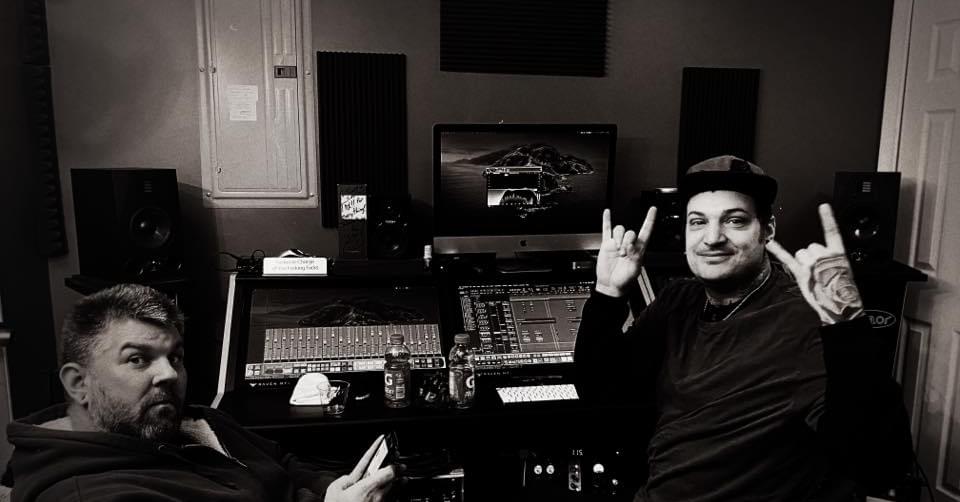
[Cover photo features CJ Wood and Scott Gross]
The Bombshelter is a recording studio in Red Lion, Pennsylvania, owned and operated by Christopher Wood and Scott Gross. Building on decades of personal experience performing as well as recording and mixing music, the two embarked on a new commercial identity for the studio in 2020 in the midst of difficult times for the world. Now, only a few years later, they have quite an impressive list of credits from across genres, whether Metal and Hardcore or singer/songwriter work. They have also amassed both analog and digital gear to cater to a wide range of needs.
Scott Gross is a founding member and songwriter of Long Island’s From Autumn to Ashes and Chris Wood is part of local outfit Bury the Masses. Their goal in establishing The Bombshelter was “to get professional, yet affordable productions to the public.” The outcome of their work, and their ongoing rotation of clients speaks to the success of their approach. It’s not an easy time to run your own business, much less a music studio, but Wood and Gross are seeking to bridge the gap between artists who want to record an album but can’t afford it, and those who can see their dream realized through affordable services. As musicians themselves, they find it rewarding to make those dreams a reality.
I spoke with Chris Wood and Scott Gross about the foundations of The Bombshelter and what their varied experiences have been like working with artists who may have very different goals and needs from session to session.

Hannah Means-Shannon: Your whole story of starting up your studio in 2020 is really interesting because while it’s true that more people were recording at home during that time, it wasn’t necessarily the easiest time to start a business. You had an uphill battle. What made you take that step?
Scott Gross: It was about 30 years before that when it all got started for us. Us sitting here was 2020. We had 30 years of business before that, so it wasn’t weird for us.
HMS: Your background in music goes way back?
SG: In general, there’s a tremendous background in terms of playing for both of us.
Christopher Wood: The studio took on what you could call a more commercial function around 2020. Prior to that, it was more just me doing my own stuff, recording my own band and friends. Scott was working at another studio and the owner of the building that they were working in had passed away, so the studio had to move, and it moved further West. It wasn’t convenient anymore, so me and Scott said, “Alright, we can work out of here.” That was around 2020, when we decided to team up here and work out of this studio. It became more commercial at that point.
HMS: So you, Chris, had already worked on your own albums, and albums for friends, but Scott had been working for some years in a studio. So then you brought all that together and said, “We’re going to charge people for this!”
CW: That’s basically how it went. When I was first getting started, I was still learning. Around 2009, I think, was when I started building things, starting small with a room and an interface. I kept building from there, so over the last 15 years, I’ve been learning how to do this. I don’t have a formal education in audio engineering like Scott does, but music has always been a part of who I am. As I was learning, I was picking Scott’s brain. It’s funny how we ended up together.

HMS: I’ve always been interested in Production. But more recently, I’ve been interviewing people at studios, because I think the public doesn’t get to know much about that side of things, usually. Mainly, there’s not one path to get that knowledge and education. What you’re saying is interesting because, yes, you can do courses and degrees in sound engineering and production, but the practical knowledge of how to be a Producer is something you gain only by doing it.
CW: In the year 2024, there’s a gap in what people do in the studio, as well. There’s an immense difference between what a Producer is and what an engineer is. Scott’s the in-house Producer. How that works is that he does all the “thinking”. He’s the intellect of the operation, so to speak. I’m the engineer and I do all the hands-on work. I press all the buttons. Scott listens to the music and to what the artists are doing to really define what the music needs to make it better. They have their own disciplines, but the world had confused that. I think people should be recognized for what they do rather than being thrown on the same pile.
HMS: I have had this exact conversation with some other Producers. You are right about this issue. There are old-school Producers who are more like the ideas person, who are more sensitive to what the music needs and where it’s going. They use words and talk to the band, making suggestions, and selecting songs.
Then there are the engineers who have the technical knowledge and training. But today, those terms are falling together and you have some Producers who are more engineering-oriented and you have some engineers who are more Production-oriented. It’s getting confusing.
CW: It can get you in trouble to make statements about it, because people can get upset about it. I’m not out here to do that, I just want people to be recognized for their work. It’s not true that everybody is a Producer. I wouldn’t call myself a Producer.
HMS: Related to this, are you both instrumentalists?
CW: Yes, Scott’s a guitarist, and my main instrument is bass.
HMS: Obviously, music is the foundational thing for both of you, and you’ve both played in bands. Are you both still in bands?
CW: I do still play music and I’m in bands. I have a solo project and I also play bass in an Indie Rock/Grunge situation with a couple guys in my rare spare time. Scott still plays and still writes regularly, he just doesn’t do it in a band setting anymore.

HMS: Do you think someone can be a good Producer or engineer if you haven’t been on the other side of the table?
SG: There have been some amazing award-winning people who are more on the business side.
CW: There are a lot of interviews where engineers and Producers say, “I couldn’t play a note!”
SG: Just from personal experience, I don’t think you could have a Producer who could do well without a super-good hold on music theory. I don’t see how that could work.
HMS: The further back we go into Rock music, there were some guys who were more on the business side as Producers. That can happen, it seems. It may be more a matter of personality, but having been in a band certainly makes you more sympathetic. As I’m sure you’d say, a lot of this business you’re doing is to make people feel comfortable being in a room making music.
CW: Yes. Scott’s a real big “vibe” guy. He talks about how important vibe is in the studio and that kind of thing, and how comfortable they are. While that’s important to me as well, I’m also a goal-oriented, goal-driven person. We get in, and I say, “Let’s work!” And Scott’s the one who says, “Slow down, let them move at their pace.” We make a good team in that aspect. He makes sure that I let the artists breathe, and I make sure that sessions don’t get too burned up sitting and talking.
HMS: There is always that danger of not getting anything done. It’s always a danger in music that people have all these ideas but don’t manage to capture them. There are also probably a lot of people who come to work with you who have never been in a studio before.
CW: Oh, a lot of people come in, who have never been in a studio before, or they’ve been in a small studio in a closet. When they come in, it can be overwhelming, because there’s a lot of equipment and a lot of stuff happening. There are people who put out incredible music out of their bedroom, because it can be about the ear. There’s the saying, “It’s not the gear, but the ear.” But gear helps!
HMS: There have been a couple of gigantically successful singles during the pandemic period that were recorded in bedrooms. It’s been wild.
SG: It’s a whole other world. It’s a whole other animal. It also puts big studios out of work. If a kid can do that and make a ton of money in royalties, they aren’t going to pay studios to do it, whether it’s better or not.

HMS: I think this is undoubtedly the age of the small and mid-sized studios. The age of the large studios is just about over, though there will always be some because some companies will have their own. The small and mid-sized studios are evolving, as you are. They face the questions you face, wondering: How will we survive? How will we attract people?
But even people who have self-Produced or self-recorded seem to hit a point where they want to go into a studio. I wouldn’t say it has to be one or the other. People like to shake things up from album to album. I guess you all deal with the question: What is it that we offer?
CW: I’ve had that conversation with Scott many times.
SG: Coffee! We offer coffee in the morning.
CW: There is coffee. We’ve talked about it many times over the year. There are a lot of bands and musicians who like to use the same studio and Producer over and over because they like the results they’ve gotten. That makes sense. If I make a record with a Producer that sells a bunch, I’m going to want to reproduce those results. But at some point, you hit a wall where the fourth or fifth album sounds like your first album because you haven’t stepped out of your comfort zone. You could go somewhere new and get a different take on things. At some point in time, it is important to step out and work with someone else, if for no other reason, to learn something new about yourself and your music so that you can apply it later.
HMS: I’m sure it’s a fine line, too, in how you communicate with people if you have suggestions.
CW: One thing that you get out here is honesty and we’re very direct people. When someone comes in, and if they have a good idea, we say so and give it a shot. If it’s not a good idea, we say, “You should do this instead.” Sometimes they listen, sometimes they don’t.
HMS: In a way, that’s one of the services you’re offering: direct, good advice based on your experience based on your knowledge. Of course, I also noticed that you do lots of different genres, which is healthy for any studio, I’m sure. But you must be pretty versatile if you work with so many sounds. Do you have people who are acoustic?
CW: Yes, my solo project is an acoustic thing. There’s a guy here in Pennsylvania who has an acoustic project that he does, who’s very talented, and he’s been through the studio a couple of times. We do deal with some acoustic artists.

HMS: Presumably, you do heavier stuff, which I think I saw in your credits. Both of you have experience in Indie Rock, Garage Rock, even Metal, I think.
CW: Yes, both Scott and I came up in that Hardcore/Metalcore scene. That’s what Scott did for many years professionally in bands. I spent most of my time playing in Hardcore and Metal bands. We’re well versed in those areas and do have those bands come through, too. We just had a band of young kids come in who just put out their first EP.
HMS: Do you focus on the songwriting side of things to give advice about what songs an artist should record? Are you saying, “These five songs are the best.”?
CW: Before a band comes in to record, they’ll give Scott demos. That’s part of his thinking aspect of what we do. I, personally, like to start putting things together in the studio and building the house here, so to speak. I don’t like to have too many preconceived notions of what they may or may not sound like.
Because there’s the demo, but maybe it was recorded six months ago with a single mic. It may sound terrible, or not, but I want to hear what they sound like here. I say, “Let’s get some sounds and let’s get moving.”
HMS: Then you encounter what they actually sound like. I was thinking the opposite, which is that with all the software now, people can build all kinds of things, but may not actually be able to play instruments live the way you’d hope.
CW: Absolutely, and that can happen. That has happened. If they can’t perform the song they want to do, we have to strip it down, and break it into chunks, and rebuild it. Which is fine, for me, but it may not always be the best approach. I like to do that troubleshooting since it’s in my personality.
HMS: It sounds like, either way, they are going to learn something. I think every time, hopefully, someone who records will learn something that helps them in the future with what they are doing. Are you okay with them asking lots of questions and trying to learn from what you’re doing?
CJW: Yes, that’s totally fine. We do get a lot of questions. We welcome it. We do like people to educate themselves. Obviously, we want people to record with us, but we’ll answer questions in general. Even afterwards, we’ll get lots of questions. People will come, do a whole record, release it, and they’ll be sending us texts and messages asking us different questions about the recording process, or equipment. Maybe they are looking into doing their own stuff, but we have no problem talking with them about it.
HMS: Often the Producer is the person who knows about and can find studio musicians if needed, or who knows a little about distribution and can give some advice about it. Do you get people asking you, “How do I release my music?”
CJW: Yes, actually. We just walked a band through releasing a record, from start to finish. We’re full service here! We do whatever needs to be done.
