
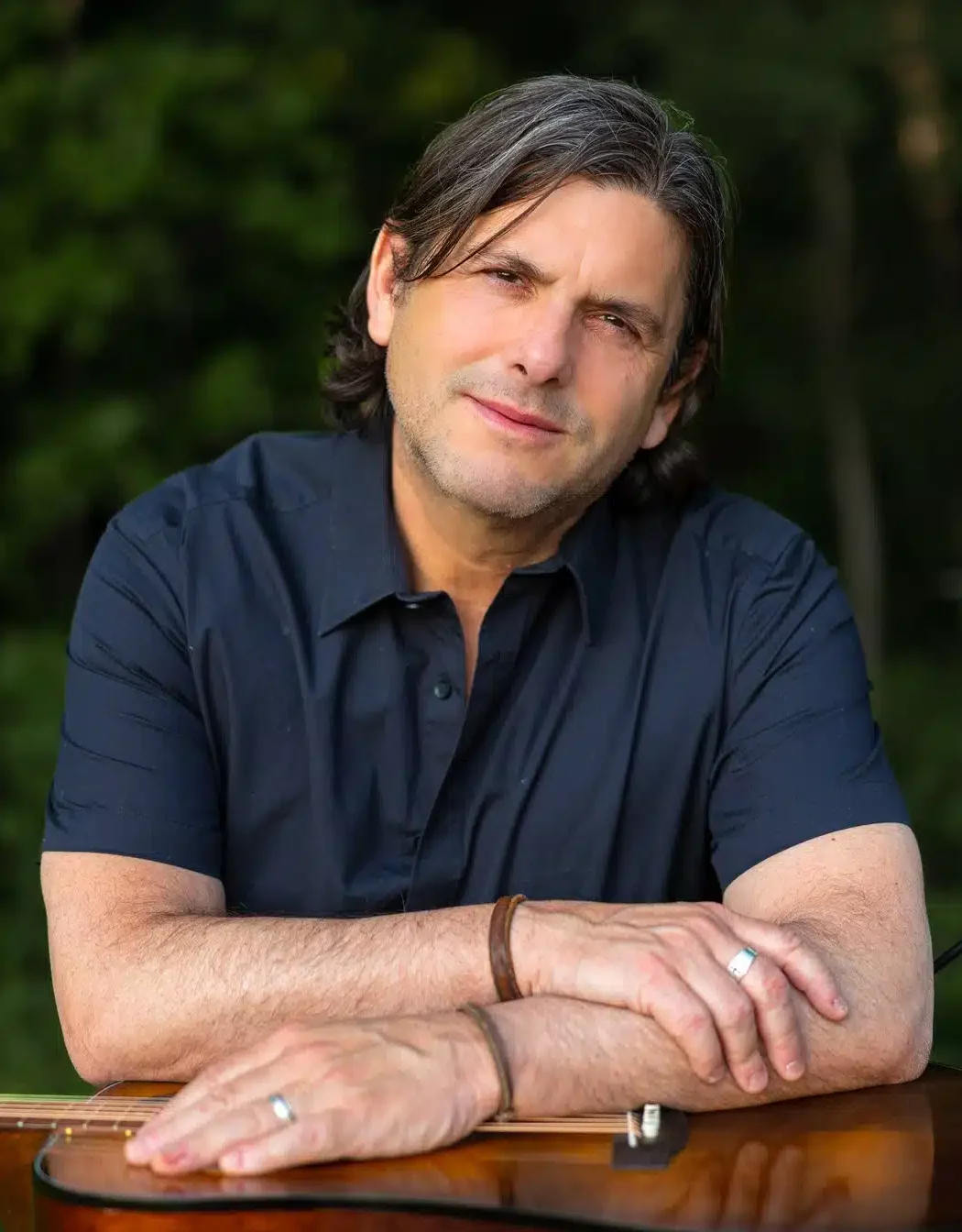
[Cover photo credit to Morgan Elliott]
Christian Parker is a notable upstate New York guitarist and solo artist who started down a very interesting road a few years ago when he began searching out the Psychedelic underpinnings in the music of The Byrds, a band who had deeply influenced his youth. When original Byrds collaborators like Earl Poole Ball and Jaydee Maness started not only collaborating with him, but asking him to keep going with the experiment, their sessions led to not one, but two albums, so far.
The first to be released was the award-winning Sweethearts, an album inspired by The Byrds’ ground-breaking Psychedelic Country album Sweetheart of the Rodeo. While Sweethearts just collects songs originally from Sweetheart of the Rodeo alongside a couple near-contemporary tracks, Parker’s recording sessions also took in songs from across The Byrds’ career. Those have now been gathered and released as Change is Now.
Based on meticulously study and recording while allowing for a modern, fresh feel, Change is Now really brings home just how visionary and creative The Byrds were in their compositions. I spoke with Christian Parker about chasing down sounds for Change Is Now.

Hannah Means-Shannon: When we talked about your previous album, Sweethearts, I know that you had originally recorded a number of songs by The Byrds and that eventually there were enough from Sweetheart of the Rodeo that you decided to make a separate album of it. Is Change is Now the result of those other recording sessions coming to light?
Christian Parker: Yes. We made the decision to completely do Sweethearts when I realized how many of those songs had been done. I had “Change is Now” done. “She Don’t Care About Time” is the first song that I recorded for all the projects. That was me coming out of the gate doing The Byrds. That was all the years of me thinking about the music and growing up with it.
I was so closely connected to it, like a lot of people who passionately love the band, the music, and the era. So that was kind of a song that I had always wanted to do. It never really got its day in the sun, or its spotlight, because it was the B-side to “Turn Turn Turn.” Then, I started on “Here Without You.” I was knee-deep in the spooky Gene Clark songs at that point. Then I did “Change is Now”, which took two months to make. It was a work in progress. A lot went into that to try to give everything its own space in the mix. I did the bass part three times on that one. We needed that done right, that’s really powerful. The bass was replaced on that, finally, several months later. I had other recordings that I abandoned. I decided, “Maybe this isn’t the best song to pick”. So there were a few dead ends.
But as soon as I got done with Sweethearts last year, that’s when I went and did all the tracking on some of the other songs. I had started “Wild Mountain Thyme”, I had “The Ballad of Easy Rider” already. I was working on those at the same time. I was recorded some of them at the same time as Sweethearts. The rest of the songs that I recorded are kind of in the order that Change is Now is laid out. That acoustic song at the end was just a demo, but it almost was thrown on. It only appears on CD and digital, since it wouldn’t fit on the vinyl.

HMS: So was all of this recording a process of going down to Syracuse from where you live to lay it down?
CP: I have a recording studio in my house. I built a real studio there. So I start the songs and work on the parts at home. I do a chunk of engineering. Anytime you hear a guitar or vocals, I did about 90% of that recording. Since then, I’ve done a little more singing down there in Syracuse. But I like to do it at home since sometimes I need to learn the songs and work through the bugs. There’s a difference between knowing them as hearing them and really knowing them! [Laughs] It’s not always a work of art, and takes a while to get there. I have to work hard on it.
On the song “Get To You”, the drums were done in Syracuse and the bass was done in Nashville. I did an electric guitar, and those parts were done. Then I sent it to Stevie Blacke in California, to arrange a string part. He asked me if I wanted to put lap steel on it because it’s in the song. He did those parts and pretty much at that point, I was ready to sing it. Then I realized how high it was!
HMS: I’ve been waiting for you to tell me about the vocals because they are so unusual on that original song. I don’t know how you sang it so differently and so high, honestly.
CP: I literally tried to sing it and got so upset because I didn’t think I could pull it off. Using your full voice from your chest, I don’t have that range. I don’t sing for Rush. Tom Petty could, strangely, sing so high, and so did [Roger] McGuinn back then. But I listened closely to what he was doing, and he was using falsetto. So I just said, “Okay, I don’t really sing in falsetto.” So I read about, saw some Youtube videos, and took a whole different approach. I got closer to the mic and I sang softer. I tried to figure out where the falsetto needed to come in and where to switch from my “head voice” to my “chest voice.” Once I got that down, I did a couple takes. Then I comped a track and took the best parts. Then I actually went and doubled it, so I sang to myself again. Then, I went and did all the harmonies. Then, I went and did all the other vocal things.
HMS: I don’t know if agree with me, but “Get To You” is such a strange song. It’s so weird. I think it’s amazing that you decided to do it, because as you’ve explained, it took a hunting-it-down approach. I feel like you really “cracked” how they did it to reconstitute this track. Do you have memories of the first time you heard this song and your reaction to it?
CP: I do, yes. I was a junior in high school the first time that I heard it. I remember listening to it when I would drive to school. It reminded me of my childhood. I always thought it was this cool song.
HMS: It’s got this fast beat that doesn’t stop, it’s got that high vocal, it sounds a little Beatles-like, a little Sgt. Pepper. In my opinion, it’s very psychedelic.
SP: It is! It’s in 5/6 time. It’s in a very strange time signature. Then it switches and goes to the high part, and then it’s in 6/4. Then it goes back to 5/6 time. It’s really a neat song in that way. It was literally a science project to figure out this song. At one point, it sounds like I put a rotary sound effect on it. It’s like an “ah-ah-ah-ah”. That’s my voice doing that with a rotary effect on it. There’s a thing that’s a breathing sound that repeats. So I had to go to the microphone and once I got a good bar of it, I just looped it. I had my friend Joe sing with me on it, on one of the harmonies. It’s so stacked. We got this really, really cool song and I couldn’t believe that I managed to pull it off.
HMS: I’m glad it didn’t become a dead-end, one that you set aside.
SP: I almost did. I was nervous. “Change is Now” is from the same record, and that one was tough to do, too. You mention the term “psychedelic”, and it still blows my mind that that record, The Notorious Byrd Brothers, came out six months before Sweetheart of the Rodeo. Gary Usher was really behind that sound, but Crosby was on “Change Is Now”. He was only there for a couple of songs on that record. It was really just McGuinn and Hillman doing the heavy lifting on that album.
HMS: Something that really stood out to me, hearing this music, is that it’s surprisingly maximalist. This is not a small effort that they are making. They are throwing it all in. When you were trying to do this, that’s what you were dealing with! “Change Is Now” is a great example of all of the layers.
CP: “Change Is Now” was the last one to get done. Tracking the lead took me a little bit to figure that one out. I was trying to figure out how to do it, so I took out my old Fender Vibrolux Amp out, and it’s got a really good sound. It needed to be clean but over-driven. Because it’s spontaneous 60’s psychedelic lead, and I don’t read music, I would listen to a phrase. I’d listen to a line, and then I’d play it, and record it phrase by phrase. Once I did that, I went back and played it start to finish.
That’s how I’d learn it and put it together. I had to compartmentalize it. The second guitar needed to come in and be weaving. I had to figure how to make is sound kind of “backwards” to, because they have this weird effect that comes in. I had to use a long crossfade. You had to know where to put those, because there are those little elements. I’m not doing it perfectly, like their version, but it’s definitely inspired by their version, you could say!
HMS: I was going to make sure to mention “She Don’t Care About Time” and I’m really surprised that it was the first one that you all worked on. That song is really interesting, too, because it’s so understated, but it’s so fluid and confident. They clearly don’t feel that they are in unknown territory, here. There’s a naturalness to it.
CP: I was just coming off my own solo stuff, too. For two years, I’d been recording my own music, and only about 90 days later, I was ready for a new project. I was a little pumped up with energy, and felt like it would be exciting to do something like this. I’d been thinking about it. I’d already recorded “The Ballad of Easy Rider.” I had a different version of “The Ballad of Easy Rider” that I’d done that’s way different. It’s kind of up-beat, instead of having a reflective sound, like the one on the original record, and this time I went after the studio version.
But “The Ballad of Easy Rider” is one that I’ve recorded more than any other as a cover song. When I was 20 years old, I recorded it on my 4-track tape machine. Then, in 1990, when I was releasing a solo record, I had one cover on it, and it was that song. It was a completely different. It was just me and my acoustic guitar, very chimy and bright. I played the harmonica on it. When I got this last recording done, I said, “I think I’m done with this song!” I really love the song. It was another one that goes back to high school, for me. Formative songs feel like a soundtrack of your life.
HMS: What songs didn’t make it onto this album?
CP: “Mr. Spaceman” is a good example of a song that I dropped. I had it almost done. I used to sing that one live all the time. It’s a cool song, but I took a different approach back then. I didn’t really approach it like The Byrds when I tried. The original “Mr. Spaceman” had a different beat than the way that I approached it. Mine was more Western sounding. When I got to singing on it, I felt like I couldn’t find my own voice on it. It was like karaoke, and I said, “I’m not doing this song.” Everyone said, “Oh come on!” I said someone else could sing it and I’d stay on the chorus. But that’s one that we left.
HMS: How did you keep yourself on track recording so many songs and keeping everything moving forward, day by day?
CP: The way that I stayed on it was trying to stay focused and organized. I kept good notes. I always tried to look at what was at the finish line. I’d ask myself, “What’s the objective?” And “When do I stop?” I knew that I had enough songs, so along the way, we had other songs that we said “no” to. I’m really happy that it turned out the way it did. The song “Full Circle” was on their reunion record of 1973 and for fans it has a lot of meaning. All the original Byrds sang it as the first song on that reunion record in 1973, where two of the original Byrds had died that year, so it was a sad and powerful time for the band. Then, they all went their own separate ways.
I just feel such appreciation towards the music and I’m really happy that I did this project. I’ve met many new friends and established meaningful collaborations from this project. Now we’re just trying to figure out how to keep making music together, but I think we’re on the right path.
You can also find our previous interview with Christian Parker about ‘Sweethearts’ right here.
