
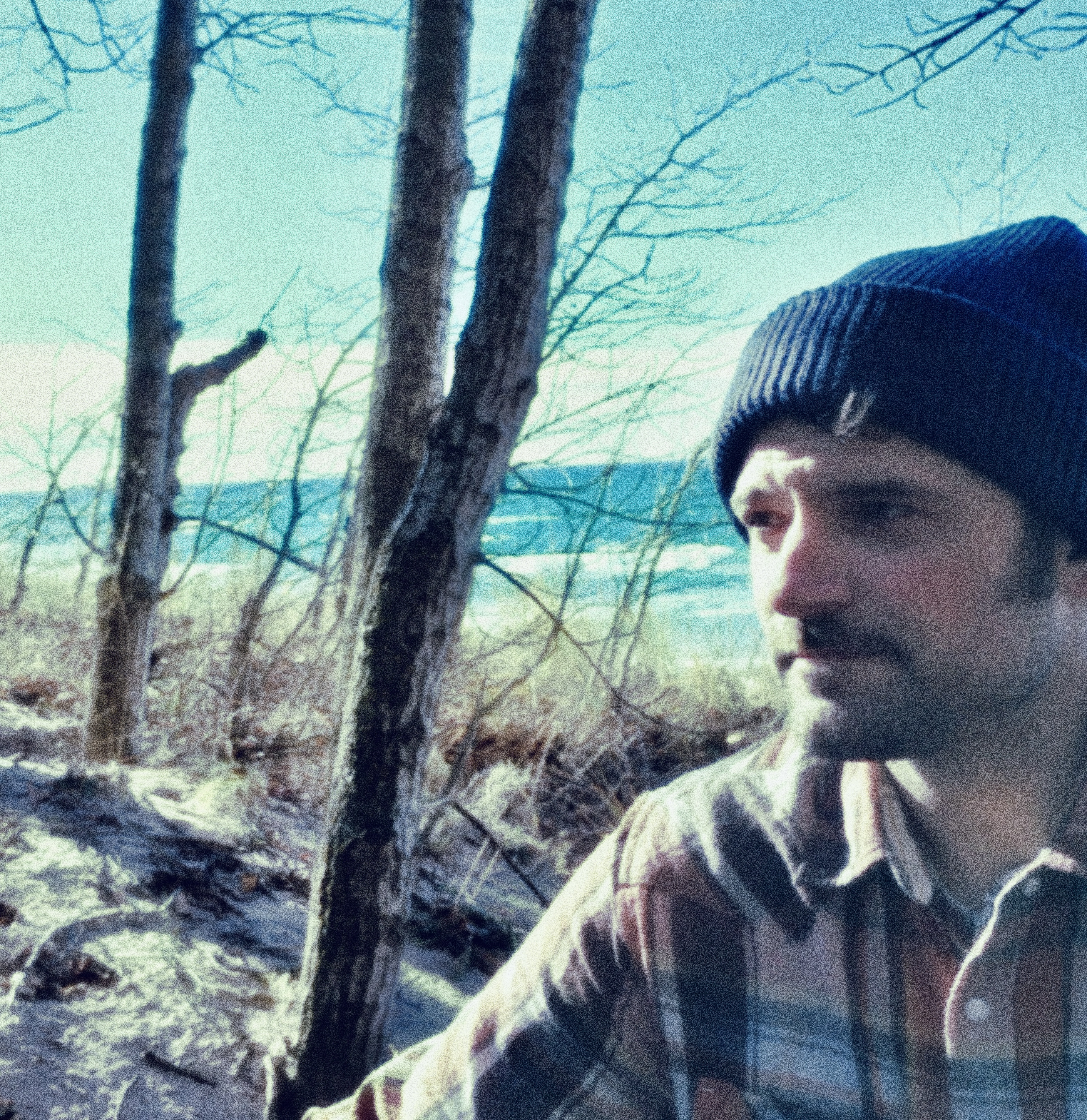
Singer/songwriter Jerome Forde has recently released his second album, Wintertide Blues, via Toronto’s (weewerk) label and has the distinction of being the first American artist to sign with them. It’s a pretty quick turnaround since Forde’s 2023 self-titled debut, but having made music in his youth, and spent several years away from it, Forde had a cache of songwriting to work with. For him, it was only a matter of choosing what songs made a natural collection, and deciding to up his recording and Production game to produce stunning seasonal results.
As a Michigan-based artist, Forde has been immersed in winter his whole life, and there’s a special synergy between his choice of wintery imagery and the fact that these are, in essence, love songs, each with different kinds of situations and perspectives. There’s a hopefulness in these conversations that are potentially more than one-sided and also a reflective look at the passage of time and what wisdom that can bring us. Sound-wise, Forde makes major leaps on Wintertide Blues, exploring his natural bent toward layering much more fully and creating not just ethereal hints and touches, but full-blown harmonic orchestrations. As it turns out, his whole concept of recording has expanded, bringing us an expanded experience.
I spoke with Jerome Forde about these developments and those hopeful glimmers that shine through Wintertide Blues.

Hannah Means-Shannon: I know that last time we spoke, you had been writing, and there were other songs in the works, but it’s still been really quick to have this new collection out. I know that you have a body of songs built up from your time away from music. In terms of recording, though, do all the songs on Wintertide Blues come after the self-titled collection?
Jerome Forde: Chronologically, yes, but I do have a backlog of songs and it’s a mixed bag. I try to put my backlog of songs into little albums, and they seem to fit together organically in that way. These songs just seemed to fit together in a way that I liked.
HMS: They really do! Sometimes poetry is grouped by subject, like Shakespeare’s sonnets, and you have all these little collections. It’s also appropriate to release this one in February.
JF: Yes! For the last album, we gave it three months before the release to work on it, but the recording process was a little different this time around. I was working with GarageBand, which I’m totally unfamiliar with, and I’ve never really done in-depth mastering or mixing. It took way longer than I expected, but I got it done in early January. It’s been really quick working with (weework), but Phil [Klygo] has been really great helping get it out there.
HMS: Now I’m imagining that your whole holiday period was spent tied to a computer!
JF: That also made things take longer, but I also have birthdays for my sons, but I took some time off. I was glad I had those days off, since I probably would have gotten too bogged down.
HMS: Learning new technology is a whole world, and I’ve spoken to many people who have been totally analog and have been switching over to digital. Do you feel more accomplished now?
JF: No! I feel like I know less now. I would totally do analog if I could, it’s just too expensive. I love the way it sounds. It sounds so warm.
HMS: I saw the video for “All Along”. To what extent is that environment, in the video, normal to you? Because you are from this kind of landscape, right?
JF: Yes. That was a particularly beautiful snowfall. We had a couple rough weeks of weather where the snow was pretty insane. It was so cold, too. It warmed up a little bit that day, and the wind died down for a couple of hours, then it started to snow in these huge feathers of snow. I was actually feeling really sick that day, and had a fever, but my wife and I knew it was a really perfect time to try to get that video done. We went to the beach in Alberta and filmed it. We shot it on an iPad, but it looks really nice with a filter on it.
HMS: The colors look really cool.
JF: My son taught me how to do that.

HMS: Child labor! Gotta love it. I love how all the visuals for this album have really come together, though, from the video, the photos, the album cover and single cover. There feels like there’s a real continuity there to the look and feel in relationship to the music.
JF: Yes, we were trying to go for something like that.
HMS: The album is unusual because the mood and the feeling is unique. There aren’t a lot of people using a wintery feel for their work aside from holiday albums.
JF: This is my only seasonal album, for whatever reason. I grew up in the upper Midwest and winter is a really big thing, dealing with it. It’s really fun going through Thanksgiving and the holidays, then around mid-February things start to get a little tiresome. You’re dealing with the winter blues.
HMS: Yes, it gets a little much. It’s a whole personality to the landscape. Even on the East Coast I can feel that in February. It’s like a little too early to be thinking of Spring, and it’s a kind of stagnation that sets in. At the same time, there’s a beauty to the music you can create around difficult ideas, and I think the album is really beautiful. I don’t think it’s a depressing album, for instance.
JF: No, I don’t think so either. There’s a lot of longing in it. Like with the last album, there’s an underlying hope. Ending the album with “All Along” caps it off and defines the full mood of the album. It’s the arc of the story ends there, and ultimately, it’s a hopeful record.
HMS: I can see how this is also a collection of love songs, but they all feel like a conversation, and because there is another person there, that’s part of what makes it a hopeful record. When people are isolated, that’s one thing, but when people are trying to communicate, that opens a door, in a way. It reaches for something.
JF: That’s a good way of putting it. I agree.
HMS: You mention that you were learning all this technology, but do you feel that you were letting things go further this time, in terms of sound? I hear a lot more here.
JF: Oh, definitely. The equipment I was using before only gave me 16 tracks and I like to layer things. That really cut me short in terms of what I could do. Now I have unlimited tracks, so I was able to use all the instruments that I wanted to in any way that I wanted to, at least in terms of number. In terms of the way that they sound, I still have limits in terms of my equipment, instruments, and mics.
My banjo is kind of a piece of garbage! My ukulele is something I bought for my son, but it sounds alright if you mic it in a certain way. I also kind of recorded each song one at a time last time, doing instruments and vocals all at once, but for this album, I did every song all together, one track at a time, and did the vocals on top, afterwards, all at once. I was able to make arrangements for every song.
I was kind of inspired by the way that Brian Wilson did Pet Sounds. He had everything, all the music, completely recorded for the guys when they came back from tour. Then they were able to lay down all the vocals all at once. Being able to create all the songs, without any vocals in them, and kind of let them stand alone as musical pieces, was my goal for instrumentation.
HMS: That really explains to me how the vocals and the music can be so closely related on this album. It’s totally up to the style and intention of an artist whether they do this, but it seems like you can’t get that really close synergy between vocals and music unless you have all the music beforehand. If you’re building a song that way, what do you usually start with in terms of recording?
JF: I usually just start with the rhythm guitar first. I put a click track on and try to figure out the tempo I want. I build around that.
HMS: What about the track, “Mistaken for the Dead”, for example? I really liked the imagery in the song. When a person has nowhere to call home, it’s almost like drifting, and being among the dead, but those are also times when you can potentially have big realizations and gain from that perspective.
JF: Yes, definitely. That song is actually one of the older ones on the album, written about 15 years ago. I guess I didn’t really have a real intention as I was writing it, I just had metaphors and images in my head. But the original version was intended to be on an acoustic guitar by itself based on a picking pattern I had. With this album, focusing more on the music, I almost feel like recording the album, and Producing the album, is almost as much part of the writing process as anything else.
I used to think that first you write a song and then record it, but recording almost makes the song become what it is. Recording this song, all the sudden it transformed into something else and became a lot fuller. I went to a strumming pattern instead and added a lot of instruments to it, as well as the harmonies. I was kind of going for a sound like the early Fleet Foxes records.
HMS: This song, by the way, has a real force and energy to it, the way that it builds up, and I think that’s more than any of the songs on the previous collection. That’s not a criticism of your first record, but it shows what this album is for you. The lyrics are also cyclical and make you think of starting over. We spoke about how the album is not hopeless, and that’s another thing that’s not hopeless, this idea of and ending also being a beginning, a circular thing. Have you ever played that one live?
JF: I haven’t played that one live. For the shows that I play, I don’t just play my own songs for 40 minutes, I’m up there for like three hours. I play a mixture of covers and originals, and most people want you to play covers, of course. They want me to be like a jukebox. I try to play the songs that are the most palatable for people who are just frequenting vineyards, distilleries, or breweries.
HMS: I can totally get that. This one is an intricate song and would definitely benefit from a band.
JF: Totally. I’ve had various offers from people to play in a band and I might take them up on that. It’s hard to be able to afford that.
HMS: That three-hour playing is so impressive! I’ve spoken to people who made a living that way, and that’s really boot-camp. Do you feel like, since you started playing again a few years ago, you’ve changed as a person from doing all those shows?
JF: I definitely have, though it’s been a slow process. Looking back on it now, I can see it. Just the amount of hours spent playing the guitar and singing. The number of hours is almost overwhelming when you think about it. Things just come easier to me now. It’s important not to get bored, though, so even for the covers that I play, I choose ones that no one has really heard of. I pick them because I think they resonate with me and are really great songs and I hope other people will benefit from them.
HMS: Otherwise, what are you doing? It has to be meaningful to you. Another really interesting song is “Maria”. That one sounds super Americana sounding, almost Honky Tonk starting out, which is cool. It feels conversational. This reminds me of conversations I have with my siblings about people we grew up with and whether they have stayed in a small world mindset. It can be hard to talk to people after that passage of time, too.
JF: I think, also, as you get older, if you have regrets, they become heavier. We only have so many options at any given point in our life, and the more advantages you have in life, the more opportunities you have. Some people only have one or two choices to make, but you make those choices and then you have to live with them. Years go by, and you think, “What if?” Things get more complicated.
Ultimately, that song has a hope of some kind of redemption. A redemption in a way of healing things, even if you drifted apart. If the conversation keeps going, like you said, there’s always a possibility of amending it. The hopefulness of the album is that constant striving. I guess I don’t like the idea of striving for the past, since nostalgia is a dead end. But there’s a way of reliving the past in the future in way that redeems our decisions and makes the past somehow meaningful.
HMS: That’s a really awesome thought. This is because the story isn’t over if you’re still alive and making decisions. If you live your life creatively, in terms of creative decision-making, it can be transformative of the past. It can change the meaning of your past for you, which kind of changes the past.
JF: I think that’s really it. Because the way we remember the past really is the past.
HMS: There’s a lot of overcast sky and sun imagery in these songs. I don’t think you did that on purpose.
JF: No, I don’t think I did. A lot of songs have that, though I tried to diversify it, because you can get obsessed with certain things. It’s almost like themes in classical music. The variations are totally different songs in themselves, but they are refracted pieces of one thing. In terms of imagery, I use a lot of nature imagery, with light and darkness, the sun and the moon.
HMS: The song “All Along” has a really powerful sound. Were you aware of building it up in that way?
JF: I’m really happy with how that came out, Production-wise. It doesn’t sound like it was recorded in my basement!
HMS: So many people record in their basements, we have to redefine what a basement recording sounds like. Is there harmonica on that song?
JF: Yes, I got a harmonica on there at the end. Even Brian Wilson used a harmonica.
HMS: I’m happy to hear that. Does “All Along” have to do with opening your eyes to what is in front of you, something you couldn’t realize?
JF: It’s the idea that there’s a perfection that you’re striving for, that’s an infinite task, but everything’s right there in front of you, in the end. The whole time, it was there. Instead of thinking in terms of Plato’s ideas, where there are these realms of forms that we can’t reach, I guess I’ve become more of a materialist, in a way, where I think that everything’s right there. We’re still alive, right now, and what else can you really ask for?
