
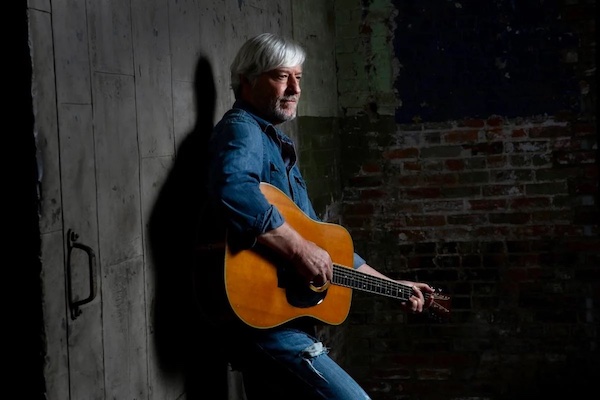
Nashville, Tennessee-based singer/songwriter Buddy Mondlock is known both for his original releases and for the songs he’s written that other artists have recorded, including Guy Clark, Nanci Griffith, and Janis Ian, just to name just a few.
Mondlock also has a long history of collaboration both in songwriting and in touring. His two most recent collections of original songs include the 2023 album Filament, and 2022 album Poetic Justice. He’s been busy with new collaborations of late, and today we’re very pleased to premier the track “Girlstown”, which will arrive for streaming and purchase this Friday, January 19th, 2024.
“Girlstown” was co-written with songwriter and colleague Chelsea Ewing and is based on her own experience with the juvenile criminal justice system and the ways in which “that experience produced scars that lasted for decades.”
To share one’s traumatic real-life experiences in a song is a vulnerable thing, and to collaborate with another songwriter about such difficult subjects is an especially great example of how music can bring people together and act as a vehicle for healing. For that reason, this team up between Mondlock and Ewing is particularly inspiring. Choosing the lyrics for this song and deciding on the mood and instrumentation of the delivery must have been particularly challenging. What emerges seems like a series of excellent choices in all areas, with lyrics chosen for pointedness, visual storytelling, and emotional weight, and music and vocals handled in a subdued, but empathetic way, that suggests determination but doesn’t distract from the story being told.
Thankfully for most of us, we won’t be able to directly relate to Ewing’s experiences being pigeon-holed as a villain at the age of 13, but this song goes a long way towards making that possible because we will react to the contrast between her age, her mitigating circumstances, and the way that this fork in the path of her life story seemed to dictate so much of what lay ahead for her. Many more people will also relate to the idea of being an adult, looking back on scarring events, and trying to decide how best to handle them in the hopes of create a less damaged life for ourselves. “Girlstown” delivers both perspectives and the biggest question it raises is one of identity: How is our identity determined and how much choice do we have in the matter?
Most likely audiences will be familiar with conversations about prison reform that are always circling in the media. While we may be aware of just how dismal our prison systems are, and how flawed our justice system is, it’s a lot rarer to hear about how children are treated by the same system. There’s a particular need for people like Chelsea Ewing to share her story in the hopes of bringing about change but it’s also a great admonition to challenge the way that we see kids who have been branded by the justice system. It’s particularly helpful that Mondlock and Ewing decided to convey this story through such an expertly-crafted song where it can make such a direct emotional connection with audiences.
Buddy Mondlock shares about the song :
This song is right from Chelsea’s own experience and it’s about her journey too. I sure appreciate her sharing it with me and I’m honored to be a part of bringing it into the light. It’s seems especially relevant right now with the recent release of the NPR podcast, “The Kids of Rutherford County” about a judge who sent children as young as 7 years old to jail. Seems like the way our criminal justice system deals with young people is long overdue for a compassionate overhaul. I love this song and I’m proud to sing it.

Chelsea Ewing elaborates about her story and experiences :
The song, Girlstown, for me is the beginning of a reckoning. I have felt burdened, even tortured in some ways by my “story.” That’s what people like to call it, your story, implying you’ve had a life outside of the ordinary. I have been separated and other’d by the labels that come with being arrested as a youth. Labels like: delinquent, felon and girlstown-girl. All of these labels were spoken over me and carried loads of suggested meanings and societal stereotypes. These labels closed doors and spring boarded minds to conclusions that weren’t always true and never fair, never full-bodied with all the details and dimensions that make up a human life. These labels to me meant I would go most of my adolescence without being hugged. It would be rare to hear “I love you” because strangers (many strangers, many many strangers) would raise me inside of structures and rigorous systems that just don’t have much wiggle room for things like nurture.
When Buddy and I sat down to write Girlstown I was just learning to really share what it means to experience the criminal justice system. To start to share with people the details of what happens when you are arrested as a youth. Details like being stripped naked and sprayed down like a dog with fleas before being given a cavity search. I was 2 months into my 13th year of life. I had no priors and no idea what was actually happening. Details like I was the only girl in my pod (pods are what they call the different sections of the Randall County detention center). There was something like 9 or 10 boys, a pervy night guard and me. After my time in the detention center I wasn’t the same, I was callused, hard to live with.
So I would eventually be sent to live in a placement called Girlstown where I lived until I graduated high school. Those details mean something for my body, mental development and relationships in the long run. As a kid I was just surviving and making the best of what I could. I let all the adults and labels have their say. Looking back now as an adult and a mother I have a lot more to say about the way young people are handled and certainly how I was handled. The song Girlstown was my beginning of taking back the narrative. I can’t seem to sing it without crying just yet. Maybe one day. I am honored Buddy recorded it. I think it’s just beautiful.

On “Girlstown”, Buddy Mondlock plays acoustic guitar and performs lead and harmony vocals, Brad Jones plays upright double bass, Hammond B-3 organ, piano, and sampled cello. The song was Produced and mixed by Brad Jones at Alex the Great in Nashville, TN. The song was written by Chelsea Ewing and Buddy Mondlock.
In recent years, Buddy Mondlock has been writing songs with military veterans through a program sponsored by an organization called Music Therapy of the Rockies and he includes several of those songs in his shows.
Buddy Mondlock and longtime friend Maia Sharp have also collaborated on a musical called, The Girl In the Red Dress. It includes several songs from their previous project with Art Garfunkel and a lot of new material from Mondlock and Sharp.
In addition to writing and touring, Mondlock also teaches songwriting. Along with one day workshops across the US and Europe he has also been a staff instructor at The Swannanoa Gathering, The Kerrville Folk Festival Song School, The Sisters Folk Festival Song Camp and retreats like Ellis Paul’s New England Songwriter Retreat and Cedarsongs in Tennessee.
