
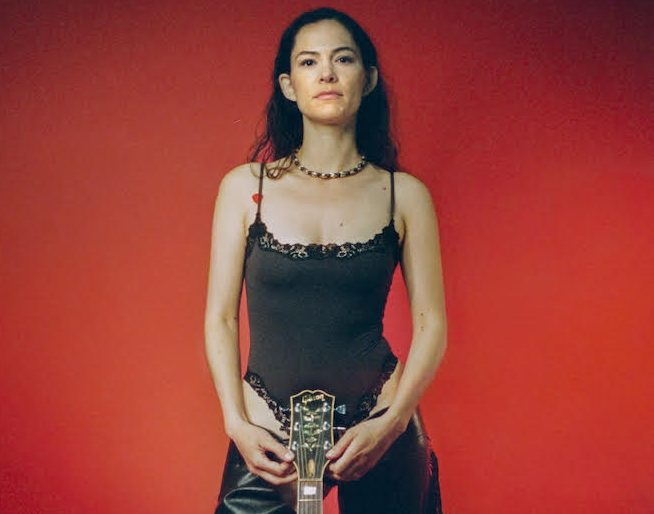
Brooklyn-based guitarist/vocalist and songwriter Dida Pelled is a continuous presence as a performer in the New York area and beyond, and will be releasing her new album of new interpretations of Blues songs, I Wish You Would, on May 1st, 2026 via La Reserve Records. Several of the singles and videos are out now, and make for an excellent preview of what’s in store.
Known for both her Jazz and Blues interests, as well as her life as a songwriter, most recently releasing Love of The Tiger in 2022, Pelled was itching to get her live performance compatriots into the studio to draw on her varied repertoire. Though they worked quickly in the studio, intentionally capturing a spontaneous feeling, they corralled enough songs for more than one album. Drawing the Blues-leaning songs together into one collection resulted in I Wish You Would.
The songs that made the cut for this collection hail from classic Blues standards and lesser Blues and Jazz songs alike, and they are brought together through a feeling of recontextualization to the modern day, with the occasional tweak in the lyrics reminding us of an updated female perspective. The songs themselves continue to remind us that relationships are a deep well for musical expression and the ways in which that experience remains the same is enough to make you chuckle. Pelled’s western-themed artwork and videos for the album add extra angles to the humor inherent in the tracks, as well as to the heartache.
I Wish You Would features Dida Pelled on vocials and guitar, Sullivan Fortner on piano, Tony Scherr on bass, and Kenny Wollesen on drums. In many ways, this is a portrait of Pelled embracing her live performance life as a powerful artform of its own, and letting audiences at home experience the big, evocative moods of these songs. I spoke with Pelled about the Blues, her recording process, and her love for “lost” songwriters, many of them overlooked women in music.

Hannah Means-Shannon: I feel like it’s a great opportunity to talk with you about the Blues, because I owe the Blues. The Blues got me started writing about music.
Dida Pelled: I also have a podcast, so I tend to ask a lot of questions, too. Do you write mainly about the Blues, or also about other things?
HMS: I write about a lot of types of music now, but I started out writing mostly about the Blues, because I had a childhood in Memphis, Tennessee, and that gave me the confidence to write about the Blues.
Dida: Yes! One of my favorite songs is “The Tennessee Waltz”! I don’t know what drew me to the Blues because I grew up in Tel Aviv, and no one listened to the Blues in my family, or around me. But I always feel like listening to old Blues songs feels like it’s the music of my childhood, without it being that. It’s just something that gives me comfort. I can put it on and not think about anything, just enjoy it.
HMS: And you’re not only a guitarist, but a vocalist, so you’re attracted to both aspects of the Blues, probably. I feel like the guitar is a voice in the Blues, too. It really speaks.
Dida: Totally. I started with the guitar, and I started singing later. I was always a Bluesy player. I never played straight-up Blues Rock, but when I played Jazz, that’s when I started getting serious about being a musician. I was always playing the bluesier Jazz, or if I was playing standards, I was always playing the bluesy things. My teachers would say, “Dida, come on. We know that you can do that, but try to do other things, too.” It was always my comfort, and what I was hearing in my mind, and what I wanted to play.
HMS: It reminds me of when people learn multiple languages, how we keep the accent of the first language that we learn. You speak the other genres, but with a Blues accent.
Dida: Exactly. But I’m also very Jazz. I don’t really have the phrasing of Blues Rock. My Blues is very jazzy. There’s something very delicate about it.
HMS: I agree. I have listened to your album, and that stood out as being different. Most of the Blues I come across these days is much more Rock-inflected and has a Rock edge. But here, the pace is often quite slow, and rich, with room for emotion. We have time to wonder, “What’s the story here in this song?”
Dida: I feel like I draw on a lot of different Blues traditions. I love Sister Rosetta Tharpe playing the Blues, or Memphis Minnie. I pull from that on this record. Or Mary Lou Williams, and the song “Rosa Mae” is by her. There are a lot of female musicians who really inspire me, and I’ve been obsessed with for years. Some of them are on this album, too.
HMS: I feel like, compared to early Rock ‘n Roll, women are a lot more represented, though it’s still a minority. I love the idea of the perspectives in these songs you interpret being intentionally female, rather than by default, male. Even back then, women performed male songs in a self-aware way.
Dida: Totally. I have changed some of the songs, too, in that way.
HMS: That’s where the word “repurposing” works well for this album, like found objects being sculpted. How did you overcome a feeling that you had to keep things in their original form?
Dida: That’s a good question. I think I’ve been playing these songs for so long, that I kind of feel like they are mine. I’ve gotten very comfortable. I’m also a singer who plays a live show, which is really where I worked out my repertoire, and my goal is to make the song mean to something to someone, and to me, right now. The best way I can do that is to make it about myself right now. I barely change anything, but sometimes it’s changing one word. I feel like I have to do that, in order for the song to mean something to me, and then for it to mean something to others.
I think the composers would be super-happy with that. You make a song that was written over 100 years ago work in a room in Brooklyn in 2026, you know? I think that’s what we should do with songs. If we’re not writing songs, we should definitely make them make sense right now. I also think a lot about what songs really pass the time, and don’t feel dated. I can’t really sing a song from regular Jazz, where I think, “I would never speak like that.” I had to pick things for this album that sounded like I would speak today. Or, I will change the song a little bit.
My wife and I have a song that we have re-written, a Cole Porter song called “Anything Goes”, and we have rewritten it as “Everything Blows.” It’s about now! It’s so fun, and fresh to sing. I bring her on stage to do it with me at shows sometimes, and I think it makes the song more important.
HMS: Do the new lyrics of that song list all the bad things going on in the world?
Dida: Yes! It’s on our Instagram, if you want to look, or come to a show.
HMS: Do you like it if an audience reacts with laughter to the song, or in some other way?
Dida: Of course! It must be interactive. That’s the whole thing. That’s what makes the shows fun. I try to be interactive so people feel comfortable responding and being involved. It’s not like a museum!
HMS: And I think for the people who wrote this music originally, live performance was everything. Being on the radio or being recorded was often an extra thing, or there might be a field recording.
Dida: Usually, the royalties were stolen from them anyway. They would just play shows. They would work their asses off to play every night and travel. We have missed out on a lot of amazing stuff, I imagine. Many people can record well, but a lot of people are amazing on stage, but only record “alright.” I guess some of them had something on stage that isn’t captured on the recordings. There are a few live albums, at least.
HMS: It’s haunting to think about when only one small recording or a handful have survived, and you know that they played their whole lives.
Dida: As I mentioned, I obsess about these women who wrote songs, so a few years ago, I put together a show of songs by these women who wrote amazing music, well ahead of their time, but never really had a career. I stopped doing that particular show, but I worked the songs into my repertoire. Like Connie Converse, or Molly Drake, the mother of Nick Drake. They are iconic figures who never really had a career.
Maybe someone released some of their demos after they had passed away. Or there are the weird ones who make a record, but then go on to do something else with their lives, like happens to a lot of people. The show I put together was called “The Lost Women of Song.” I played songs that I liked by them, arranged them, and then told the stories, as much as I could figure out. So some of the songs on this record, and probably there will be some on future records, are by the women who I am talking about.
HMS: Are the people who you played with on this record part of your live band? How did you record this?
Dida: The bass player, and the drummer, we’d played a lot together live. I have to tell you, it’s about who to call. I knew the people knew this music, and had such a tasteful way of playing, that I wouldn’t need to say anything. They would just hear my vibe, and play that way. That’s how they play with me, generally, so it wasn’t like picking someone, and telling them what to do. It’s picking the right people. We even made it a point, me and the Producer, to not have a rehearsal.
HMS: Wow! That’s brave.
Dida: Because me, and Kenny, and Tony, the bassist, and drummer, had played together already. They already knew the songs. I wrote some notes for them to look at, at the recording, but they didn’t need a rehearsal and then Sullivan wouldn’t need a rehearsal. It’s hard to find a song that he wouldn’t know. There’s nothing he can play badly. I don’t know that I can ever make an album without him as the piano player now, he’s so good. We didn’t want to have the magic wasted on a rehearsal.
One day before the recording, Sullivan and I met together for an hour to go over the tunes. But we wanted the first time that we were playing together to be recorded. And I’m very happy with how that turned out. Some of the songs on the record, the first take is the one that we chose.
HMS: That’s amazing to hear because it means that you were never surprised in the wrong way, once you were playing together. Anytime you were surprised, it was a good surprise that you could roll with.
Dida: Yes! But they are really the best musicians in the world. They never play a bad note, and they are so flexible, and dynamic, and bring a lot of life to the music. It’s very hard to be tasteful, but also be interesting. They are really that. It was so comfortable to play with them.
HMS: They must love this kind of music, or they wouldn’t be able to play like this.
Dida: Yes, it’s like casting. They are the perfect people for this music. I learned to play music like this, and perform music like this, from seeing them play, actually. Tony, the bass player, also used to play guitar, and sing, and have his own band. When I was younger, I used to go see him every Monday when he’d have a show at The Living Room, on the Lower East Side. I would go and record him on my phone. I was obsessed with the way he sounded, and I said, “This is what I want to do!” It was this jazzy, bluesy, rocky thing, and it was clear to me that that is what moves me the most. So I did choose the people who are my idols, and I love how they play music.
One of the last songs on the record, “Trouble”, is one that I learned from Tony. He used to play that song at shows, and I couldn’t find it. I asked him about it, because there nothing online about it. It was like a lost song. He said that he learned it from playing it live with Dakota Staton, a fmous singer he used to play with. He learned it from her, and I learned it from an iPhone recording of Tony. For this record, I asked, “Can we play that song?” So, we just did a duo, of me, and him. He’s on guitar on that song. It wasn’t a random choice at all.
HMS: It seems like you almost conceived of the sound for this album based on who was going to play with you. It’s like when people write certain orchestrations with particular players in mind.
Dida: Exactly. I chose the people who made me want to play this kind of music.
HMS: I love how you learned that song person-to-person, like learning a craft. That almost never happens anymore, because people learn from recordings. That’s really special. And that song was written by a woman, I think.
Dida: That’s right. She wrote it for Dakota to sing. She wrote a few songs for her.
HMS: There’s another one of your “lost songs”, sitting right alongside a lot of songs that are famous, that have been interpreted many times before. It makes for a great, inclusive collection.
You can also catch up with Dida Pelled on her video podcast on Radio Free Brooklyn, The Dida Show.
