
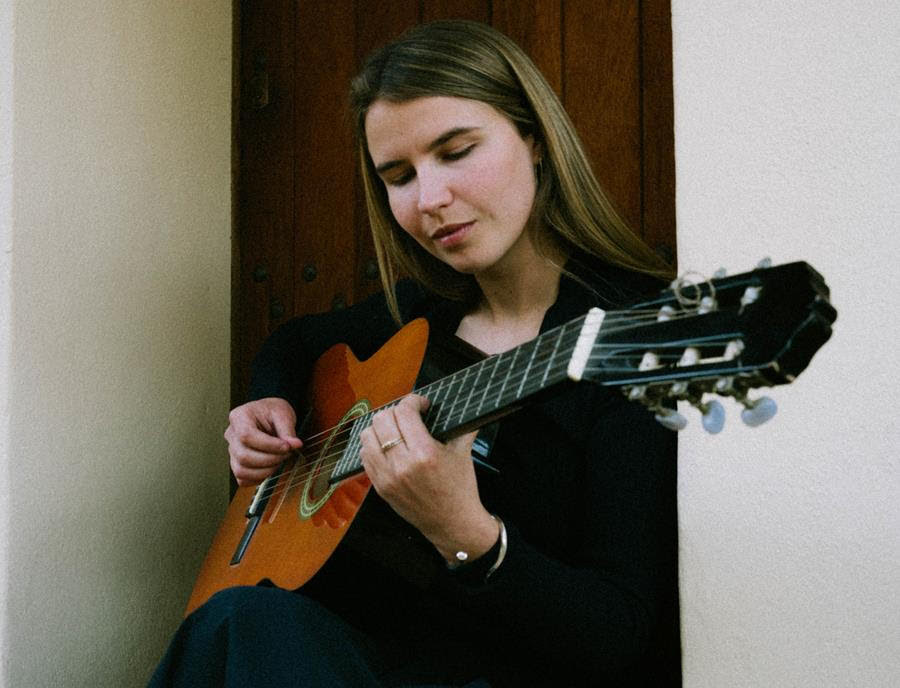
[Cover photo credit to Luis Vidal]
UK-based singer/songwriter Liza Lo recently released a live EP of tracks recorded from her debut album, Familiar, recorded at Gearbox Records. Her debut full-length album itself only arrived in January 2025, but it follows an EP and plenty of live play experience. While she regularly moves between genre boundaries, some of the tracks on Familiar show a stripped-down approach, and some show the flourish of a full-band set up that she’s continuing to embrace these days.
As a multi-cultural person who grew up in Spain and Amsterdam, but is currently absorbing the many musical influences that London has to offer, Liza Lo’s songwriting is expansive and reflective, just like her musical explorations. Working as co-Producer with London-based Producer Jon Kelly for Familiar encouraged Lo to move towards a more organic approach, playing live in the studio, and it has encouraged her in a more naturalistic direction. In fact, we may well hear more of Lo’s attraction to the intimate aspects of Folk music in future releases. I spoke with Liza Lo about live playing, the impact of her environment on her songwriting, and what trends she sees coming up in her own sound as well as the themes behind her songwriting.

Hannah Means-Shannon: I’m happy that you’ve had a chance to play live lately and have live dates coming up to bring these new songs to audiences.
Liza Lo: That’s right. I actually just played a show recently, and I’m playing a show in Spain later this month. But we have a bigger tour coming up in November. We’re doing a tour around the UK, and then we’re also playing in Amsterdam.
HMS: Do your songs usually have a live-play life before they are recorded?
LL: The set-up that you see in the live play videos is a set-up that we’ve been figuring out the songs with, with the fiddle, the double bass, and the three guitars. We’ve played a few songs already with some of the new songs. Luckily, we are able to play them live before we go to record them, which is something of a rarity. We’re going into the studio at the start of September to record, and the songs will have some of the feel of being on a stage.
HMS: That is becoming kind of rare, I agree, though I speak with a number of Americana artists who much prefer to do so.
LL: Ideally, I think everybody would love to play the music to people before they put it on a record. I think it has a huge impact on how the record sounds, and from knowing which songs people respond to. But not everyone is in that position.
HMS: I understand that having a band kind of set up is new for you, and was more of a set up for Familiar. Did that affect how you wrote the songs?
LL: It was the first time that we went into a studio as a full band, yes. We’d played shows as a band before. We’d never gone into record a song with my drummer or bassist, who always play live. But this time we went in, as a group, for a few days, and played all the songs. That felt very new.
HMS: Was that a goal that you were working towards?
LL: For years, I Produced myself, which was also really fun, and some other players played on the songs, too. But it was definitely a nice continuation from that point to get everybody playing together. It was quite an experience for me to record without a click track and to just rely on each other. That was really fun, though I didn’t know at first that was what we would be doing.
My co-Producer on the record, Jon Kelly, when we went into the studio for the first time, said, “We can just play it without a click track.” I said, “We can do what??” He said it would be fine. I didn’t know how it was going to go. It was actually the best decision, and I would never go back. The freedom of it was really fun. It felt natural, if that makes sense.
HMS: I do feel like the songs have an organic aspect, and the texture feels like being in a room with the instruments. That feels special.
LL: Thank you. That was really a goal of mine, to make it feel like you could step into the room, literally, and not much would be different. So if you had been there, with us, and had some headphones on, it would pretty much sound like that. So I’m so glad that it comes across on the record, and you can feel that.
HMS: I think the video for “Confiarme” supports that, because it’s like taking a camera into the situation and just showing to the audience, visually, where that sound is coming from.
LL: Yes, absolutely. With “Confiarme”, also, the live version is very similar to the live version, since the song is more stripped back. It’s just me and my guitarist, and we added some texture, but we didn’t add any heavy instrumentation, like drums and bass.
HMS: The album shows that wide span of sounds, where some songs are more built-up, like “That’s What I Used To Do.” It’s a very dancy song, where the drums are very important. I liked the see the range of possibilities on the album.
LL: I feel like it’s fun when an album takes you to different places. I feel like you can go to the intimate places, and then go to the places that are more driving. That’s like life. There are mellow times, not just the peak times, like a wave. Did you have a favorite on the album?
HMS: That’s hard to say. I was very interested by “Gipsy Hill” because of its dynamic nature. It had the very quiet, stripped back moments, and the more built up moments, so it felt like a kind of centerpiece for the album. It shows, sound-wise, both zones in one song. I was also thinking a lot of the life of cities and towns, with the album. A lot of the rhythms felt like walking, or the sounds going on in city life.
LL: Yes, that’s a really good point actually. That makes sense, because all the songs were written in the time that I’ve been living in London. It’s not necessarily the pace of the city, but it’s the pace of my life that’s like that. Whereas my life used to be much more filled with nature and space, because I grew up in Spain in a way more rural town, my life now is much more city-oriented. I do love my escapes out. That’s like my safety blanket. But I think that there is a walking pace in it.
HMS: Then you bring in the organic recording, and it’s two things being brought together, a very human thing.
LL: The freedom of the music without the click, without the rigidity, contributes to that. It feels like your free-walking.
HMS: It seems like the instruments get to have their way as well. The vocals are very important, but they don’t overshadow the instrumentation, and that brings a certain energy to things, too.
LL: Because I sang everything live as well, the vocals were more all together. It’s very much that we read each other, and viewed each other in the room, so that barrier got broken. It wasn’t, “Here’s music, and here’s lyric.” The guys that we recorded the album with, I’ve played together with them for so long that it felt really comfortable.
The set up for the next recorded music is quite different, actually, in terms of instrumentation.
HMS: Oh, yes? How so?
LL: We’re going a lot more towards traditional Folk, I guess. We’re going with drums, as well, and more strings, but the fiddle and the double bass are a big part of it.
HMS: Does knowing that affect how you write, or are those kinds of decision made at a later stage, after basic songwriting?
LL: I think it does have an effect on how I’m writing now, but it depends on what I’m listening to, what I’m inspired by, I guess. I’ve been listening to a lot more old Folk music, so loads of Joni Mitchell, James Taylor, and Nick Drake. I feel like that has a really big effect on what I’m interested in. I wrote, in a way, before I decided on the instrumentation, but I went to a lot of traditional Folk sessions in London. I just loved the world of it. I thought, “Alright, maybe we need to try something else then, if this is what I’m liking right now. Maybe we can ease instrumentally into that right now, and move away from the more traditional Pop.”
HMS: That’s cool that you surrounded yourself with that sound, to explore it, and it did catch fire for you. It’s great when you can physically put yourself in a space, and go to shows and sessions, as well.
LL: It’s true. I’m very lucky in London to be able to do that. The fiddle player, Owen, is a traditional fiddle player. He plays a lot of trad sessions. So he’s the one who kind of introduced me to it. And my guitarists are also really involved, and have released their own Folk albums, so they brought me to sessions. It’s super different to what I make and what I have been introduced to before, since I’m not English. It’s quite new to me—that whole world.
HMS: Because you have these different cultural influences in your life, and we’re talking about Folk music, do you think other cultural traditions will come into your music?
LL: I grew up listening to a lot of Flamenco music because of living in Spain, and that was something I was familiar with. But it’s definitely something that I want to continue to learn from. I never properly got deeper into it. My interest is broad, and there’s also a Portuguese influences I really love. The Folk spectrum is endless. It’s so wide. Every week, I am introduced to something new, even new instruments.
HMS: I know that you had worked with Jon Kelly before, and you did on Familiar as well. Do you talk about these directions with him? Does he know that you’re leaning towards Folk now?
LL: He definitely knows. I see Jon quite a lot. He’s been my mentor for over two years, and he’s taught me so much. He’s a big part of the songwriting, as well, as the first person who I show new songs to. He’s kind of like the filter. He’s very approving of it, so far. He was there, in the room, when we did all the live videos, which was very sweet. It was the first time that he saw my fiddle player play, and he approved.
HMS: I often talk with people about Producers and how finding someone that you can work with is so key to your life. Because you might have all these wonderful ideas, but getting them recorded can become a difficult process if you aren’t able to work with someone who “gets” what you’re doing.
LL: It’s very true. It’s a real gift to know John and for him to hand over his advice so kindly, openly, and generously. I’m very lucky.
HMS: Do you find a difference in the kinds of stories that you’re starting to tell with your newer music than the ones that we see on Familiar? I don’t think that Familiar adheres to only one type of story, but the songs are very questioning, and looking back on the past, recognizing growth or change.
LL: That’s a great question and good for me to think about. I definitely think there’s growth in the “answers”, in my responses to those questions, but I still find myself finding and discovering a lot. I think the songs are still a lot about questions, and development. Something I’m noticing a lot now in my songs is that a lot of them are about time, and the vulnerability of it.
Some major things have happened in my life over the past year, where I’ve learned to realize how precious it is. Nothing ever stays the same, so what is now will be different at this time next year. When I was writing the last album, I was thinking, “What is life? What is it?” Now, I feel like the writing is a little bit more grounded, and saying, “The chaos is just kind of what it is. It outs itself in a number of ways, and it can be beautiful. It can be about new connections.” So there’s also a lot of lightness in it, too.
There are a lot of lighter songs that I’m writing about things that I find truly beautiful, like true, new friendship. Or how you can meet somebody, and they are instantly so close. I don’t know how to explain that. You meet someone, and you realize, “Oh, you’re my person.” Maybe you’ve spoken for four hours, but that’s it, and you know they are staying. I guess a lot of it is about the passing of time, though, and the ever-changingness of it all.
