
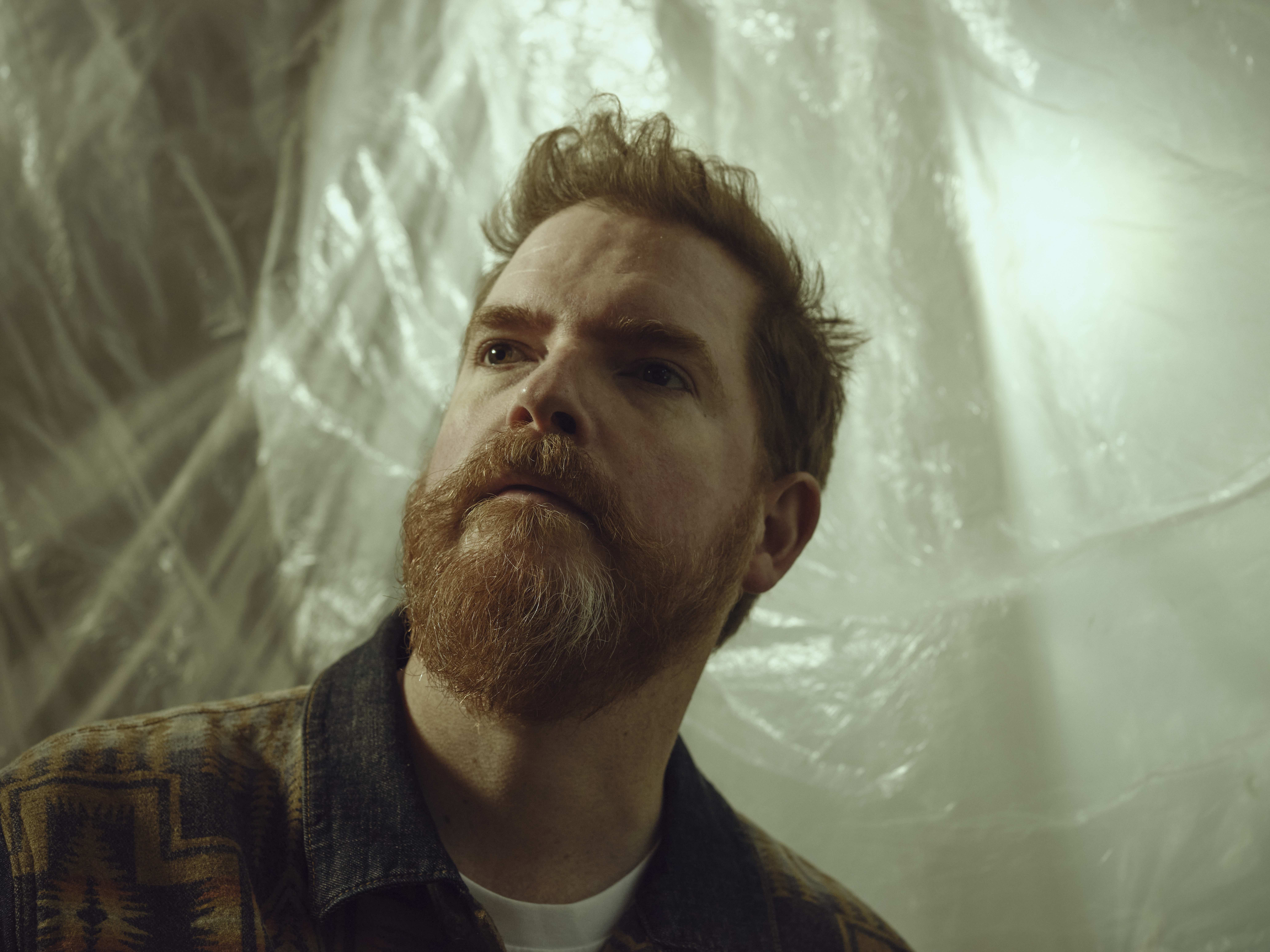
[Cover photo credit to Phil Fisk]
In March 2024, singer/songwriter John Smith released The Living Kind, an album that you might call experimental if he wasn’t someone already given to quite brave experimentation in the past. But it was an album in which longtime mentor and Producer Joe Henry (Lisa Hannigan, Rhiannon Giddens, Guy Pearce, Bonnie Raitt, Joan Baez) persuaded Smith to approach quite differently than he had before. Not only was it tracked live, but it was tracked at Henry’s home in Maine in mid-winter in sub-zero weather, and featured mainly Smith and bassist Ross Gallagher.
For Smith, who had always felt most comfortable in a live setting, this tracking live made some sense, but it was still significantly out of his comfort zone. For one thing, he’d already pursued a regime of songwriting ahead of the session that was more compressed than usual, and this led to surprising results in the songs that emerged. Combining this new territory with this new approach, Smith found that he made strides in his vocal style, finally capturing in the studio his preferred, most emotive live delivery. While all the songs emerged from a kind of recovery period in Smith’s life, coming off the back of many family struggles which he documented on previous album, The Fray, this new work shows the artist moving with greater confidence towards the future.
I spoke with John Smith in the midst of touring in the UK about his life and times surrounding making The Living Kind.

Hannah Means-Shannon: How did you come to work with Joe Henry on this album? It seems like his suggestions and ideas impacted how things developed for you.
John Smith: With this record, I knew it was happening, basically the moment and I looked each other in the eye, at his house. We’d written a song together over dinner with his missus. We went upstairs and made a demo. He said, “You know there’s absolutely no reason why we shouldn’t make a record here at my house. Why don’t you come back in a few months, and let’s make a record.” A few months rolled by, and I postponed. That happened three times. Because life was getting in the way and I had a lot of gigs that year.
Over that winter, Joe said, “If you can get over here the first week of February, I think I can make this work. After that, I’ve got other jobs.” So I had like two months or less to write the record. That was an unusual time when I sat down and put pen to paper all day, every day, as a jobbing songwriter. That’s not the way I work because I’m much more flighty. Sitting and really digging in is not comfortable at all, but that was a really exciting exercise because I got all kinds of results that I wasn’t expected. When I took the songs to Joe, there were two or three that I didn’t like at all, and those were the ones he said, “Let’s record these first!” And now, those are some of the ones that I love the most. I was so intent on making a record with my mentor and big brother, Joe, so when I had this opportunity, I wasn’t going to let it go to waste. I challenged myself to be disciplined about writing, which is so hard. [Laughs]
HMS: I think that sounds incredibly hard. People with many decades of experience can’t necessarily write that quickly.
JS: It’s terrifying.
HMS: Was it equally terrifying to record in a very limited time in a live way, or is that something that you usually do?
JS: It was completely live, and we were limited to four channels, in four days. I’ve worked with Joe plenty of times now, since I’ve known him since 2011, and have played on many things that he’s Produced now, so I’m very familiar with how he works. It’s very intuitive. You’ll play something maybe three or four times, and if you’ve sailed past it, it’s time to start on something new. For this one, I practiced, and practiced, and practiced. I’m independent, so I don’t have a lot of cash for the studio, so I thought, “I know how this works, practice, practice.”
But when I went into the studio, Joe did this unusual thing of putting me with a bass player who I’d never met, and we immediately started dancing. It was uncanny. Joe would say, “Try this on the acoustic guitar.” Or, “Try that on the electric guitar.” And it would work. He’d be very subtly steering the ship the whole time. We were two days in, and we had seven of the songs recorded. It was all so natural. We recorded too much, actually. Two songs didn’t make the record. But you can only really do that when you trust somebody, and Joe puts you in a familial environment.
HMS: I’m guessing there was not a lot to do but focus on music, because this was Maine in the winter.
JS: Generally, after working, you’d have a walk, you’d have a smoke, you’d go to bed. But with this session, it was -25 degrees Celcius [-13 Farenheit] since it was Maine and February. There was no going for a walk. We’d just sit and listen to records. I was in bed by nine or ten every night, up at six in the studio. It was great.
HMS: Some people prefer “destination recording” where you go somewhere contained and therefore your whole mind is on that atmosphere. You stay in the zone during the whole period.
JS: Yes, there’s something to it. I made my second record driving around the South in a rented Chevrolet, recording out the back in barns and churches in Texas and Louisiana. The whole thing put me on edge, and it was great! It made me commit, completely. Being on the edge of your seat while making a record forces you to dig deep.
HMS: Given how you all recorded this album, when you listened to it later, were there things there that surprised you?
JS: Yes. And it was the vocal performance that really hit me. Joe had managed to get me to sing in a way that I’d never committed to on tape. When I go out and play live, I really try to dig in and sing my guts out. I’ve always been inhibited in a studio. It’s hard to really be yourself in front of a microphone when there’s not audience there, and no tangible or palpable response. It’s all happening in your head. Joe managed to get the hook in and draw it out of me a little bit. I found myself singing in a way that felt electric to me. I felt like I was being really honest. When I heard that back, that was the surprising thing. I had really sung the song in the way that tells the story. He said he’d never heard me do that before. That was really exciting for me. It did feel like I was singing better than I’d done before.
HMS: Making discoveries when making albums is so interesting. That’s what distinguishes something that you do by rote from something that changes you in the process. Do you think that the songs themselves contributed to that development and outcome for you? I know these songs come from a very personal place and a lot of things that you’d been through in recent years.
JS: The songs are largely about emerging from a difficult period, and seeing it recede into the rearview. And seeing that better things are ahead while keeping an eye out, being optimistic, but not taking anything for granted. That’s very much how I have felt the past couple of years in my life. So, yes, the songs are really about that. Since I made The Fray, I turned 40, and I reframed my relationship with my career a little bit, prioritizing family over everything.
I think when I sing a love song now, it perhaps has more meaning. When I sing about struggles, perhaps I’m able to sing it more honestly now that I’m a little older and more experienced. I’m not hiding behind a veneer of “John Smith, the singer/songwriter”. I’m trying to be John and sing honestly. It’s taken me years, but since I’ve started doing that, it’s been revelatory.
HMS: That’s huge. It seems like that would make the boundaries between the music and daily life a little easier to navigate, though I’m sure there are still difficulties.
JS: One of the hardest things about being a musician, and a parent, is that when you’re working, you want to be with your family, and when you’re with your family, you want to work. When I’m home, I try to work really strict office hours from nine to six, and then I switch off my phone and everything. Then I’m with my family and wife.
When you go on the road, you are “on” all day, you’re just in the zone. The dichotomy used to eat me up. I was burning myself out, and my daughter was three, and I was miserable. Then Covid came and everything that happened in the background for me changed everything. It was a very challenging backdrop to a whole set of other health-related issues in my family. It forced me to reevaluate my relationship with work, that I was becoming a workaholic. I’ve attempted to make sense of it all by making songs!
HMS: And then Joe says, “Come make an album!” And you get on a plane.
JS: We were talking through that whole time. He had an enormous fight with cancer that began before Covid, and continued through Covid, so we were talking about these things that we were both going through. Come 2022, when I toured the US for the first time in three years, I visited Joe, and that’s when he said, “Come and make a record.” The Fray was very heavy and is burdened by those events, but The Living Kind is more like looking back on it, and saying, “Yeah, that was tough, but the world keeps turning. Let’s get on with it!”
HMS: When things are heavy, sometimes an expansive song makes a song more approachable. I think many of the songs on The Living Kind are approachable in that way.
JS: I feel like I’m trying to paint with different colors, but with fewer strokes, if that makes sense.
HMS: That painting comparison really works, because painters have different eras and styles as well. In some of these songs, there’s a choral feeling in how the elements work together, whether in voices and instrumentation. It gives things a lift, like in “Silver Mine”. Was that one very different in terms of your initial writing and how it turned out?
JS: When I wrote it, I wasn’t sure what the guitar part should be. I was strumming it and that felt boring, but I knew the song was more about the singing. In the session, I tried a finger-picking thing, and Joe said, “Play that. Sing over that.” So that is maybe the second take that made it onto the album, only the second time I’d sung it with the guitar, almost making it up as I went along. I think that’s why the recording is so raw. I was hearing it for the first time as I was doing it. That’s the great thing about working with Joe, that spontaneity!
HMS: Because you’re someone who both sings and plays guitar, do you ever want to record your vocals separately from your guitar? Here, you tracked them together.
JS: I’ve done it in the past, where I’ve recorded guitar first, then vocals, because, arguably, you get more reliable results sonically, but it’s nowhere near as spontaneous, intuitive, and fun. So, actually, I cut this one live, and then I had to go and recreate it in a different studio to make instrumental versions! My publisher said that we needed instrumental versions and this was all live. The whole point is that it might be placed in an ad, which I wouldn’t say “No” to. I had to record all the songs instrumentally, listening to the album. I had to play it note for note, but without the vocal. That’s the hardest day I’ve ever had in the studio, and we had only two days to it.
HMS: That sounds excruciating because everything about the album is what happened in that room. Then, almost archaeologically, you have to reconstruct it!
JS: Yes, and you hear all the mistakes you’ve made. It was horrible. But I did it. You have to give your music the best chance you can. My absolute dream in this career is to do a little writing in film and TV, so anything that I can do to help with that is something where I’ll go and do it.

